The agency called the experiment, which was conducted in collaboration with two national labs, two vendors and the Nuclear Regulatory Commission, a “milestone test case.”
Budget constraints and compliance considerations have presented hurdles for the agency as it aims to onboard technologists, a DOE IT leader said during a Thursday event.
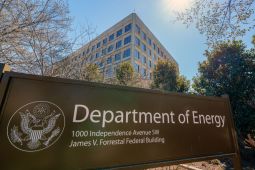
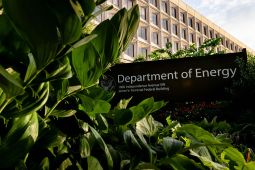
The U.S. Department of Energy building is seen behind a sign marking the location of the agency’s headquarters on March 18, 2025, in Washington, D.C. (Photo by J.David Ake/Getty Images)
National Labs, other federal agencies, academic institutions and private-sector companies can submit collaborative applications to address the challenges identified by DOE.
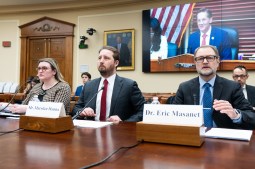
From left, Paige Lambermont, research fellow at the Competitive Enterprise Institute, Marsden Hanna, head of energy and sustainability policy for Google, and Eric Masanet, UC Santa Barbara professor testify during the House Science and Technology Committee Investigations and Oversight Subcomittee hearing on “Powering America’s AI Future: Assessing Policy Options to Increase Data Center Infrastructure” in the Rayburn House Office Building on Tuesday, Feb. 24, 2026. (Bill Clark/CQ-Roll Call, Inc via Getty Images)
The Energy Department’s Oak Ridge National Lab launched an institute to optimize data centers, and the Pacific Northwest National Lab issued an RFI to inform future buildouts.
Darío Gil, former SVP of IBM Research, is seen during the inauguration of Europe’s first IBM Quantum Data Center on Oct. 1, 2024 in Ehningen, Germany. The tech industry veteran now serves as the Energy Department’s under secretary for science and director of the Genesis Mission. (Photo by Thomas Niedermueller/Getty Images)
The agency is continuing to deepen its collaboration with industry as it works to advance technical priorities amid a tight schedule and forthcoming deadlines.
The technology was “used in place of a large team that would be required for coding and development of emergency services facilitation,” according to DOE’s AI inventory.