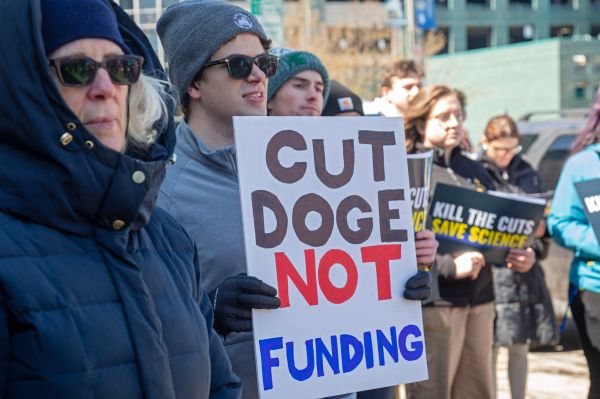
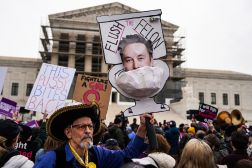
Labor unions hold a “Kill the Cuts” rally at Wayne State University in Detroit on April 8, 2025, protesting Trump administration cuts to research, health care, and higher education. It was one of a many coordinated rallies across the United States. (Photo by: Jim West/UCG/Universal Images Group via Getty Images)
Federal records show DOGE's role in initiating grant terminations across the National Science Foundation and indicate that the White House also flagged awards to cut.
Sen. Elizabeth Warren, D-Mass., questions executives of the nation’s largest banks during a Senate Banking, Housing, and Urban Affairs Committee hearing Sept. 22, 2022 in Washington, D.C. (Photo by Drew Angerer/Getty Images)
The logo for the Small Business Administration is pictured on the final day of the Great American State Fair on July 10, 2026, in Washington, D.C. (Photo by Al Drago/Getty Images)
The agency recently awarded nine new contracts for the program aimed at fueling innovation in regions across the country. The RICs have a heavy defense-tech bent.
Demonstrators stand outside the Office of Personnel Management headquarters Feb. 4 to protest the Trump administration’s Department of Government Efficiency and a “deferred resignation” offer to federal workers from the OPM called “Fork in the Road.” (Photo by Madison Alder)
Judge Denise Cote said the government failed to provide a credible explanation for why DOGE needed access to personal information to modernize the human capital agency.
Experts are sounding the alarm on a new provision allowing DHS’s chief AI officer to waive any requirement outlined in the directive, including prohibited use cases.
The Robert C. Weaver Federal Building, the current headquarters of the Department of Housing and Urban Development, is seen on July 8, 2025 in Washington, D.C. (Photo by Kent Nishimura/Getty Images)
Julian, who has served as HUD’s assistant CIO since July 2025, takes over for Eric Sidle. Both previously worked at EV firms Chargepoint and NIO, as well…
Former U.S. Chief Data Scientist Denice Ross is spearheading efforts to build the field of data policy and monitor federal data at the Federation of American Scientists’ Data Policy Institute. (FedScoop)
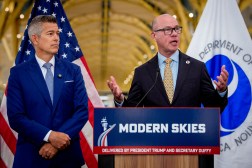
FAA Administrator Bryan Bedford, right, and Transportation Secretary Sean Duffy, left, speak during a news conference at Ronald Reagan Washington National Airport on Sept. 28, 2026 in Arlington, Va. (Photo by Andrew Harnik/Getty Images)
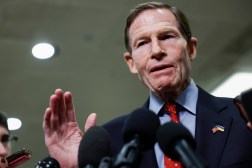
Sen. Richard Blumenthal, D-Conn., speaks with reporters after attending a closed-door, classified briefing for Senators at U.S. Capitol Building on Feb. 14, 2023 in Washington, D.C. (Photo by Anna Moneymaker/Getty Images)
Jennifer Franks, director of the GAO’s Center for Enhanced Cybersecurity, speaks during the Elastic Public Sector Summit on March 19, 2026, in Washington, D.C. (Scoop News Group photo)