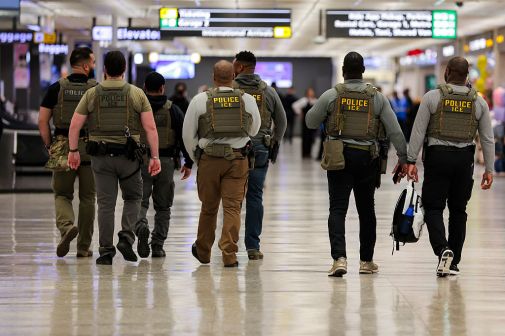
House Democrats want ICE, CBP uniforms to feature identification tech

Certain agents with Immigration and Customs Enforcement and Customs and Border Protection would need to add a scannable QR code to their uniforms under legislation introduced Thursday by a trio of House Democrats.
The Quick Recognition Act aims to implement identification and verification requirements for immigration enforcers, tasking the Homeland Security secretary with requiring officers to wear a clearly visible QR code when engaged in enforcement efforts.
When scanned, the QR code would pull up a publicly available DHS website that displays the full name of the officer, the badge number, the agency and operational unit, active status and possible photograph. The user would also have access to a secure complaint form, as well as the number of complaints received regarding the officer.
“This legislation would modernize identification standards for federal immigration enforcement officers and improve transparency during enforcement encounters,” a press release shared with FedScoop and distributed by New York Rep. Ritchie Torres’s office stated. Reps. Darren Soto of Florida and Shri Thanedar of Michigan joined as co-sponsors.
The proposed bill comes amid heightened ICE activity and confrontations with the public, such as in Minneapolis, where DHS says 3,000-plus people have been arrested in the past six weeks, and one person was fatally shot by an ICE agent.
Technology has played a role for both sides of the standoff. For ICE, data-sharing agreements with other agencies and organizations has led to a sizable data estate that has contributed to arrests. The agency wants to expand its biometrics collection and remove certain limitations.
“When we talk about the future of ICE and how we’re going to do business, it’s inevitably going to go back to how we’re standardizing data, how we’re consuming it and advertising the data,” ICE CIO Dustin Goetz said Thursday onstage during an event in Washington, D.C.
Those opposed to ICE’s tactics in Minneapolis — and other cities — have also leaned on their modern technology toolbelts. Individuals have used mobile applications and social media forums to track DHS personnel.
The online activity has raised concerns for DHS. Last month, the House Homeland Security Committee sent letters to Apple CEO Tim Cook and Google CEO Sundar Pichai inquiring about the measures taken to remove DHS-tracking applications from their platforms.