Senate duo seek agency collaboration in mitigating AI-powered fraud
As lawmakers worry about AI’s potential to benefit fraudsters, a bipartisan pair of senators is looking to federal agencies as a means to mitigate the threats.
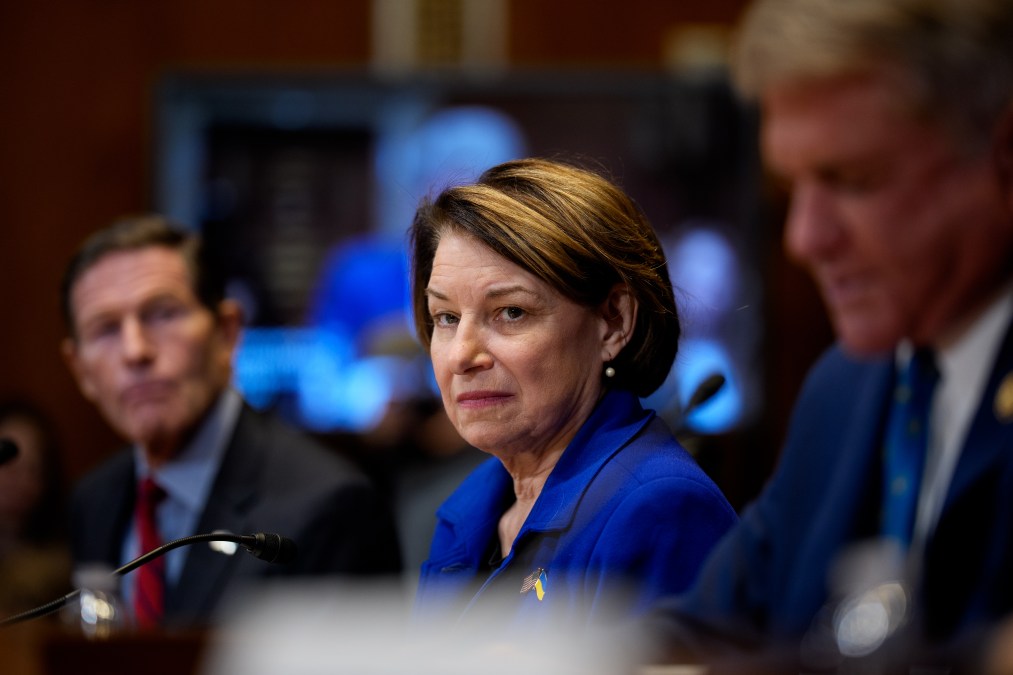
Introduced earlier this week, the Artificial Intelligence Scam Prevention Act from Sens. Amy Klobuchar, D-Minn., and Shelley Moore Capito, R-W.Va., would create an advisory committee to ensure scam prevention is an interagency imperative.
“Artificial intelligence has allowed scams to become more sophisticated, making it easier for fraudsters to deceive people — especially seniors and children — into giving up their personal information or hard-earned money,” Klobuchar said in a press release Wednesday.
The bill aims to increase awareness, improve reporting and enhance prevention efforts. If passed, the advisory committee would feature the chairs of the Federal Trade Commission and the Federal Communication Commission, the Treasury secretary and other representatives. The group would work to establish and distribute related best practices and other useful information to agencies and private-sector organizations.
“While there is incredible potential with artificial intelligence, we must also be vigilant in protecting against harmful uses of the technology, especially when it comes to fraud and scams,” Capito said in a statement accompanying the legislation’s announcement.
AI-fueled fraud has been on lawmakers’ minds as use of the tools grow, among federal workers and fraudsters alike.
A pair of House lawmakers introduced the AI Fraud Deterrence Act in November 2024, aiming to increase fines imposed on fraudsters, though that bill seemingly stalled. The same year, the FCC barred the use of AI-generated voices in robocalls.
The push continued this year. A bipartisan bill in the Senate focused on protecting Americans from AI-powered financial scams, called the Preventing Deep Fake Scams Act, was introduced in June, the companion to a bill in the House introduced in February.
Lawmakers also have an eye on the inverse: AI-powered fraud prevention and mitigation.
Some see using AI to fight fraud as a way to level the playing field between bad actors and federal enforcement, as identified in the Consumer Safety Technology Act, introduced in July, which would require the Commerce Department and FTC to study how emerging technology could thwart fraud attempts. The DETECT Act, introduced in August, had a similar goal, calling on the Government Accountability Office to investigate AI’s role in aiding tax fraud detection for the IRS.
Technology leaders within the federal government are just as eager to adopt technology that could potentially protect consumers, save their departments money and improve safety. Ankur Saini, CTO at the Department of Transportation’s Federal Motor Carrier Safety Administration, is looking into the potential for AI to help his teams with data analysis and pattern identification to better catch unsafe motor vehicles, he said during a panel discussion earlier this month.
Other panel participants at the ACT-IAC Imagine Nation ELC 2025 event in National Harbor, Md,, representing NASA, the Centers for Medicare & Medicaid Services and the Department of Housing and Urban Development, noted similar intentions to tackle fraud with AI’s help.
“In our HUD world, if someone’s drawing funds in a strange way or there’s a hidden relationship, we’ll never get to it without some sort of AI tool,” said Rae Oliver Davis, former inspector general for HUD.