A security camera is installed as Immigration and Customs Enforcement agents stand guard in front of protesters outside Delaney Hall on May 29, 2026 in Newark, N.J. (Photo by Michael M. Santiago/Getty Images)
The U.S. Court of Appeals for the D.C. Circuit said some of the Trump administration’s arguments were “weak sauce” and the data-sharing “indisputably contravenes” privacy law.
The National Housing Law Project has been seeking communications about HUD’s pact with DHS and USCIS to share tenant information for immigration enforcement.
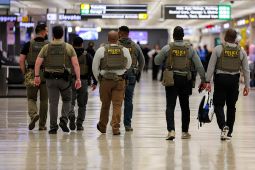
Immigration and Customs Enforcement agents patrol Dulles International Airport as a worker washes windows on March 24, 2026 in Dulles, Virginia. (Photo by Heather Diehl/Getty Images)
With 26 lawmakers backing it, the legislation would prevent the two Department of Homeland Security units from sharing information related to immigration enforcement.
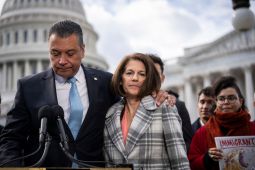
Sens. Alex Padilla, D-Calif., and Catherine Cortez Masto, D-Nev., embrace during a news conference outside the U.S. Capitol on Nov. 16, 2022 in Washington, D.C. (Photo by Drew Angerer/Getty Images)
An amicus brief led by Congressional Hispanic Caucus members made the case that the data-sharing pact violated privacy law and threatens federal revenue.
Two GOP-backed Treasury bills that cleared the lower chamber this week embrace unproven fraud prevention methods, are overly broad and put people’s data at risk, critics say.
The Treasury Inspector General for Tax Administration said the DHS component fell short on safeguarding standards that hadn’t been resolved before the IRS process began.
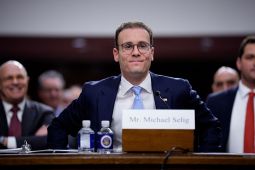
Michael Selig, President Donald Trump’s nominee to lead the Commodity Futures Trading Commission, appears during a Senate Agriculture, Nutrition, and Forestry Committee hearing on Capitol Hill on Nov. 19, 2025 in Washington, D.C. (Photo by Andrew Harnik/Getty Images)
Michael Selig told House Agriculture Committee members that the agency, down 20% from fiscal 2024, is “adequately staffed” to monitor markets, thanks in part to tech.
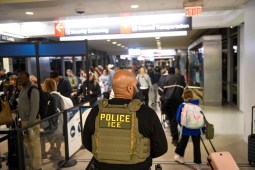
An ICE agent stands alongside a long line of travelers waiting to pass through a TSA Checkpoint at the Philadelphia International Airport on March 28, 2026 in Philadelphia, Pennsylvania. (Photo by Matthew Hatcher/Getty Images)
The Department of Homeland Security unit increased its annual target of arrests of individuals with criminal history or pending charges after more than doubling its 2025 goal.
Signed by 115 lawmakers, the filing makes the case that the IRS-ICE pact “improperly challenges” Congress’s power to protect taxpayer information and will deprive the federal government…
Former agency staffers and experts believe the independent financial regulators’ MOU won’t “shake everything up,” but data and technology callouts bear watching.