Roughly 50,000 could lose federal workforce protections under new OPM rule

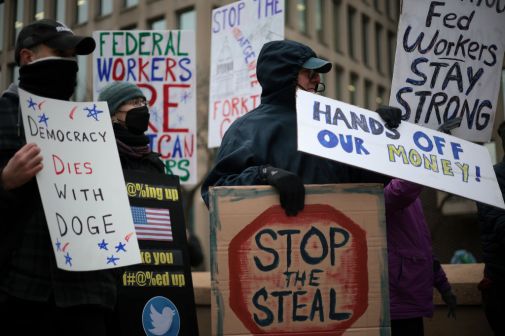
The Office of Personnel Management finalized a new classification Thursday for career federal workers in policy-related roles that will effectively make them easier to terminate.
The new “Schedule Policy/Career” creates an administrative category for nonpolitical “career” federal employees who work in roles that are defined as influencing policy. Workers added to that classification will be converted to “at-will” employees and will no longer be eligible for adverse action procedures or the ability to appeal terminations.
Roughly 50,000 employees will be subject to the change, per an estimate in the final rule.
Despite the administration’s assertion that the new schedule is for “accountability” and will not be subject to political loyalty tests, federal employee advocates have long argued the policy is a thinly veiled attempt to strip career employees of safeguards in an effort to replace them with workers who are politically aligned with the president.
The announcement from OPM on Thursday stated that the final rule explicitly does not allow discrimination based on politics, prohibits use of the new schedule to reshape the workforce or conduct mass layoffs, and would protect whistleblowers. OPM also stated that it would take on a role to review agency actions to ensure they are compliant.
But those assurances were immediately viewed with skepticism by federal worker groups.
“No matter what the administration says, today’s action has nothing to do with restoring merit in federal employment,” Max Stier, president and CEO of the nonpartisan, nonprofit Partnership for Public Service, said in a written statement.
Stier said the new classification could be used to remove expert career officials and “replace them with political supporters who will unquestioningly do the president’s bidding.”
The desire to create such a classification began during the first Trump administration, which put forward a similar classification labeled “Schedule F.” That classification was promptly repealed by the Biden administration in 2021. A government watchdog found that while no agencies had officially placed roles into “Schedule F,” some considered it.
The announcement on Thursday was coupled with a Substack post from OPM Director Scott Kupor, who argued that without the new schedule, the federal government lacks the same accountability mechanisms the private sector has. He also implied, without evidence, that some career officials pursue “policies of their own making.”
“While most civil servants execute the law faithfully, there are many clear examples where government employees resist or slow-walk the policy initiatives of the president, secure in the knowledge that there will be no repercussions for this behavior,” Kupor said. “That is, until today.”
OPM didn’t provide any additional details about how it defines what counts as workforce reshaping or loyalty tests.
The finalization comes after a long push by the Trump administration to remake the federal workforce through terminations, agency restructurings, and programs that have incentivized workers fearful about the future of their role to resign from government service. So far, those efforts have led to a net loss of 242,260 federal workers since President Donald Trump’s inauguration, per the most recent federal workforce data.
Everett Kelley, the national president of the American Federation of Government Employees, said in a written statement Thursday that the final rule was a “direct assault on a professional, nonpartisan, merit-based civil service,” and described a chilling effect the rule could have among federal workers.
“A professional civil service means nurses and doctors can advocate for patient safety, inspectors can report violations, cybersecurity experts can warn about threats, and benefits specialists can tell the truth about what it takes to deliver services — without worrying they’ll be punished for it,” Kelley said.
Converting workers into at-will employees will make the government “more vulnerable to pressure, retaliation, and political interference, which is exactly the opposite of what the public is asking for right now,” he continued.
Several organizations, including AFGE, indicated plans to file lawsuits over the final rule.
AFL-CIO, another union representing federal workers, similarly said it will file a lawsuit, and one organization plans to refresh an existing challenge to the policy. Protect Democracy, which describes itself as a nonpartisan, anti-authoritarianism organization, had already filed a lawsuit against Trump’s executive order to establish Schedule Policy/Career last year. That lawsuit was on hold until the final rule was published, and Protect Democracy plans to file an amended complaint this month, per an email from the organization.
Pending legislation in the House and Senate also attempts to block the policy.
The Saving the Civil Service Act would make a worker reclassification like Schedule Policy/Career unlawful and ensure that Congress has the final say on certain changes. While the Senate version of the bill has only sponsors who caucus with Democrats, several Republicans signed on to the House version.
In a joint statement, Virginia’s Democratic Sens. Mark Warner and Tim Kaine, whose constituency includes a vast amount of government employees, said the nonpartisan nature of the civil service has long set the U.S. apart from other countries and fostered continuity.
“The Trump Administration’s move to reclassify federal employees to make it easier to fire them for political reasons will hurt these workers and their families, threaten our national security, and make it harder for Americans to access the services they need,” the senators wrote.
As far as next steps for agencies, the rule requires officials to revise their internal policies to reflect the change. In guidance to agencies sent Thursday, OPM included templates for the updates as well as sample notices for applicants and employees under the new classification.
The reclassification of positions to Schedule Policy/Career will also require an executive order, the guidance said, so until such an order is issued, agencies “must continue to treat employees and positions as they are currently classified.”
This story was updated Friday, Feb. 6, with additional details about possible litigation.