Lawmakers take another shot at NSF-run prizes for using AI to solve problems

Congress is breathing new life into legislation that would place the National Science Foundation in charge of $1 million prize competitions where artificial intelligence is used to solve problems across a range of sectors.
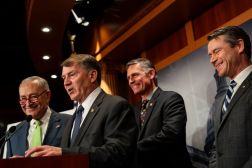
The AI Grand Challenges Act was reintroduced Monday by Sens. Cory Booker, D-N.J., Mike Rounds, R-S.D., and Martin Heinrich, D-N.M., and Reps. Ted Lieu, D-Calif., and Jay Obernolte, R-Calif. The bill was first introduced in 2024 but failed to advance in the Senate or the House.
Under the bill, the NSF-run competitions would bring together researchers, entrepreneurs, innovators and other tech-savvy professionals to leverage AI in tackling complex issues in disciplines including health, energy, environment, national security, materials science and cybersecurity.
“The impact that AI has already made on our country is promising, but we haven’t even scratched the surface on harnessing its full potential,” Rounds said in a press release. “The ability to make progress in the fields of science, technology and especially health care will be revolutionary and could even lead to the cures of many diseases. Grand challenges have proven successful in ways to advance new scientific discoveries.”
NSF would work with the Office of Science and Technology Policy, the National Institute of Standards and Technology, the Defense Advanced Research Projects Agency, the National AI Advisory Committee and other relevant agencies to determine the specific challenges. There would also be a component in the competitions to “address AI system-specific challenges like bias mitigation, content provenance, and explainability.”
Funding for the awards would come via requests from other federal agencies, as well as contributions from for- and non-profit entities, and state and local governments. Each prize would be worth at least $1 million. A competition focused specifically on breakthroughs in cancer detection and treatment would award at least $10 million to the winner.
“Spurring innovation in AI is essential to maintaining America’s leadership in this critical field,” Lieu said in a press release. “By leading in AI research, innovation, and deployment, we can ensure strong safeguards are built in as the technology evolves.”
The lawmakers noted in the press release that the federal government has overseen hundreds of prize competitions over the past 15 years, calling such challenges a “cost-effective” approach to solving intractable problems by bringing in “large and diverse groups of participants from across disciplines who are singularly focused on achieving a particular goal.”
Heinrich said in the press release that competitions would essentially serve as a counter to private investment in AI that has been focused on “building tools whose main effect is making it possible to create large-scale harmful content and automate away good-paying jobs.”
“I’m proud to introduce legislation that will help unlock AI’s potential for good by making this technology more accessible,” the New Mexico Democrat said, “even as more work remains to ensure AI is developed and deployed responsibly to meet our greatest challenges in this generation and the next.”