Energy official emphasizes tempo, accountability in reaching key Genesis Mission goals
The Department of Energy is beginning to ramp up efforts tied to the Trump administration’s Genesis Mission while advancing complementary priorities, a top agency official told House Science, Space and Technology Committee members Wednesday.
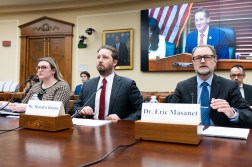
“Today, we’re going to be announcing the first $320 million in programs for the American Science Cloud and for the Transformational Model Consortia,” DOE Undersecretary for Science Dario Gil said during a hearing, with all 17 national laboratory directors sitting in the crowded audience behind him.
The funds are aimed at kickstarting the curation of datasets based on the labs’ decades of research, that then will be used to build “a new generation” of AI models. The investment will also enable the department to start building core computing infrastructure and enhance collaboration. The two goals go hand in hand with the Genesis Mission.
“We are already executing,” said Gil, who spent more than two decades at technology giant IBM before entering his leadership role in the federal government in September.
A dedicated team, composed of members from across the labs, are working on the foundational layers of the Genesis platform.
“To give you an example, we have workflows already that allow a scientist to trigger a question, and the workflow automatically provisions time in a supercomputer, waits for the results, analyzes it … triggers an experiment and the feedback continues,” Gil said. “This aspect of the workflow, enabled by AI, literally was like science fiction.”
There is still a list of unknowns even as the department works toward broader goals, such as developing an integrated national AI platform built on scientific datasets, laid out in President Donald Trump’s November executive order.
A variety of models will power the Genesis platform, but the exact domain knowledge, type and vendor partnerships fueling the development is to be determined. Some models will be of the open-weight variety, and others will be classified and treated similarly to sensitive data, Gil said.
How other agencies and departments — such as the National Institute of Standards & Technology or the National Oceanic and Atmospheric Administration — will help the DOE is also up in the air. The approach to international collaboration with U.S. allies as it relates to the Genesis Mission is unsettled as well.
What is certain, however, is that the agency is moving forward with a sharp sense of urgency.
“I tell the team all the time, if there was one single failure mode that I see in all of this, it’s that we don’t move fast enough,” Gil said. “We just have to act like our life depends on it.”
Accountability, security
To move with speed — while ensuring security standards — the department is prioritizing accountability.
Gil meets with the 17 lab directors weekly to discuss progress, and the department is working on creating a program management team to work in partnership with lab directors and different offices. Recruiting for that is underway.
Quantitative and qualitative metrics of success are in the process of being identified as well, from platform and model capability measurements to execution of the portfolio.
“We are going to run with a tempo … where every week matters,” Gil said. “We’ve got to see progress.”
Security is top of mind, too, for both the DOE and lawmakers, who asked questions about the dangers of unbounded agentic capabilities and adversaries reverse-engineering Genesis Mission AI models.
“We’re going to do a tremendous amount to protect what we’re creating,” Gil said. “But whether we succeed or not as a country on this, is in our ability to get our act together, execute and run faster.”