DOGE pitched AI-fueled ‘regulation extermination’ tool to HUD

DOGE’s playbook for using artificial intelligence to eliminate regulations was on full display at the Department of Housing and Urban Development last summer with the introduction of an AI tool built for the “extermination” of federal housing rules.
Documents obtained by Democracy Forward via Freedom of Information Act requests reveal a PowerPoint presentation delivered at HUD on SweetREX, a tool named for DOGE associate Christopher Sweet, according to Wired reporting last August.
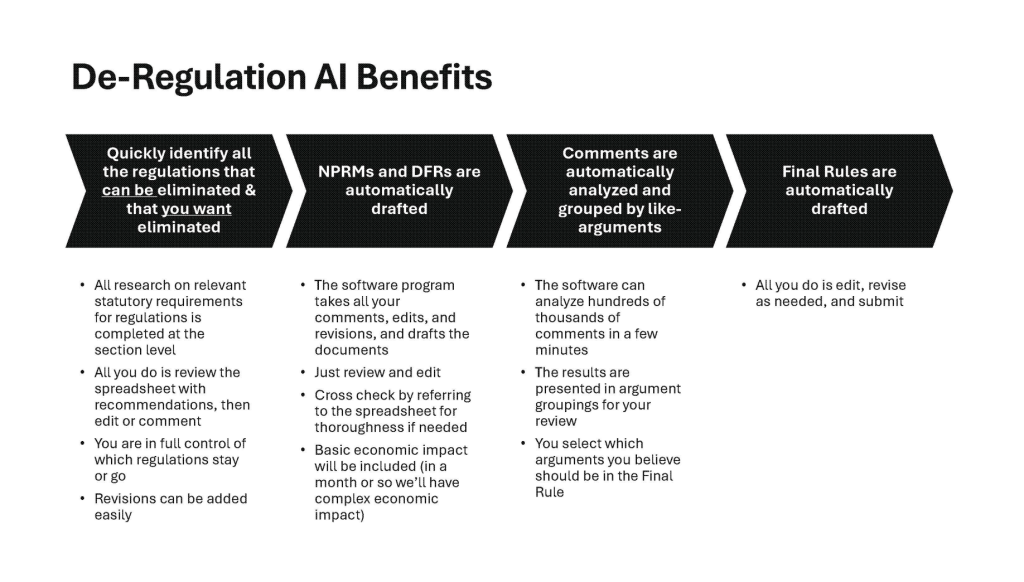
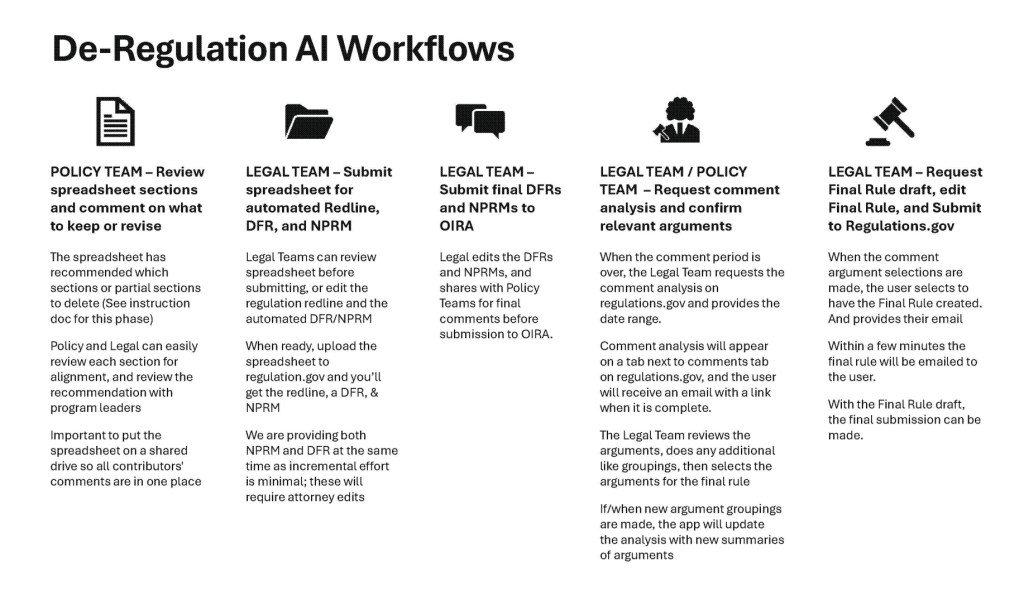
The new documents, shared with FedScoop and first reported by Lever, laid out a multistep process in which all HUD regulations would be analyzed by the AI. The tool would then provide recommendations to “keep, delete, or partial delete” each rule, per the presentation.
Attorneys would review the suggestions and agency staffers would make the final decision. HUD regulations cover everything from the prohibition of discrimination on the basis of sex in mortgage assistance to providing legal aid for foreclosure-related issues.
The pitch to HUD employees from DOGE was that the tool would simply “automate all the most time-consuming steps in deregulation” and leave “program groups” in control “every step of the way,” along with reviews and edits from legal teams “as needed.”
Nevertheless, a source familiar with the FOIA submissions said in an interview with FedScoop that the “explicit instructions” given by DOGE to HUD employees make clear that “the default assumption is that rules and regulations should be rescinded.”
“That presents a lot of concerns, especially [because], as we all know, AI tools are sycophantic and will sort of adopt the preferred outcome of whoever is using them,” the source continued.
“So if the DOGE folks go in with prompting the LLMs such that the LLM … interprets that it should be giving a deregulatory result, then the results will end up being more on rescinding regulations than not.”
The source’s “default” deregulatory interpretation is backed up by the FOIA documents. One set of instructions notes that the “deregulation goal is to eliminate any regulatory provisions that may represent potential overreach or impose unnecessary burdens beyond what Congress has legislated.”
“We start with the position that the proposed regulatory eliminations are the default case,” the document continues. “If you disagree with all or part of an elimination, please note it and your rationale in the columns provided in the spreadsheet.”
The source said it’s not clear from the documents if any HUD rules have been written or rescinded based on SweetREX recommendations, nor is it something that can be determined by looking through the Federal Register.
But the general feeling among those familiar with the FOIA submissions is that LLMs are not equipped to perform this type of analysis, and outsourcing this work to an AI tool undercuts the role that Congress has empowered agencies — and humans — to play.
HUD’s press office did not respond to FedScoop’s questions about the tool, including whether it was deployed at the agency and the extent to which DOGE is involved in agency operations.
DOGE, meanwhile, made the case in its presentation that HUD’s attorneys and policy teams would be freed up to do more “high-value work” thanks to the AI tool, which claimed to slash rulemaking time by at least 90%.
A different source familiar with the FOIA submissions, who previously worked at the Department of Labor, told FedScoop that DOGE’s baseline assumptions on the review of comments submitted in response to a proposed rule are “wildly incorrect.”
The PowerPoint estimated that SweetREX’s analysis and review of 100,000-plus comments would take 2.4 hours, down from what it says is currently roughly 36 hours of human review from legal and policy teams.
“There is very wide variation in rules I worked on,” the source said. Even for regulations that DOL was “trying to get out relatively quickly,” the review and analysis process often took weeks, they said.
“So the idea of 100,000 comments being reviewed in a day, and [with this tool] you could review it in an hour, I think it’s using a baseline that doesn’t incorporate the preexisting reality,” the source added.
Beyond the workforce assumptions, the source questioned how an AI tool is equipped to determine compliance with new rules, including some that appear open to a good bit of interpretation. The documents, for example, point to the Supreme Court’s June 2024 ruling in Loper Bright Enterprises v. Raimondo as “reference criteria” for “determining compliance.”
In that decision, the high court ruled that the Administrative Procedure Act “requires courts to exercise their independent judgment in deciding whether an agency has acted within its statutory authority, and courts may not defer to an agency interpretation of the law simply because a statute is ambiguous.”
The former DOL source said a “recent and sweeping” decision like Loper Bright only “vaguely articulates a number of different nonexclusive categories of ways that Congress could have delegated authority to agencies.”
“I think it’s just infeasible for an LLM to come up with reasoned judgments about that,” they said.
Though it’s unclear what direction HUD might take with the tool — the agency’s AI use case inventory does not list it — the fact that it was or is under consideration is still alarming to Democracy Forward and those familiar with the FOIA submissions.
“It seems to have been done in a very callous, sort of rushed way with only a rudimentary understanding of U.S. laws and how the rulemaking process works,” the first source said. “And that’s extremely concerning to us.”