Legislative branch sees boost for modernization in government spending package
Civic technology advocates are celebrating after the government funding package to reopen the government allocated millions of dollars to modernize the systems and workflows that underpin congressional offices.
The spending deal, signed by President Donald Trump last month to end the 43-day shutdown, set aside $4 million for the House’s Modernization Initiatives Account, a fund dedicated to increasing efficiency in Congress, including by expanding the use of office technologies.
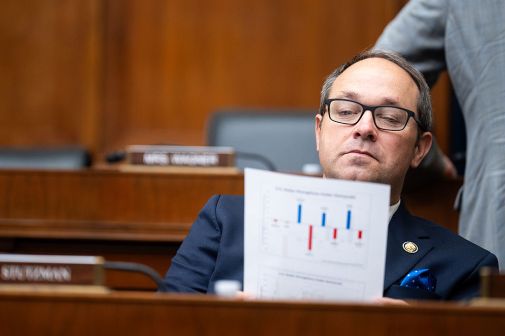
“The MIA funds initiatives to ensure that the House can serve the American people efficiently and effectively. From providing closed captioning service in committees and the House gallery, to developing a first-of-its-kind legislative staff directory to building a comprehensive constituent casework tracker, the MIA plays a critical role in bringing the best modernization ideas to life,” Rep. Stephanie Bice, R-Okla., the chair of the House Administration Subcommittee on Modernization and Innovation, said in a statement after the bill’s passage.
Aside from funding, the legislative branch appropriations bill for fiscal 2026 confirms Congress’s modernization priorities, from managing casework data to incorporating artificial intelligence into everyday workflows.
Wins for constituent services
The MIA funding will support numerous projects, including casework services and the development of new data management tools. In its report on the legislative branch appropriations bill, the House Appropriations Committee recognized the efforts of the Case Compass project, which aims to anonymize and aggregate constituent casework data.
The project is designed to recognize agency trends before they become larger issues and help caseworkers respond more efficiently to constituents.
“Even if the average American obviously doesn’t understand what casework is and won’t ever see Case Compass or know about it, I think that the repercussions of that program is going to be something that is going to make our legislation better,” Aubrey Wilson, director of global initiatives at the nonprofit POPVOX Foundation, told FedScoop. “It’s going to improve congressional oversight, it’s going to improve how legislation is implemented and how much it hits Americans.”
The House also increased pressure on the Congressional Research Service to update and expand the directory of congressional liaisons. CRS maintains the only comprehensive list of congressional liaisons at executive-branch and independent-agency offices, but, as modernization advocates have pointed out, the list of casework liaisons extends beyond the nearly 200 offices currently listed in the online directory.
The House report said it is looking into the feasibility of expanding the liaison list to include local and regional agency contact information, following a recommendation from the Select Committee on the Modernization of Congress, which ended in 2023.
“It’s been a need that’s been highlighted over time, but the inclusion of that in this [spending bill] to be a priority and to have to be expanded, and the fact that CRS is the one to do that, that was a huge win,” Wilson said.
The Senate report similarly encouraged the Senate Sergeant at Arms to develop methods to track aggregated casework data and casework toolkits.
Artificial intelligence emerges as top priority
Much like federal agencies in the executive branch, policymakers and civic technologists are increasingly considering how AI can and should be integrated into the legislative workflow.
POPVOX said the legislative branch appropriations bill for fiscal 2026 prioritizes AI more than ever before, suggesting the branch is trying to align with the Trump administration’s tone on emerging technology.
“There’s a lot of catch-up that needs to be done to be where the executive branch is starting to be with really leaning into using this tech,” Wilson said, adding that newer technologies like AI have not always gotten as much attention in appropriations for the legislative branch.
The White House has made the use of AI a key priority of the Trump administration, encouraging innovation and its widespread adoption in both the public and private sectors to increase efficiency and compete on the global stage.
House Appropriations noted in its report the “rapid development” of AI tools and their potential to improve workflows across Congress.
“The committee emphasizes the high value potential that large language models, utilizing resources containing within agencies such as the Library of Congress, including Congressional Research Service, the Government Accountability Office, and even the Congressional Budget Office, could play in accelerating the knowledge, efficiency, and operation of each agency, as well as the entire Congress,” the report stated.
The committee called on those four legislative agencies to collaborate on common policy standards and explore how LLMs could be integrated into the congressional process.
“The fact that leg branch encourages these agencies to start piloting and figuring out and exploring how they can start using these (LLMs), I think that’s a really big win,” Wilson said. “We’re celebrating, because it definitely shows we’re starting to get in the right direction.”
As part of this push, the Office of the Chief Administrative Officer is directed in the package to provide quarterly updates to the Appropriations Committee and the House Committee on Administration on the progress of AI implementation within the House.
“With the average age of Congressional staff hovering around 31 years old, the House and Senate are host to many early adopters of this new technology,” POPVOX wrote in a blog post last month. “As chiefs of staff, staff directors, and office managers face the necessary task of helping their staff navigate the smart adoption of these new tools, continued training and promotion of responsible platform usage will empower Members, staff, and interns with access to up-to-date guidance and knowledge.”
Among these tools is Microsoft’s Copilot chatbot, which is expected to be available this fall for up to 6,000 House staffers. Announcing the deal in September, House Speaker Mike Johnson, R-La., admitted the U.S. government, in some respects, is “crawling behind where the industry has sprinted forward.”
The Office of the Chief Administrative Officer confirmed earlier this year that it was reviewing the flurry of OneGov deals between the General Services Administration and private AI companies to see which partnerships may apply to the legislative branch.
Challenges to congressional adoption of AI
While there is a “high level of interest” among members in AI, the committee noted there is still a focus on “appropriate privacy protocols and sufficient training for AI users.”
“The committee reminds members and staff that the CAO has established AI policies and calls on the CAO to continue to be responsive to Members interested in the implementation and training on AI,” the report states.
Capitol Hill has offered various training sessions for congressional offices on AI use, but some experts note that ensuring safe use is more complex than that.
“Training is a way to mitigate some of the problems, but you can’t train your way to safety. It’s not a real thing,” Daniel Schuman, executive director of the American Governance Institute, told FedScoop. “Just like training people on how to deal with viruses and spam, malware, and cyberattacks, like you can’t train your way to cybersecurity. You can mitigate some of the risks, but some of the risks are inherent in the way that we design the platform, and it needs to be made either more safe or we need to be comfortable with what the trade-offs are.”
“Congress needs to be careful, they need to be more careful than most people. Having AI help you write your resume is one thing, but dealing with the constituent concerns is something else,” Schuman continued. “Some of that is fine to draft responses to questions … but dealing with very private concerns that people might have is a different thing.”
Implementing AI in Congress is further complicated by lawmakers’ growing focus on safety and regulation. As a result, some have been hesitant to embrace the technology in their own offices.
“There’s age gaps in terms of people’s comfort with it,” Schuman said. “Is this your authentic work, or are you taking from someone else’s stuff? Is it the pastiche of other work? There are concerns that it just recycles ideas that folks have and doesn’t help generate new ones.”
The changing culture around AI
Still, attitudes toward AI appear to be changing, congressional modernization advocates have told FedScoop in recent months. Wilson credited this in part to the increased use of AI models in everyday life.
“Most people have come across a large language model at this point. They probably know what the acronym LLM stands for, and they probably have used these in their personal life at this point,” Wilson said, adding that “even though every member is pretty autonomous with how they want their staff to operate, the availability of these tools is really important.”
Congress and other parts of the government have long addressed the so-called “pacing problem” as technology has developed, Wilson said.
The pacing problem, Wilson said, is the idea that “technology is so rapidly evolving in the world that for our democratic institutions to remain relevant and trusted and efficient, it needs to keep pace with that rapid change, but internal adoption of technology and the understanding that technology is so slow and it lacks so much intenterlly, that it’s really almost impossible for our institutions to keep pace.”
Schuman argued that the issue with the technology’s adoption is actually a scaling problem in Congress.
“Congress is a human institution and it has to be able to scale to the demand of the needs it must meet,” he said. “And that means that it has to be designed to address the problems that face the American people, that allow members of Congress and their staff to collaborate with one another to come up with real solutions. Technology is neither the source nor the cure-all to our problems, but it can help us address them.”
The Trump administration appears keen to break this pattern, pushing for fewer regulations and the removal of red tape to prevent adoption from being hampered. White House leaders often frame the need to cut regulations as a matter of national security and winning the so-called AI race.
Some civic technology leaders are also using this argument to push more attention on modernizing the legislative branch.
At the beginning of 2024, POPVOX reported the House was one of the very first federal legislative bodies to provide public official guidance on the use of generative AI tools, and the Senate followed shortly after.
“In the two years since that report came out, we’ve seen a drastic variation of how parliaments around the world are being agile enough to adapt to this emerging tech,” Wilson said. “I think that the United States legislature is falling behind [where] other legislatures around the world are.”