Former federal technologists tap public meetings for data in new AI venture
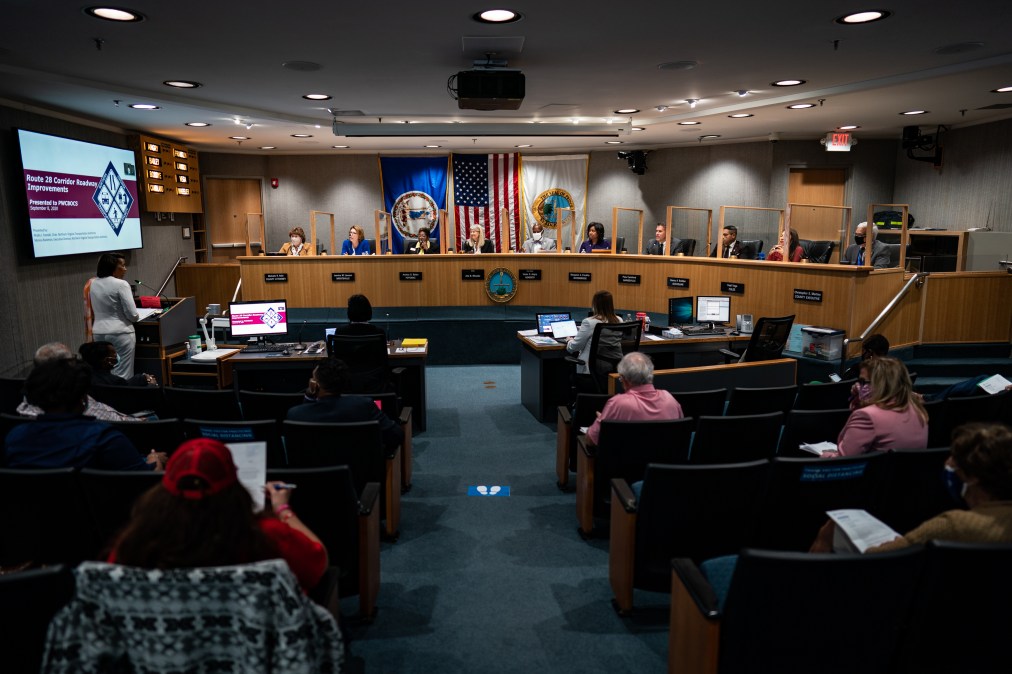
For some, the idea of local government meetings may conjure up Parks and Recreation-style sitcom antics. For others, it might evoke memories of the procedural tediousness of Robert’s Rules of Order. But for one new AI company founded by three former government technologists, those forums present something entirely different: an untapped trove of policy data.
GroundVue, which officially launched this week, is using what it describes as social science-fueled AI to turn hours of recorded public meetings across the U.S. into structured data, make connections across localities, and organize the findings for policy leaders. The aim is to help county, city, and state governments to better inform their solutions.
“The signal to understand what the impacts are of federal changes to state, county and city government is available — it’s locked up in government meetings,” Shannon Arvizu, the founder and CEO of GroundVue, said in a recent interview.
So far, the company is in early stages. GroundVue plans to launch its tool in three states in the next three months — Virginia, California and Minnesota — and is currently talking to prospective customers. But it has big plans for growth. Its founders told FedScoop the company is expanding its team, expecting a national rollout later this year, and aiming to add full historical data to the platform in two years.
In addition to Arvizu, the founders are Ann Lewis, the company’s chief technology officer and former director of the General Services Administration’s Technology Transformation Services, and Travis Hoppe, the company’s chief AI officer and outgoing acting CAIO at the Centers for Disease Control and Prevention. Arvizu, for her part, was previously a senior advisor to the White House chief data scientist and U.S. Department of Commerce.
Notably, the company is set up as a public benefit corporation with a fiscal-sponsored 501(c)(3) nonprofit arm. Public benefit corporations are still for-profit entities, but they have missions written into their legal foundations that drive their work. Examples include Patagonia and Anthropic. Meanwhile, the nonprofit arm is aimed at helping supplement the cost of the service to localities that might not be able to afford the product.
“We wanted to make sure that we are using this data for good, and so for us, that meant putting it into our legal documents that our purpose is to inform the development of policies that lead to greater household economic security, wellbeing, [and] quality of life in our country,” Arvizu said.
The founders, for now, declined to share details about specific investors. The company’s website says it’s “solely funded by mission-aligned impact investors and philanthropic institutions.”
GroundVue’s aim for public good will also shape the company’s customer base.
A lot of people might be interested in using the tool, Hoppe said, but if they don’t align with the mission of household economic security and better lives for Americans, “then they’re not somebody we’re going to sell it to.”
Sustainable data source
GroundVue’s impetus came last summer when Arvizu was working on a project to measure the county-level impact cuts to Medicaid under Congress’s One Big Beautiful Bill Act.
While there was research into national and state impacts, Arvizu said there was little information about how counties would fare. That information was important for states like California, where counties administer Medicaid. To fill that gap, UC Berkeley’s Agile Government Initiative, where Arvizu is a senior fellow, began to explore options.
They landed on calling stakeholders in a subset of California’s counties to “ground-truth” — or verify conversation by conversation — data about health system impact, including hospital and clinic closures as well as job loss numbers, Arvizu said.
“At the end, we heard from the counties: One, this is incredibly valuable. There’s so little research coming out at the county level when it comes to monitoring policy changes. And also, who’s going to be updating this?” Arvizu said.
The local governments, she said, wanted more data over time, expansion to programs like SNAP, and inclusion of the other counties in the state. That’s when Arvizu, who has a Ph.D. in sociology, began to think about a more sustainable and scalable data source for that kind of county-level information. She reached out to Lewis.
“I just found the vision behind this in terms of the problem to solve, the scope of the work, the need, the gap in the marketplace to be really, really compelling,” said Lewis, a computer scientist by training.
The two continued conversations for the next several months, and despite initially being recruited to be an advisor, Lewis said she was so excited by the project she couldn’t resist the opportunity to join the budding company as its CTO.
“The data just doesn’t exist right now, especially at a local level … but it could exist,” Lewis said. “We can use cutting-edge AI tools to pull this data together in a way that wouldn’t have been possible two years ago.”
That’s where Hoppe comes in. Hoppe, who has a Ph.D. in physics, has worked on data and AI issues in the federal government since 2016 and recently announced his departure from CDC to begin working on the company full-time.
“Strengthening the ecosystem of America’s governance, whether it’s in public health or economic prosperity, is … the thing that we should be doing in government,” Hoppe said. “And so to be able to support that is the reason why we all came together — the three of us.”
OS for government
GroundVue’s work starts first with finding publicly available meeting videos for the roughly 90,000 governments across the country.
According to Lewis, while about 50% of those videos are where you’d expect them, the remaining share can be difficult to source. Those videos are then transcribed and analyzed with AI. But AI alone isn’t the “special sauce,” Lewis said. Rather, it’s the company’s sociological approach to analysis.
What Arvizu said sets the data apart from legislative texts is being able to see where debates exist, the frames of justification, and who is talking about what. The company can then add layers to the data such as community indicators to identify socio-economic profiles of an area.
In a demo of the tool, GroundVue showed FedScoop a prototype for Virginia. That platform allowed users to search based on specific policy areas — like data centers — and filter by the locality and date. Results showed what policy actions were made, who the speakers were, and provided a summary with rationale. It also included links to the original source conversation within the meeting for validation.
“It’s an operating system for modern government,” Hoppe said.
As for how they’re ensuring accuracy of the transcribed information, Hoppe pointed to data validation.
According to Hoppe, GroundVue’s efforts are aided by the fact that public meetings are often highly structured, but there can still be inconsistencies. To help with that task, the company plans to hire subject matter experts for each of the policy domains to build the code books that will help tag those conversations and refine the information.
Rather than just sentiment analysis, the aim is to be an information source people can validate and trust, Hoppe said. “We are using AI to listen to the meetings and to tag them,” he said. “We’re not using them to generate anything.”
What it’s also not doing is creating a large language model. Instead, it’s evaluating models as they come out and tapping into those that fit its needs, Hoppe explained.
Shaping the product
Ultimately, the company expects to eventually make a public-facing version of the tool available.
“We think a lot of these insights really do need to be spread far and wide,” Arvizu said. “So the philanthropic dollars enable us to scale our mission in that way, and then we have the public benefit corporation — enterprise SaaS — to then fund the sustainable revenue generation of the core technology.”
In the immediate future, GroundVue plans to continue working out the details for its partnerships.
That includes pinning down what Lewis called the “right shape of the product to sell.” In other words, it could be a software as a service (SaaS) offering in some cases, and in others, it could mean local governments working with the company’s policy team in addition to the platform to achieve their goal.
“We’re trying to be flexible and work with potential customers to define what are the outcomes and metrics that are actually meaningful in terms of moving the needle on policy innovation,” Lewis said.
When asked about how they were building trust with local governments as outsiders, the founders pointed to efforts to establish those relationships early on. Per Arvizu, the company currently has dozens of beta users that work at the state, county, and city government levels.
“We would only build this if they told us this is something they need — this is something they want,” Arvizu said. “Otherwise, it wouldn’t be worth our time.”