The Agriculture Department is trying to “get smarter” about AI with fewer resources. Other agencies are trying other ways to keep up with changes while dealing with…
Experts are sounding the alarm on a new provision allowing DHS’s chief AI officer to waive any requirement outlined in the directive, including prohibited use cases.
The nine-page draft would set requirements for unbiased AI and reserve the government’s right to use the technology for “any lawful Government purpose.”
Federal leaders have embraced AI’s promise, but scaling from experimentation to measurable mission impact requires a sharper focus on data readiness, governance and time-to-impact.
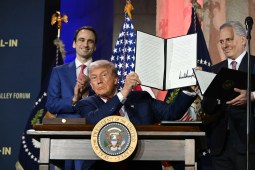
President Donald Trump displays an executive order on artificial intelligence he signed at the “Winning the AI Race” AI Summit at the Andrew W. Mellon Auditorium in Washington, DC, on July 23, 2025. (Photo by ANDREW CABALLERO-REYNOLDS/AFP via Getty Images)
In newly released compliance plans, agencies cited many of the same barriers to AI implementation and varied widely in how they’re approaching high-impact uses.
With autonomous AI agents on the rise, Salesforce’s Nadia Hansen says agencies must balance innovation with governance, training and human oversight to build trust and impact.