Acting ICE director denies existence of database tracking US citizens
U.S. Immigration and Customs Enforcement’s top official rejected claims from lawmakers Tuesday that the Department of Homeland Security component is building a database of protesters.
The alleged detractor database has been referenced in several reports by think tanks, letters to DHS officials from lawmakers and in interviews with border czar Tom Homan. During Tuesday’s House Homeland Security Committee hearing, Rep. Lou Correa, D-Calif., cited a well-circulated clip of an ICE agent in Portland, Maine, telling a person videotaping that she would be added to a “nice little database.”
“I can’t speak for that individual,” said Todd Lyons, who serves as acting director of ICE. “But I can assure you that there is no database that’s tracking United States citizens.”
Lyons doubled down on his denials about the database’s existence during a Senate hearing Thursday. When asked if ICE is giving protester information to any other agency, Lyons said: “We do not.”
Despite Lyons’ pushback on the database claims, skepticism is persistent as stakeholders point to reports to the contrary.
“He either 1) perjured himself or 2) has no idea what’s going on in his own agency, because all those facial recognition shots they’re taking of people on the streets of this country are going somewhere besides the agents’ smartphone,” Patrick Eddington, senior fellow in homeland security and civil liberties at the Cato Institute, said in a post on BlueSky.
FedScoop reached out to DHS for clarification. Tricia McLaughlin, the agency’s assistant security for public affairs, reaffirmed that there is no database of domestic terrorists run by DHS.
“We do of course monitor and investigate and refer all threats, assaults and obstruction of our officers to the appropriate law enforcement,” McLaughlin said in an email Tuesday. “Obstructing and assaulting law enforcement is a felony and a federal crime.”
Body cameras and other tech
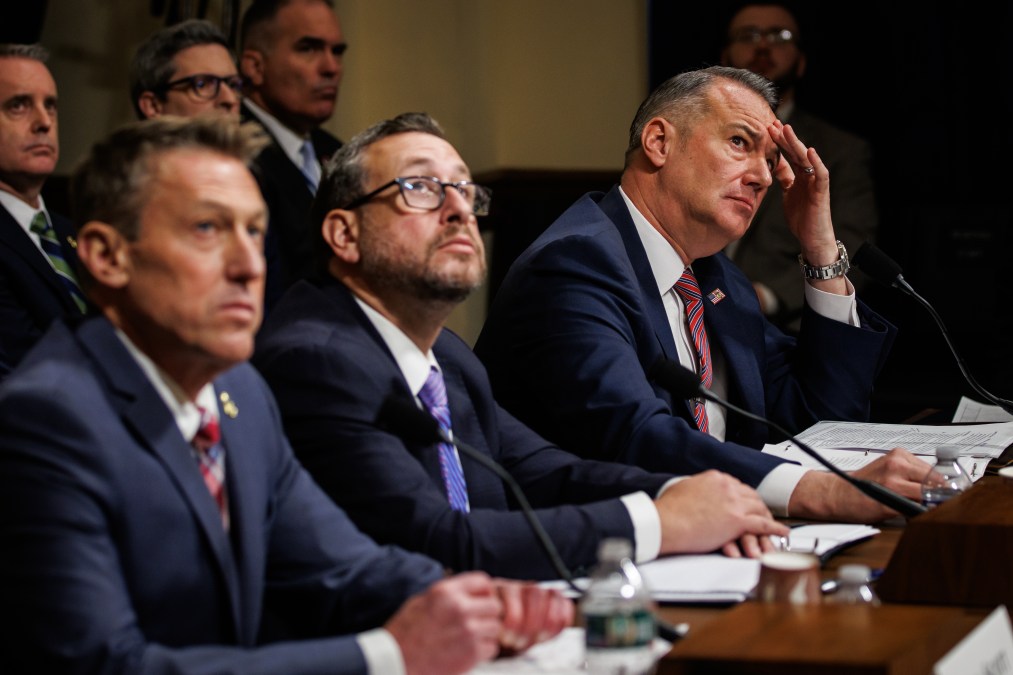
The oversight hearing featuring three top officials across DHS’s law enforcement operations comes amid ongoing clashes between agents and civilians.
“Transparency and communication are needed to turn the temperature down,” House Homeland Security Committee Chairman Andrew R. Garbarino, R-N.Y., said in a statement accompanying the hearing announcement in January.
Following the fatal shootings of two U.S. citizens in Minneapolis, DHS Secretary Kristi Noem laid out plans to equip every officer in the city with body cameras.
“As funding is available, the body camera program will be expanded nationwide,” Noem said in a post to X, formerly known as Twitter.
The planned influx in body cameras could result in a potential data storage crunch if resources aren’t allocated properly, according to Customs and Border Protection Commissioner Rodney Scott.
“When body cameras got rolled out to CBP, the technical capability got rolled out but the funding for the personnel to support the programs and the data can basically drain all your other operations,” Scott told lawmakers. “Fund the entire program so that we can be transparent.”
Scott said 10,000 CBP agents carry body cameras out of the roughly 67,000 agents along the ports of entry. Lyons said about 3,000 ICE officers are currently equipped with body cameras and another 6,000 cameras are being deployed out of the 13,000 total officers in the field.
With the funding from the One Big Beautiful Bill, Scott said CBP is also investing in biometrics, border surveillance equipment and communication systems. U.S. Citizenship and Immigration Services Director Joseph Edlow cited tech investments in his prepared remarks as well.
“With the support of Secretary Noem, USCIS announced the creation of a new vetting center to enhance screening and vetting of immigration applications, with resources that allow us to better focus on identifying terrorists, criminal aliens, and other threats to public safety,” Edlow testified. “The center leverages advanced technologies and works closely with law enforcement and intelligence partners to strengthen our ability to protect national security.”
This story was updated Feb. 12, 2026, with comments made by Lyons during a Senate hearing.