Anthropic faces different government responses as Pentagon battle continues
As Anthropic’s legal battle with the Trump administration continues, it’s getting a mixed reception from federal officials.
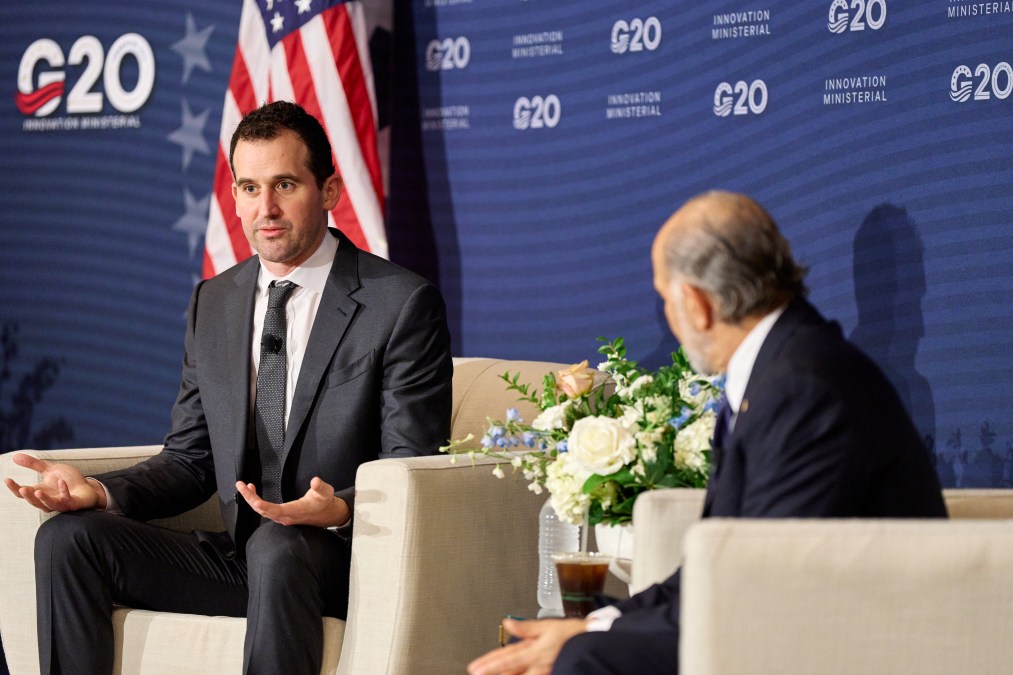
On Wednesday, Commerce Secretary Howard Lutnick told Bloomberg that Anthropic and the government were “in tune together” after months of on-and-off tensions between the Claude maker and the Trump administration. Lutnick’s comments came after he appeared on stage for a discussion with Anthropic co-founder Tom Brown at the G20 Innovation Ministerial in North Carolina.
Then on Thursday, Pentagon research and engineering leader Emil Michael posted on social media that the company “is still a designated supply chain risk” at the department and within the defense industrial base. “Thank you for your attention to this matter!” the brief message concluded.
The statements made just a day apart underscore the differing positions on the Claude maker within the Trump administration and indicate that even amid a continuing legal battle with the Pentagon, Anthropic may find a warmer reception among other federal officials.
“It seems contradictory because it is,” Jessica Tillipman, associate dean for government procurement law studies at George Washington University Law School, said of the statements. She added: “None of this has made sense because designating Anthropic as a supply chain risk never made sense.”
Tillipman pointed to the fact that the Pentagon’s previous statements about the AI developer came as reports that the National Security Agency, which is part of the Department of Defense, was using Anthropic’s Mythos model.
That contradiction played a part in a U.S. district judge’s recent decision in favor of Anthropic. In her Aug. 27 ruling, U.S. Judge Rita Lin cited the government’s Mythos use in her assessment that the administration’s purported national security concerns about the company were not earnest.
Additionally, other agencies seem to be moving along with Anthropic’s tools. The Department of Energy’s top IT official told FedScoop recently that “everybody wants” Claude and that the agency purchased it initially in 2024. Meanwhile, SAM.gov records show that the Federal Communications Commission signed delivery orders with Carahsoft for Claude in May and July (contract IDs 273FCC26F0051 and 273FCC26F0081).
Still, there is a risk that the mixed signals could be damaging for Anthropic.
Simona Grossi, a professor at Loyola Marymount University’s Loyola Law School who filed an amicus brief in support of Anthropic in the district case, told FedScoop that it’s hard to say what the Trump administration’s stance is on Anthropic.
In an email, Grossi said “the two statements are in tension with each other, and this is not without consequences. The market is not receiving clear messages and that translates into a burden for the company — others might not feel comfortable doing business with Anthropic for fear of becoming the administration’s next target.”
Active challenge
Spokespeople for Michael did not provide a comment in response to a request for clarification on his post, but legal experts told FedScoop it’s likely that he’s referencing the active challenge to Anthropic’s supply chain risk designation in the U.S. Court of Appeals for the D.C. Circuit.
Anthropic filed its petition for review in the circuit court at the same time as its district court complaint in an effort to challenge different aspects of the administration’s actions. While Lin struck down the supply chain risk designation under one statute, the appellate petition challenges a designation that relies on a different statute.
There are, however, still questions about Michael’s wording.
Grossi told FedScoop that Michael’s assertion about the active designation being “for the industrial base” needs more explaining.
In addition to vacating the designation under a federal statute aimed at protecting the defense industrial base, Lin also vacated Secretary Pete Hegseth’s directive that implemented a secondary boycott against Anthropic among military contractors. Meanwhile, the designation at issue was made under the Federal Acquisition Supply Chain Security Act, which is a statute that broadly covers federal procurements.
Whether the determination under that statute “can be implemented consistently with an injunction against carrying out the directive that ordered it is a question the government will have to answer,” Grossi said.
How the district court ruling applies is already a debate in the circuit case. Anthropic argues that Lin’s decision on the supply chain risk designation at issue in that case is “persuasive authority” for the challenges in the circuit. But the same day Michael issued his post, the government entered its disagreement.
The White House, Department of Commerce and Anthropic either did not respond to FedScoop’s request for comment or did not provide comment.
Coming up
As far as what’s next for the litigation, legal experts said there are some new considerations for the circuit case.
For Anthropic, the biggest challenge in the D.C. Circuit will be its “inherent deference towards national security decisions,” Tillipman said. That being said, the issues at hand are at the extreme.
This “has to be one of the most outer limits of national security excuses I’ve ever seen,” she said.
The open questions include Anthropic’s challenge under the procurement statute and accompanying constitutional challenges, Grossi said. Lin’s ruling also doesn’t bind the circuit — though the courts do rely on the same record — and it isn’t the final word.
The government’s appeal of the district court’s preliminary injunction is still pending in the U.S. Court of Appeals for the Ninth Circuit but is on hold while the circuit case plays out. Grossi said “an appeal from the final judgment is all but certain.”