House committee votes to subpoena Oracle after fiery hearing on VA’s $27B EHRM contract
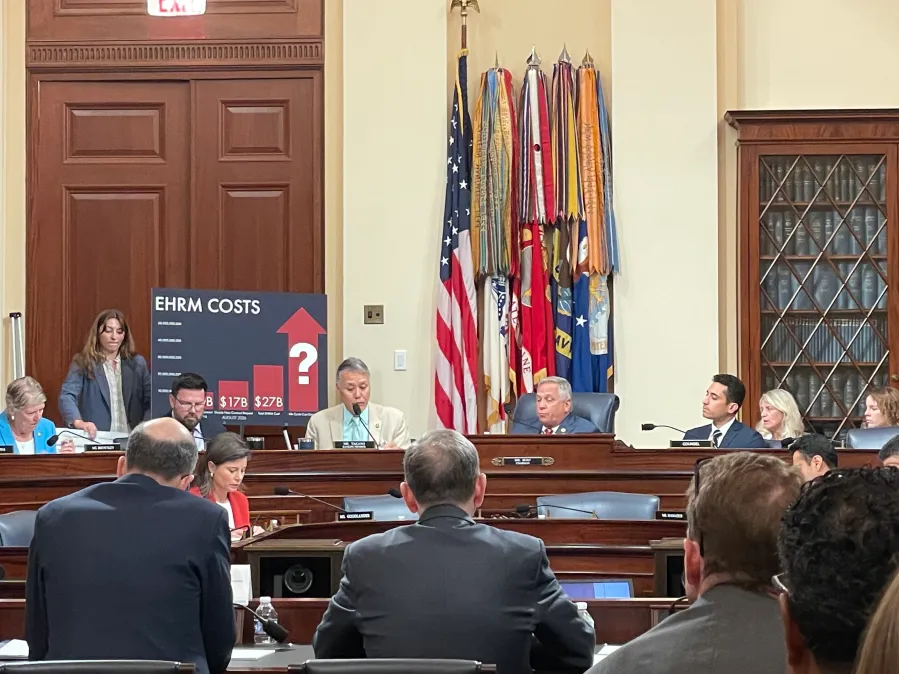
Executives from Oracle Health have been subpoenaed to appear before the House Veterans’ Affairs Committee after an explosive hearing Wednesday on the electronic health record modernization at the Department of Veterans Affairs.
Outrage over the recent $17 billion VA-Oracle contract ceiling hike spilled across the aisle following testimony from VA Deputy Secretary Paul Lawrence and EHRM Integration Office Program Executive Director Neil Evans, with members calling it “unreasonable” and “corruption.”
“We have seen this story before. Time after time, this committee has learned that VA’s first price tag is rarely the last one,” said Chairman Mike Bost, R-Ill. “Before Congress funds additional work, veterans and taxpayers deserve to know why costs are rising faster than planned.”
Lawmakers said they learned of the new contract from news reports — specifically citing FedScoop coverage — instead of directly from Oracle or the VA.
Oracle was invited to testify at the hearing, but then pulled out due to timing constraints, according to ranking member Mark Takano, D-Calif.
“It seems that you thought it was acceptable to let Oracle skip what is probably the most consequential conversation to date about the project,” Takano said to Bost.
Committee members met behind closed doors for over half-an-hour to discuss a motion from Rep. Maxine Dexter, D-Ore., to subpoena Oracle Chairman and Chief Technology Officer Larry Ellison and Oracle Co-CEO Mike Sicilia. The motion was agreed to in a 19-0 vote.
Rep. Morgan Luttrell, R-Texas, told FedScoop that the meeting was a “fruitful” and “very engaging debate” where “everyone agreed” to say “enough.”
“We’re not doing this anymore because we have to answer to our veterans, and I’m a veteran,” he said. “Our veterans ask us, ‘why, why, why?’ You’re taking more money, more money, more money and nothing is happening. It’s our job in the VA committee to have accountability on this, and we did that today, and that’s why we were unified.”
Oracle, formerly Cerner, is poised to hit its $10 billion ceiling as it has been working to upgrade the VA’s health records since 2018. But after delays due to the effort’s “unanticipated complexity” and a pause to renegotiate the contract in 2023, VA modified the contract to raise the ceiling to $27 billion total and extend it to 2031 to complete the work.
In 2022, before the 2023 contract renegotiations, Sicilia told the Senate Veterans’ Affairs Committee that Oracle would absorb any extra costs past its original ceiling of $10 billion.
“Oracle is committed to delivering the VA an EHR system that exceeds expectations without exceeding the contracted cost,” his statement said. “If there are issues with performance or workflow we commit to fixing those issues at our expense.”
In the contract modification documents, VA explained that the new estimated value is “based on historical work executed to date, the standard deployment model, and all other requirements necessary to deploy and sustain the EHR under the approved accelerated deployment schedule, which is required to meet VA requirements and Veteran’s needs.”
EHRM deployment has gone well so far, both Lawrence said and Secretary Doug Collins have said in recent months. Lawrence told the committee the VA will not come back and ask for more money for this contract in the future.
“We have spent exactly the money you have allowed us,” Lawrence said. “We have deployed in the schedule exactly as we said we would. We have had serious conversations with our contractors that this is the money available to do the things we need to do. The secretary has been very clear about the importance of this mission. I’m very confident that is the money we need.”
In 2022, the Institute for Defense Analyses estimated that EHR modernization life cycle costs would total $49.8 billion, including $32.7 billion for implementation over 13 years and $17.1 billion for sustainment over 15 years, according to the Government Accountability Office. Lawrence said his estimate of the life cycle costs is around $48 billion.
The GAO echoed some of Congress’s concerns about EHRM, as Director of IT and Cybersecurity Carol Harris said of the 18 recommendations the watchdog has issued, 14 remain not fully implemented.
“Full implementation of our recommendations will help ensure the department’s actions are sustained and that the program is well positioned to support its accelerated deployments and optimal use of the new system,” she said.
While not included in the continuing resolution passed by Congress this week, the House-passed fiscal 2027 Military Construction and Veterans Affairs appropriations bill would give $3.4 billion for EHRM.