DHS-built surveillance apparatus to surge in year ahead, documents show
The Department of Homeland Security is poised to pour funds into surveillance technology projects this year amid signs of lagging governance.
In analysis of publicly available contract forecasts, the agency outlines its plan to award hundreds of millions of dollars in contracts in 2026 that expand detection and tracking capabilities.
These contracts are in addition to the agency putting a $1 billion ceiling on a single award blanket purchase agreement with Palantir, a software company that helps customers, like Immigration and Customs Enforcement, analyze vast datasets. That contract went into effect in February.
The ramp-up comes as questions and concerns circulate about the effectiveness of oversight of the department by lawmakers, the DHS inspector general and others.
Surveillance isn’t a new pursuit of DHS, but the agency is in an unprecedented era all the same, sources told FedScoop.
“They really started to ramp it up during [President Barack] Obama’s time in office,” said Patrick Eddington, senior fellow in homeland security and civil liberties at the Cato Institute. “But we’re in a completely different world now.”
Funding is a key factor that has emboldened the agency’s surveillance efforts.
The Trump administration’s One Big Beautiful Bill, which was signed into law July 4, 2025, gave DHS more than $191 billion. The funding package was nearly double what was provided in the appropriations process for fiscal 2024 and included more than three times the non-disaster grant funding appropriated that year, according to the Congressional Research Service.
“The funding has really supercharged a lot of the surveillance that we’ve seen,” said Maddie Daly, assistant director of federal affairs at the Electronic Frontier Foundation. “DHS has been purchasing a sweeping array of technologies that can scan people’s faces, track cell phone activity and monitor immigrants and U.S. citizens alike.”
“They’re contracting with a lot of companies that produce spyware tools,” she added, pointing to DHS’s agreements with vendors like Penlink and Cellebrite that provide the agency with tools to extract mobile device and computer data. Cellebrite denies claims that its software is spyware or used in surveillance efforts, and instead, says its tools are used “lawfully” and “with a warrant.”
But Daly said that when ICE or Customs and Border Protection buys these types of technologies, “we’re really concerned about the civil liberties implications because you can have this sort of software used against you without knowing.”
DHS’s evolving agreement with surveillance vendor Paragon Solutions has also sounded the alarm for some stakeholders. Paragon sells a tool that can allegedly mine data from phones without the owner’s consent. Last year, the agency lifted a stop-work order on a $2 million deal with Paragon that the Biden administration had frozen.
Rep. Shontel Brown, D-Ohio, ranking member of the House Oversight and Government Reform Cybersecurity, Information Technology, and Government Innovation Subcommittee, and two other House Democrats questioned the agency’s decision and requested a list of data surveillance targets in an October letter to since-ousted DHS Secretary Kristi Noem. Brown sent another letter in February, alongside a dozen other Democratic lawmakers, expressing concern over the risks to data privacy and civil liberties that could be exacerbated by DHS’s procurement of tools from Paragon and Penlink.
“Republicans gave ICE a literal blank check in Trump’s Big Ugly Law, and we’ve seen the tragic consequences already,” Brown said in an email to FedScoop. “It is clear that the Oversight Majority has little interest in actual oversight when it comes to the Trump Administration.”
Republican leaders for the Judiciary and Homeland Security committees did not answer questions from FedScoop about oversight.
The booming AI economy has also had a hand in bolstering the surveillance tech ecosystem, as many providers sell products that use the technology to analyze massive datasets.
“There are so many emerging firms that sell new, unproven, invasive technologies that police departments and other agencies are really willing to shell out money on,” said William Owen, communications director at the Surveillance Technology Oversight Project.
This year, DHS will spend between $10 million and $20 million on an AI-enhanced surveillance data platform, according to planning documents. The agency already uses AI as part of investigations and immigration enforcement, including to sift through tips and biometric matching. Mobile Fortify, an AI tool used by ICE and CBP, has faced scrutiny for its high-impact, in-the-field use for identity verification.
Advocacy groups have concerns as AI becomes a more common addition to surveillance operations.
“With these technologies, the bias is baked in,” Owen said. “They are not somehow more objective than people themselves.”
Watchdog groups also said there’s been a clear shift in where surveillance technology is being deployed.
“So much of their enforcement operations, certainly during the last 12 months, have been very directed towards the interior,” Eddington said, pointing to tools like Mobile Fortify.
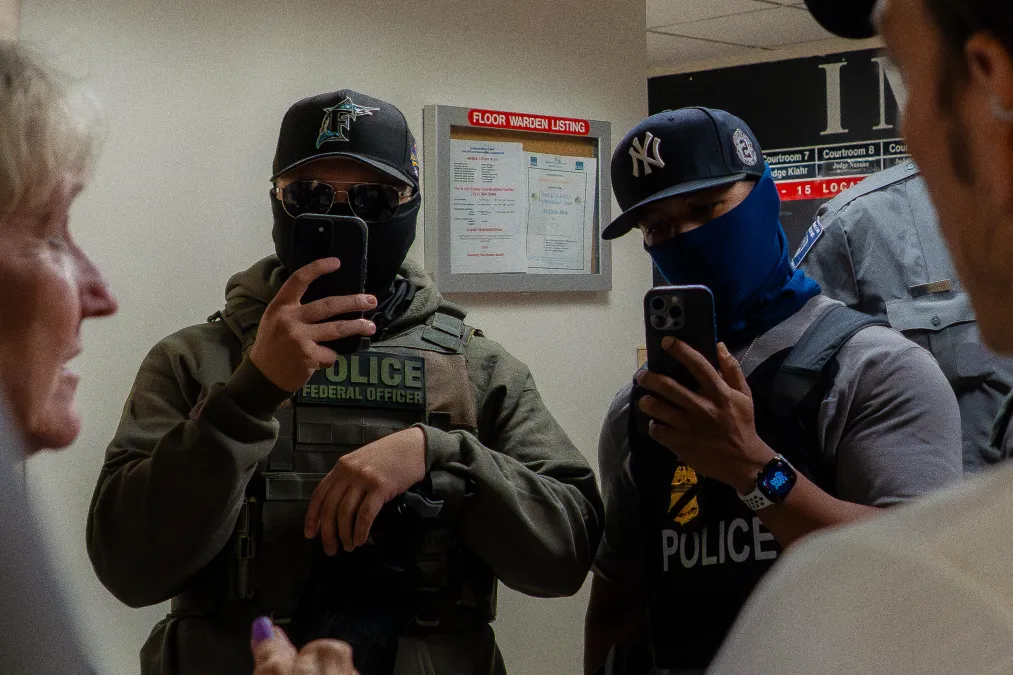
ICE officials have denied the existence of a database used to track U.S. citizens, but there have been reports that the agency is working to surveil protesters. ICE agents have been seen taking photos of protesters, for example.
“Those are not just simply staying on the agents’ phones,” Eddington said. “This data is being aggregated one way or another. It raises fundamental First and Fourth Amendment-related questions that really need very close scrutiny by Congress and the courts.”
Owen echoed Eddington’s sentiment on the operational focus shift: “In the past, certain biometric surveillance and facial recognition was used at the border or in a more shadowy, behind-closed-doors way. The use directly out in the field is very striking.”
DHS is getting ready to spend up to $50 million on enhancing mobile surveillance capabilities, according to contract forecast documents. Another $100 million-plus will go toward a modular mobile surveillance system.
“This is just a lot of money being spent with basically no oversight,” Eddington said.
The absence of oversight
At a time when DHS is ramping up surveillance technology projects, there are indicators of lagging transparency, accountability and oversight.
Internally, DHS has several mechanisms that officials could be leaning on.
As required by law, federal agencies must conduct a Privacy Impact Assessment before developing or procuring IT systems or projects that collect, maintain or disseminate information from or about members of the public. These assessments must also occur when an agency intends to identify U.S. citizens in conjunction with other data elements, according to DHS’s website.
“DHS conducts a PIA when developing or procuring any new technologies or systems that handle or collect information in identifiable form; creating a new program, system, technology, or information collection that may have privacy implications; updating a system that results in new privacy risk and issuing a new or updated rulemaking,” the agency website said.
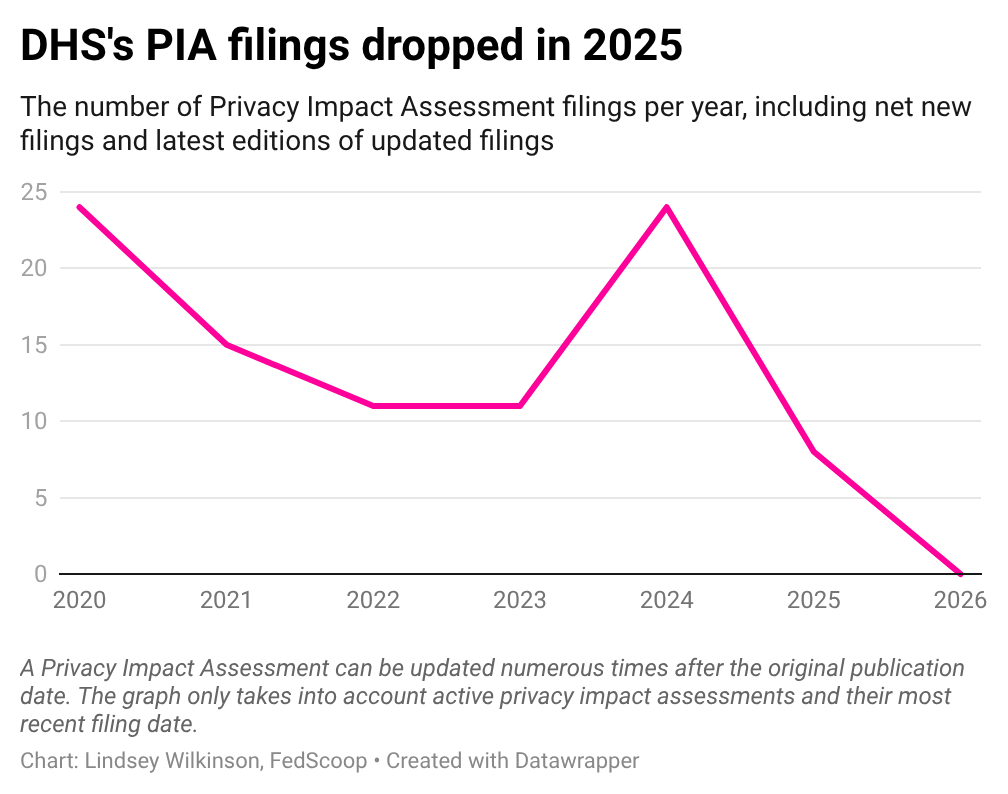
PIA filings dropped in 2025 to just eight, after hitting a 2020 peak of 24 in 2024, according to FedScoop’s analysis of 217 active PIAs across four relevant sections. There haven’t been any PIAs filed this year.
DHS did not respond to a request for comment before publication. The agency has operated under a partial shutdown since Feb. 14.
PIAs are under the purview of the chief privacy officer. Wired reported last week that DHS privacy officers were ousted after the officials objected to mislabeling government records that would have blocked their public release.
Another internal oversight function is the agency’s inspector general office. The IG launched an audit in February to investigate several aspects of DHS’s operations, including its management and security of biometrics and personally identifiable information, as well as interior immigration enforcement activities.
DHS IG Joseph Cuffari, who has held the position for nearly six years, told lawmakers in a letter earlier this month that DHS “has systematically obstructed the work” his office has been trying to complete by “blocking” access to records, systems and other necessary information. The OIG did not respond to a request for comment.
Sen. Gary Peters, D-Mich., announced he was opening an investigation into the alleged obstruction efforts and “communications from DHS’ General Counsel warning the Inspector General against communicating with Congress,” according to a press release earlier this month.
Lawmakers have tried to rein in DHS in other ways, too.
In December, nearly 50 House Democrats pushed DHS to reconsider its expanding biometric data collection processes. Democrats have also introduced legislation that would set limits on DHS’s surveillance technology use. Several letters have been sent to the law enforcement agency expressing lawmakers’ apprehension and requesting clarity on operations.
“Oversight Democrats are doing everything we can to conduct oversight,” Brown told FedScoop via email. “It is clear that ICE and DHS are out of control and that includes their use of technology.”
CyberScoop senior reporter Tim Starks contributed to this article.