White House wants to downsize DHS inspector general office
The Department of Homeland Security’s Office of the Inspector General will be a trimmer organization if the White House’s fiscal 2027 budget proposal goes into effect. The funding request outlines a plan to reduce the office’s workforce by 85 full-time employees and a net decrease of nearly $22 million in funding compared to fiscal 2026.
Most of the cost-cutting is credited to the potential workforce reductions, which would bring an $18.5 million drop in personnel costs. Another $8.1 million would come from the elimination of contracted support, including cybersecurity testing, investigative digital forensics, inspection data analytics support and IT engineering.
In corresponding budget documents, the White House said the latter reduction will shift audit and investigative efforts from a contracted workload to a “limited federal workforce.” The personnel reductions “will impact the OIG’s capacity to perform oversight of the Department’s operations” and the unit’s ability to undertake congressionally requested audits.
The potential cuts to the key oversight unit come amid mounting demands for increased transparency and accountability at DHS.
“At no point in DHS’s history has oversight been more needed than now because the base budget has expanded so rapidly,” David Bier, director of immigration studies at the Cato Institute, said in an email to FedScoop.
The topline DHS budget proposal for fiscal 2027 represents a 5.7% increase in budget authority, $118.4 billion total, compared to the fiscal 2026 annualized continuing resolution. This follows — and would work in tandem with — the multiyear investment coming from the One Big Beautiful Bill Act that allocated more than $190 billion to the department. Signed into law last summer, the One Big Beautiful Bill earmarked nearly double what was provided by the appropriations process for fiscal 2024.
“The IG budget should expand proportionally to the overall budget, but not only has it not expanded, the administration proposes to reduce it,” Bier said. “The result will be more violations of congressional requirements on appropriations and more waste, fraud, and abuse.”
As it faces deep cuts, the OIG has already grappled with meeting expectations and fulfilling its role as a watchdog for the agency.
The OIG has failed to post its semiannual report for the past two cycles. FedScoop reached out to several members of House and Senate committees covering Homeland Security to inquire about whether the agency had reported its activities to Congress as required by statute, but did not hear back. The IG has also garnered criticism about its effectiveness.
“The administration has systematically dismantled many of the inspector general offices across the federal government,” Darrell West, senior fellow at the Brookings Institution’s Center for Technology Innovation, told FedScoop.
As the Trump administration kicked off its second term last year, the Washington Post reported the president dismissed more than a dozen inspectors general. The IG workforce has also felt the squeeze in recent years, decreasing by nearly 1,500 personnel across federal inspector general offices and by more than 110 at DHS’s OIG since 2024, according to OPM’s federal workforce data.
“It’s going to be very hard for the inspector general to look at what’s going on within the department when they don’t have adequate budget or personnel,” West said.
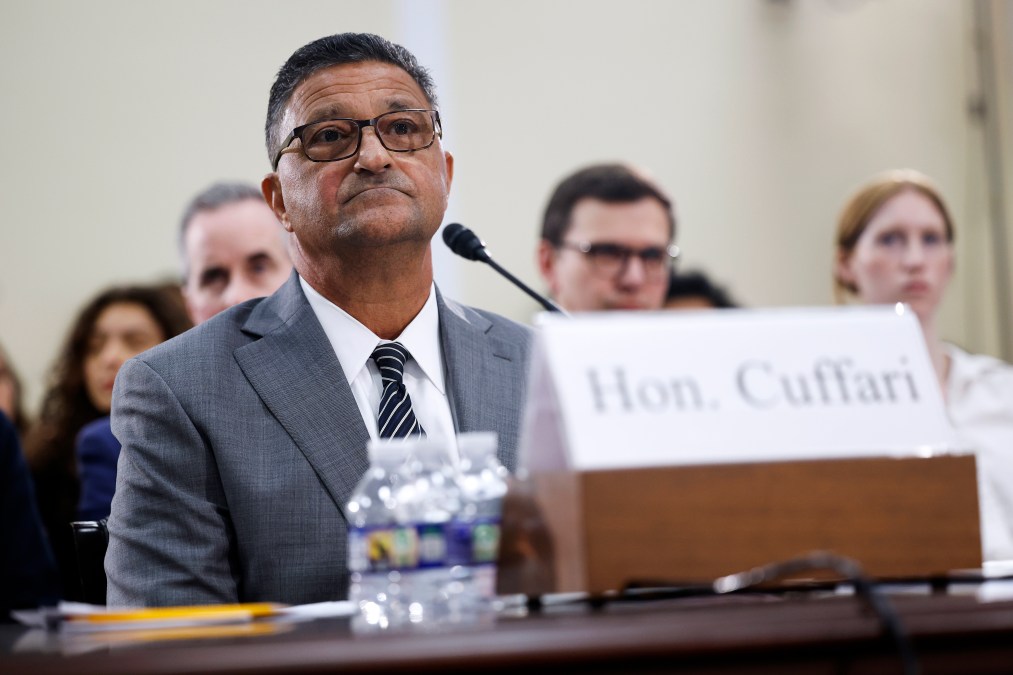
Interagency tensions only obstruct efforts further. DHS IG Joseph Cuffari, an appointee during the first Trump administration who’s been in the role for nearly six years, wrote a letter to Congress last month saying agency leadership had obstructed his office’s work and blocked access to necessary information.
Cuffari also provided Congress with correspondence in which DHS General Counsel James Percival said he viewed “any notification to Congress that you are being denied access to records as in bad faith and bordering on a material misrepresentation.”
Some analysts see the potential cuts to the OIG as a strategic move by the Trump administration following a particularly controversial year at DHS.
Ongoing investigations include handling of grants and contracts, DHS’s management and security of biometrics and personally identifiable data, reliability and completeness of border-related data, Customs and Border Patrol IT access controls, and DHS’s preparation of counter-unmanned aerial systems technology for upcoming major public events, among others.
“It’s no surprise that the Trump administration wants less scrutiny of its leadership of the Department of Homeland Security,” Debu Gandhi, senior director of immigration policy at the Center for American Progress, said in an email. “Cutting funding for the DHS Office of Inspector General when that office is reportedly in the midst of sensitive investigations with the potential to embarrass the administration may slow down some oversight.”