National labs work to optimize AI infrastructure amid Genesis Mission
The Department of Energy’s national labs are laying the groundwork for beefed-up AI infrastructure as the agency continues to advance Genesis Mission goals.
The Oak Ridge National Laboratory unveiled a dedicated unit to AI infrastructure Thursday, called the Next Generation Data Centers Institute. The internal group will serve as a hub for collaboration across national laboratories, industry, utilities and state stakeholders, focusing on thermal management, systems architecture, grid integration, load management, supply chain resiliency and cyber-informed engineering. The institute will also assess impacts of AI infrastructure on a number of factors and will use the lab’s digital twin environments as a testbed to validate performance before scaling.
Last week, the DOE’s Pacific Northwest National Laboratory began the process of building better data centers by issuing a request for information to gather industry insights on the design, construction and operation of a high-performance data center optimized for AI. The RFI is meant to inform future procurement strategies and technical requirements. Respondents are requested to share trade-offs between data center buildout options, as well as challenges that can arise for different cooling methods.
The two AI infrastructure-focused moves come as the agency broadly works to make progress on goals outlined by the Trump administration’s Genesis Mission, which aims to stand up supercomputers and launch a platform combining the latest advancements in quantum, high-performance computing and AI.
Darío Gil, DOE’s under secretary for science and director of the Genesis Mission, told FedScoop that the Energy Department is preparing to show “quite a lot of results” of the efforts later this year.
As part of the initiative, the DOE identified 26 challenges that they’d like to tackle with help from industry and academia. One of those challenges centers on deploying new data center technologies that can help scale AI advancements while remaining secure and manageable.
Figuring out how to rapidly build out capacity while minimizing impacts to citizens and the grid is top of mind for stakeholders across disciplines.
“We must fully understand the trade-offs of data centers: both the potential they hold for the quality of jobs and investments in our communities and the impact on electricity costs, our environment and even our health,” Rep. Emilia Sykes, D-Ohio, said during a hearing last week.
Ohio has the fifth most data centers of any state with 217. One data center in Akron can draw enough electricity to power 63,000 homes, Sykes added. And of the nearly 85,000 homes in Akron, many are already seeing increases in electricity costs, she said.
The right way to allay data-center driven affordability concerns and the accompanying capacity crunch depends on who you ask.
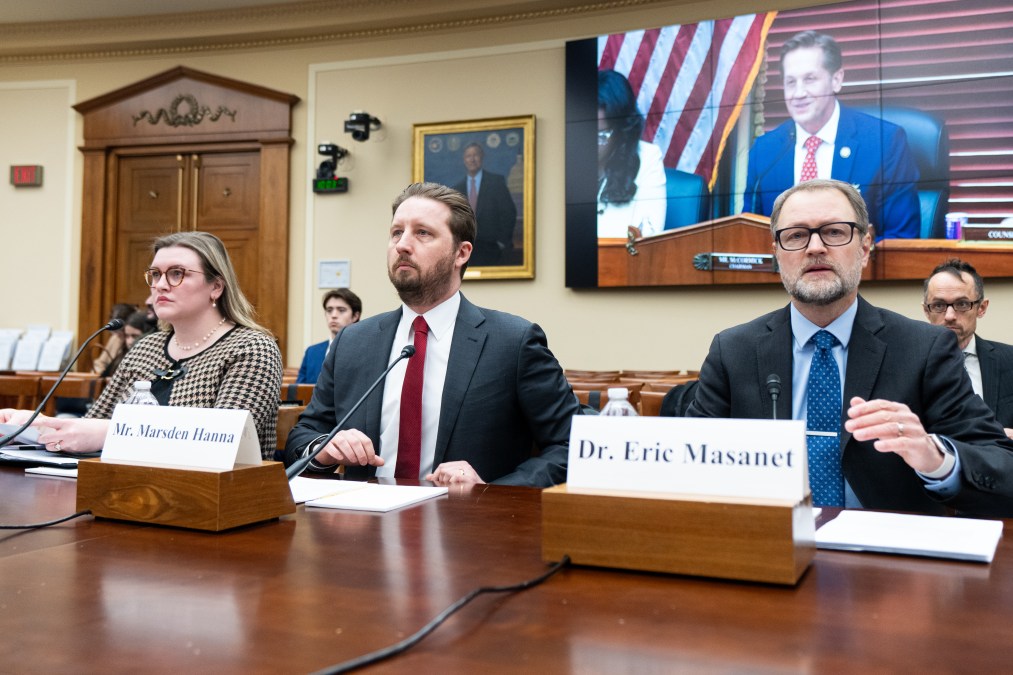
Paige Lambermont, research fellow at the Competitive Enterprise Institute, advocated for easier permitting and removal of government obstacles to allow innovative solutions, during the hearing. Eric Masanet, professor in UC Santa Barbara’s Bren School of Environmental Science & Management, pushed for more transparency and accountability from data-center operators.
“Very few data-center operators disclose the energy and water use … [and] some companies report no data at all,” Masanet said last week. “As a result, analysts have to make assumptions … this uncertainty hampers effective decision-making.”
Lawmakers have taken their own swing.
A bipartisan House bill introduced in September tasked the Energy, Interior and Agriculture departments with carrying out research to examine the effects of AI data-center buildouts on rural America. In November, lawmakers across the aisle in both the House and Senate pushed for assessments of liquid cooling tech to mitigate rising energy demands and costs. Senate Democrats have also pushed back on “sweetheart deals” that the Trump administration has made with Big Tech companies.
The national labs are stepping up to the plate, too.
“Artificial intelligence is transforming every part of our society, but its energy appetite is unlike anything we’ve seen before,” Stephen Streiffer, director of the Oak Ridge National Lab, said in a press release. “The electricity required to power AI data centers is expected to double or triple in the coming decade, straining infrastructure that is already under pressure. ORNL is uniquely positioned to meet this challenge.”