NWS wants to accelerate a radar infrastructure overhaul. It’s seeking industry help.
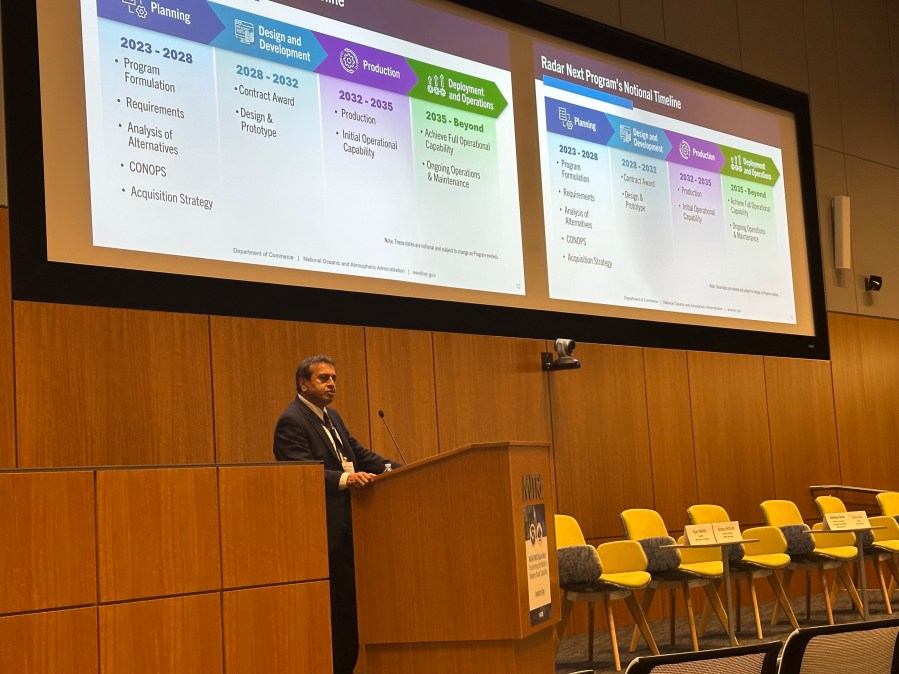
As the National Weather Service continues preparations for its major refresh of the country’s aging radar infrastructure, accelerating the speed of that deployment is top of mind.
“The biggest thing that worries me is just looking to our international partners and how long it’s taken them to do this — we have to be able to do it faster, and we’ve got a lot more area to cover,” Ajay Mehta, director of NWS’s Office of Observations, told FedScoop Tuesday on the sidelines of the agency’s first industry day for the Radar Next program.
When asked what the biggest unanswered question from industry is for the program, Mehta pointed to the schedule. Specifically, he said the agency is looking for details about how quickly new radar technologies can be deployed and what the manufacturing capabilities look like.
“We can do the cost estimates, we can come up with the requirements, but how quickly can we deploy is going to be our biggest open question,” Mehta said.
While still in planning phases, Radar Next is aimed at replacing the country’s existing radar system with a modernized network that would lean more heavily on commercial solutions while also expanding coverage. Through broad agency announcements and now its first industry day, NWS is inching closer to firming up program details such as cost, what it plans to buy, and how long it will take to implement the new system.
And time is of the essence.
The current system, known as NEXRAD, is a nationwide network of nearly 160 radars operated by NWS, the Federal Aviation Administration and the Air Force. It consists of one type of large ground-based radar that operates in a portion of the microwave radio spectrum called the S-band. But that infrastructure, which was built in the 1990s, is expected to face critical system failures that will render it unsustainable in the 2030s, per information shared at the industry day at MITRE’s headquarters in McLean, Va.
That’s a risky prospect as the radar network fuels numerous systems in the public and private sector, including severe weather warnings for events such as flash floods and tornadoes.
While people see radar-based alerts on the evening news, they might not know there is a risk, Mehta told FedScoop. Roughly 90% of severe weather warnings are generated by radar data. “These radars are aging, and they are so critical,” he said.
A Senate bill reauthorizing the Weather Act, a comprehensive law aimed at improving weather research and technology, would direct the agency to deploy Radar Next by late 2040. However, during his presentation, Mehta told the audience that the deadline might be moved up in subsequent drafts as a result of the push to accelerate the work.
In the meantime, the agency is working to firm up details for the program.
While NWS has funding for the planning, a commitment from the Department of Commerce won’t come until the program hits its second milestone, where cost and acquisition details will be baselined. Per Mehta, the industry day kicks off the next phase of that process.
“In order to even answer those basic questions, we need input from industry,” Mehta said to FedScoop.
Radar Next is envisioned as a hybrid network that will still use federally operated S-band radar as the backbone of the system, while also relying on commercial products and services. The program will purchase and integrate commercial data and leverage additional commercial radar capabilities that operate in the C- and X-bands and are more portable. While the government already uses some commercial data, the data purchased for the new program would be more than just a supplement, filling in gaps and complementing federal data.
“I want to emphasize that the future of our radar network will rely on a hybrid architecture,” Taylor Jordan, assistant secretary of commerce for environmental observation and prediction, told those gathered at the industry day event. “We are combining government-owned systems with key commercial data buys in new ways of doing business. These commercial acquisitions are the keystone of our strategy.”
Commercial partnerships are aimed, in part, at expanding coverage.
During his presentation, Mehta said there is a push from lawmakers to expand the system and fill gaps across the country, such as mountainous regions and areas outside the continental U.S. “That’s where we’re really looking for commercial partnerships to help us do that. We know whatever network we deploy will not be sufficient,” he said.
The planning comes amid broader operational changes at NWS. In virtual remarks at the event, NWS Director Ken Graham said his aim has been to transform the weather service and pointed to the agency’s ongoing move to cloud-based systems, exploration of numerical weather prediction, reorganization and new operations model, as examples.
In fact, NWS’s operations model was established in the 1990s and designed around the radar, including country warning areas, Graham said. “Now we’re building a weather service designed around our partners,” he said.