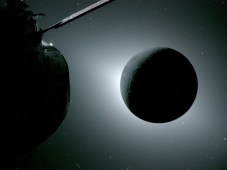
The Moon was backlit by the Sun during the Artemis II mission on April 6, creating a solar eclipse. The photo was taken by a camera on the Orion spacecraft. Troy LeBlanc used it in his presentation as one of many examples of NASA images. (Photo via NASA)
Microsoft and Google are among the vendors NASA is working with for mission control and image cataloguing use cases, per Johnson Space Center’s top IT official.
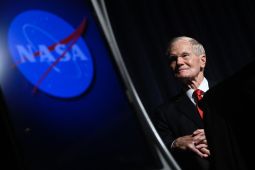
NASA Administrator Bill Nelson looks on during a press conference at NASA headquarters in Washington, D.C., on Sept. 14, 2023. (Photo by Andrew Caballero-Reynolds / AFP via Getty Images)
NASA inspector general report finds that the space agency is falling short on tracking the contractors responsible for the mission series to the moon and later Mars.
Nick Skytland highlights the approach his team takes to procuring sophisticated leading-edge technology and says this is being similarly applied to IT acquisition.
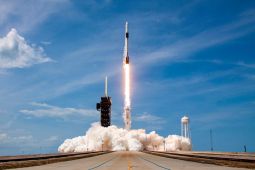
A Falcon 9 rocket carrying SpaceX’s Crew Dragon spacecraft launches on the Demo-2 mission to the International Space Station with NASA astronauts Robert Behnken and Douglas Hurley onboard on May 30, 2020, at the Kennedy Space Center in Cape Canaveral, Florida. (Photo by SpaceX via Getty Images)
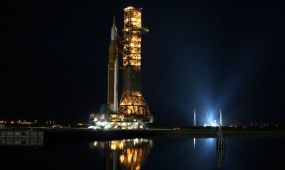
The Artemis I rocket is ferried atop its mobile launch platform back to the Vehicle Assembly Building at the Kennedy Space Center in Florida on April 26, 2022. (Photo by Gregg Newton / AFP via Getty Images)
A Falcon 9 rocket carrying SpaceX’s Crew Dragon spacecraft launches on the Demo-2 mission to the International Space Station with NASA astronauts Robert Behnken and Douglas Hurley onboard on May 30, 2020, at the Kennedy Space Center in Cape Canaveral, Florida. (Photo by SpaceX via Getty Images)