IT professionals, advocates ‘frustrated’ after Congress fails to reauthorize TMF

Civic technologists and former government leaders are frustrated with Congress after the expiration of the Technology Modernization Fund froze nearly $200 million in funding for government IT projects.
The failure to reauthorize the TMF, which expired Friday for the first time since its 2017 inception, does not reflect the issue’s typical bipartisan support, those tech experts said in interviews with FedScoop, making the investment vehicle’s lapse all the more infuriating.
Experts on both sides of the aisle suggested the expiration of TMF, which is housed under the General Services Administration, undermines the Trump administration’s push to modernize government systems. They also warned of the long-term consequences of letting these funds lapse.
The TMF was created in 2017 to fund technology projects across the federal government, but the bill that made it also set an expiration date that only Congress can extend. Since the start of the TMF, more than $1 billion has been invested into 70 different projects across 34 federal agencies.
Projects funded by TMF ranged from the Department of Homeland Security’s rebuilding of its information-sharing system to the Department of Veterans Affairs’ digitization of payment forms. And just last week, the funding vehicle awarded more than $28 million to the Department of Energy’s National Nuclear Security Administration for various modernization projects.
The TMF “isn’t an optional experiment,” said Jordan Burris, former chief of staff to the White House’s Office of the Chief Information Officer during the first Trump and Biden administrations. “It’s the government’s only scalable way to upgrade the digital systems that deliver benefits, defend our networks, and keep core public services running.”
“Yet Congress continues to treat modernization like a one-time project rather than the ongoing national priority it is,” added Burris, now the head of public sector for the digital ID verification firm Socure. “When funding disappears or authority sits in limbo, agencies fall back to patching brittle systems, and the public lives with the consequences.”
Frustration over the legislative process
Trade groups and IT industry experts were similarly disappointed that congressional delays and opposition from even just one person could stall the effort. While there is no definitive answer to what or who contributed to the TMF expiration, some have pinned the blame on procedural hurdles that frequently slow progress in Congress.
“It’s been very hard to move individual bills … the stuff that seems like it’s super commonsense, bipartisan, fiscally responsible. It’s just a slog to get anything out,” said Timothy Brennan, the vice president of technology policy and government relations for the Professional Services Council.
Timothy Cook, the executive director for the Center for Procurement Advocacy, pointed to the government shutdown earlier this session, which halted congressional activity for 43 days and pushed funding discussions and other priorities toward the end of the year.
“The biggest issue is that with the government shutdown and so many priorities and widespread change in the government,” Cook said. “It’s not really lost; it’s just another one of those things you have to do.”
Expiration of the TMF authorization became increasingly likely last week after a last-ditch effort to include reauthorization language in the National Defense Authorization Act fell flat, and lawmakers failed to advance alternative legislation in time.
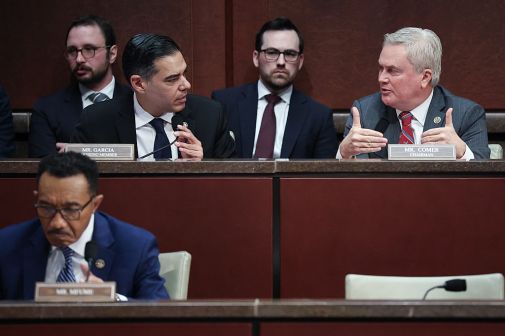
Rep. Nancy Mace, R-S.C., and the late Gerry Connolly reintroduced a bill in the last three Congresses to reauthorize the TMF beyond 2025, but it did not advance out of the House Oversight and Government Reform Committee in time this year. Virtually the same bill passed the House last year, but did not make it out of the Senate.
A spokesperson for the Oversight Committee told FedScoop earlier this month that TMF reauthorization was a “high priority” and that the panel plans to advance a reauthorization bill at a scheduled markup in the new year.
Funding for the TMF has broad bipartisan support in the House but has at times faced pushback from congressional appropriators.
“It’s not that folks don’t know on the Hill that this was up for reauthorization,” Brennan said. “There are a number of things that need to be reauthorized that go through the Senate Homeland Security [and Governmental Affairs] Committee that have not been reauthorized.”
Sens. Gary Peters, D-Mich., the ranking member of HSGAC, and Jerry Moran, R-Kan., reintroduced a companion bill to reauthorize the TMF through 2032 as an amendment to the NDAA. Sen. Rand Paul, R-Ky., who chairs HSGAC, has previously signaled opposition to the TMF.
A longtime government-spending hawk, the Kentucky Republican was the sole “no” vote last year when HSGAC advanced the TMF reauthorization bill out of committee. Paul’s office did not respond to an inquiry about how he would act and vote this year.
“There’s just frustration that there is a holdup on getting this through. I don’t think the [TMF] office in particular has done anything to make Congress feel like, ‘Hey, we’re not willing to make changes,’” Brennan said. “Usually, there’s an easy way to negotiate those things.”
“From a process standpoint, it is insane to expect to have these amazing results that we want on IT modernization, but not have consistent funding streams and a consistent plan in place to execute,” he added.
Reauthorization does not equal appropriations
Some sources suggested they are further disappointed by the expiration, as the reauthorization does not require new funds but only a green light from Congress.
Ross Nodurft, executive director of the Alliance of Digital Innovation, agreed, telling FedScoop that technology “evolves quickly. Big technology modernization projects don’t follow appropriation cycles cleanly.”
“Having a revolving fund … the reauthorization is not asking for money. It’s asking for authorization to do work they’ve been doing,” Nodurft added.
Traditionally, the sitting administration asks Congress to fund the TMF.
During the Biden administration, Congress poured $1 billion into the fund in 2021 as part of the American Rescue Plan. Congress eventually rescinded $113 million of that last year, and GSA indicated this year that the Trump administration is seeking to sidestep the appropriations process to refill the fund annually by transferring unused funds from agencies.
As a result, the House did not allocate any additional money to the fund. Senate appropriators set aside $5 million for the TMF in their fiscal 2026 Financial Services and General Government appropriations bill.
“When you talk about how much IT modernization costs, that is a comical amount to include for a fund like this,” Brennan remarked.
Separately, the Modernizing Government Technology Act, which created the TMF, also authorized Chief Financial Officers Act agencies to establish agency-specific IT modernization working capital funds. Some agencies have taken advantage of this, including the Small Business Administration, the Department of Homeland Security, and the Department of Transportation.
These funds are agency-specific and not impacted by the TMF expiration.
Repayment structure draws skepticism
Some industry observers have suggested that repayment terms have become overly lenient over time, contributing to increased skepticism in recent years.
The TMF was intended to be a self-replenishing working capital fund that provides initial funding to agencies for modernization projects. After a specified period, the agency repays these funds.
“It’s especially frustrating because this moment was avoidable,” Burris said. “The TMF model was designed to be transparent, repayable, and focused on measurable outcomes. But instances in prior administrations where funds were used too loosely helped turn ‘modernization’ into a four-letter word and fed the false claim that TMF was a slush fund.”
“That history handed skeptics in Congress a convenient excuse to walk away from sustained investment just as the stakes are rising,” Burris continued.
A former GSA leader told FedScoop the agency “changed and relaxed” the original funding model and failed to adhere to the self-sufficient model by allowing “radically relaxed” repayment terms. The former official said loan discipline can create discipline across projects, but without accountability for loan repayments, projects could face their own completion issues.
“Tell someone they only have to repay a small percentage of the loan, they’re going to manage their project in a different way than if they have to pay the full amount,” the former leader said.
Under the Biden administration, the GSA and the Office of Management and Budget in 2021 changed the TMF repayment model to give projects greater flexibility in repaying those investments. This included allowing specific projects to provide only partial repayment.
GSA signaled a desire to reform these repayment terms earlier this year, stating in May that its funding model would shift to prioritize full repayment of new “high-impact” investments across the federal government.
When asked about concerns about the repayment structure, a GSA spokesperson pushed back against the argument that the repayment structure or program performance contributed to the expiration.
The spokesperson said the expiration was instead a “matter of legislative timing,” adding that “TMF funds have been managed with full accountability and transparency,” and all TMF-funded projects “completed their payments as required.”
“GSA maintains rigorous oversight of TMF investments through established governance processes,” the spokesperson added. “All TMF-funded projects undergo thorough review and monitoring by the TMF Board, which includes federal CIOs and IT experts who evaluate project plans, milestones, and repayment schedules.”
The spokesperson noted the TMF was designed to be “flexible and responsive to the complexities of federal IT modernization.”
“Over the past two years, we have strengthened repayment requirements in phases to ensure program sustainability while giving agencies time to adjust to the new structure,” the spokesperson said. “TMF now requires full repayment for all new projects, demonstrating our commitment to fiscal responsibility and the long-term viability of the revolving fund.”
Moving forward, Burris suggested that “tightening guardrails” around project selection and performance reporting would send a message to agency leaders and the public.
How TMF could be reauthorized
TMF will remain frozen unless Congress chooses a path to reauthorize it, though that timeline is likely to extend until lawmakers return from the holiday recess next month.
To reauthorize TMF, Congress will either need to pass a standalone authorization bill like Mace’s or attach it to a larger government funding package.
Industry insiders predicted the latter is the likelier pathway given the hurdles in the Senate. They noted this maneuver was how the TMF was created in the first place, through an addition to the 2018 annual defense spending bill.
In the meantime, acting TMF Executive Director Jessie Posilkin wrote in a LinkedIn post Monday that the office remains “fully committed to the work already underway.”
“The TMF continues to manage a strong portfolio of active investments,” Posilkin said, adding that “Every project in the portfolio continues to move forward, and every day we see the impact of this work across the government. I am deeply proud of the TMF team and our partners across federal agencies. Their dedication, expertise, and creativity have shown what is possible when we approach modernization with collaboration and purpose.”
Posilkin wrote that the “mission continues and so does that impact,” and pointed to TMF projects at the departments of Labor and Homeland Security that saved the agencies $1.8 million and $30 million a year, respectively.
The GSA spokesperson said the agency is advocating for TMF reauthorization to Congress, and working with the legislative branch to “share information and explore how the fund can most effectively support” agencies and the public. They said GSA also welcomes continued discussions with Congress on maximizing the program’s impact and accountability.