ICE credits technology, data-sharing for exceeding arrest goals
Immigration and Customs Enforcement surpassed its arrest goals in fiscal 2025 thanks to technology additions and data-sharing partnerships across the agency and federal government, according to the Department of Homeland Security’s latest annual performance report and plan.
ICE more than doubled its fiscal 2025 goal with 167,651 arrests of individuals with criminal convictions or with pending criminal charges, a 106% jump from the prior year, the agency said in the report published Friday. The DHS unit has since increased the future annual target to 400,000 arrests.
“This increase was achieved by strengthening partnerships with other agencies, improving data and technology for identifying cases, and focusing enforcement efforts on public safety threats,” DHS said.
The agency has ramped up its technology use, embedding tools closer to core law enforcement operations.
ICE’s adoption of artificial intelligence drove the growth of AI use cases across the broader agency, according to DHS’s 2025 artificial intelligence inventory published earlier this year. ICE agents are using the technology to process tips, review data for investigations and identification verification.
Around eight of the two dozen actively deployed use cases are high-impact, while another eight are categorized as presumed high-impact but determined not to be, which has raised concerns among experts, FedScoop previously reported. High-impact use cases are defined by the tools’ outputs serving as the principal basis for decisions that have a legal, material, binding or significant effect on rights or safety, according to an Office of Management and Budget memo published last April.
In addition to its growing use of AI, ICE — and DHS broadly — has also expanded detection and tracking capabilities to form robust surveillance systems.
The agency’s tech efforts are coupled with a sharpened focus on data as the foundation of improving other capabilities.
“When we talk about the future and how we’re going to do business, it’s inevitably going to come back to how we’re standardizing data and how we’re consuming and advertising the data,” ICE CIO Dustin Goetz said during an event earlier this year.
ICE has broadened its data estate by expanding data-sharing agreements with other DHS divisions and across the federal government. The IRS, International Justice & Public Safety Network and the Centers for Medicare & Medicaid Services have all shared information with ICE, to the dismay of privacy advocates and lawmakers.
ICE’s data-sharing agreement with the Transportation Security Administration has also supported immigration enforcement operations while raising concern among lawmakers. Reuters reported Tuesday that more than 800 of ICE’s arrests came from the information-sharing partnership with TSA since the start of the Trump administration.
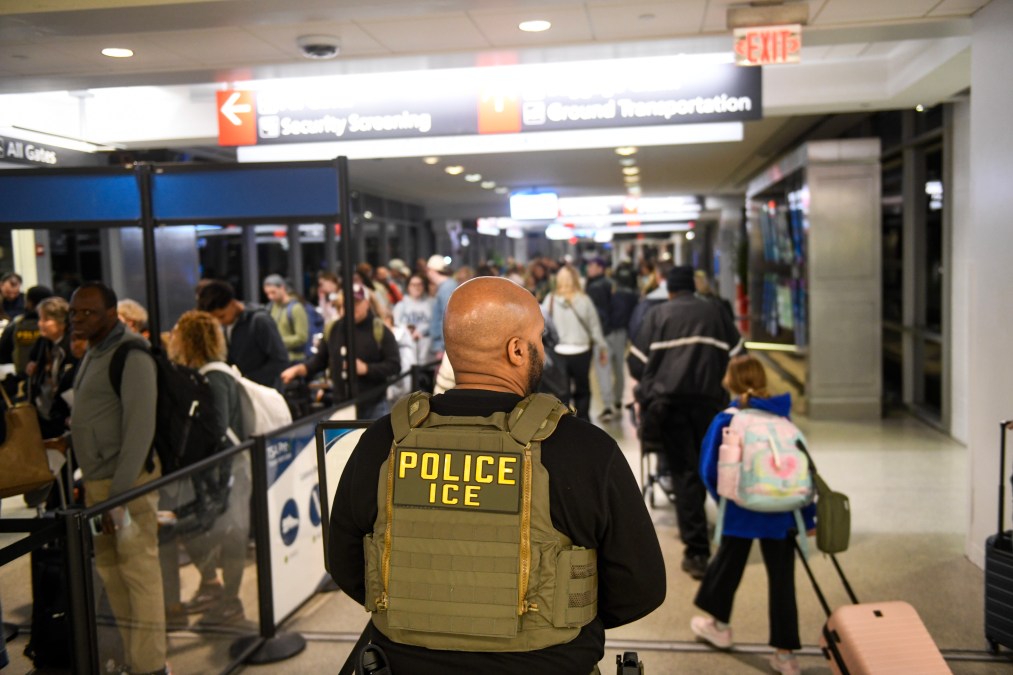
The partnership between the sister agencies has become more public-facing as the partial DHS shutdown marches on. Agents have been deployed to airports across the country with some monitoring lines and others operating TSA’s identity verification systems.
“ICE was not intended to be omnipresent in daily civic life,” Andrew Nietor, member of the American Immigration Lawyers Association, said in a March blog post. “Yet its footprint has expanded from courthouses to neighborhoods, workplaces, and even parking lots, shifting from targeted enforcement to visible, normalized presence.”
“The solution to a funding crisis is not to repurpose an immigration enforcement agency into a stopgap security agency,” Nietor added.