State Department is testing agentic AI to ‘buy back time’ for workers
The State Department is exploring how to use artificial intelligence agents to speed up its work, an agency official said Thursday.
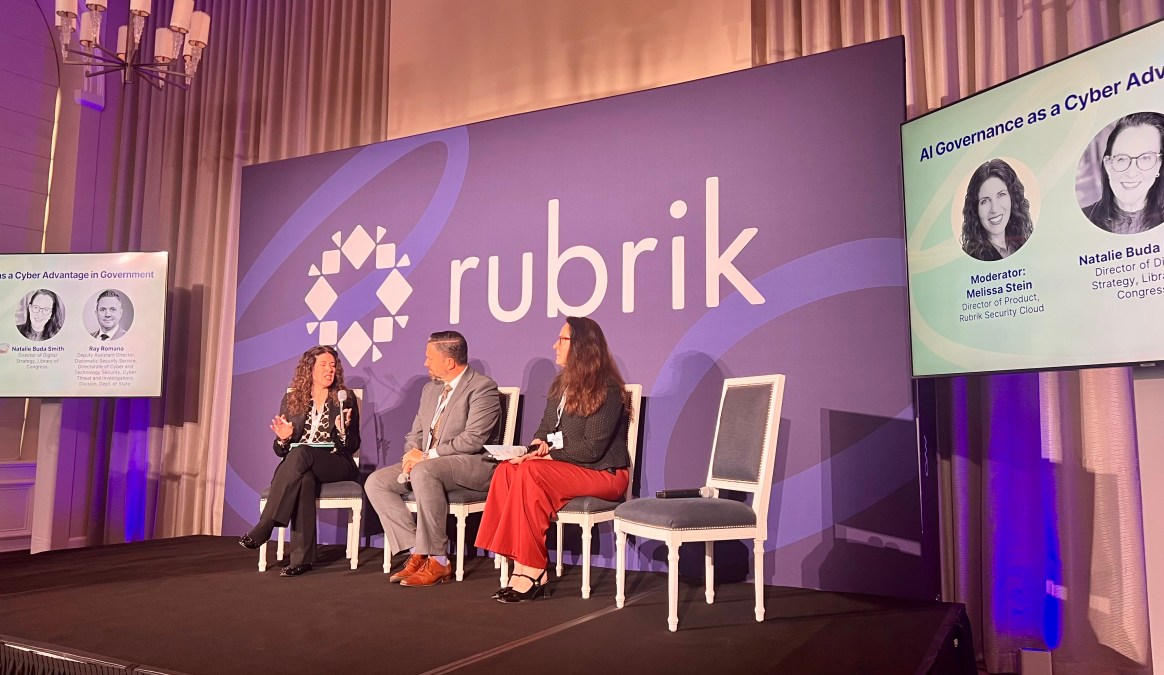
Ray Romano, deputy assistant director of State’s Cyber Threat and Investigations division, said at a FedScoop-produced Rubrik event on federal cyber resilience that the agency is moving forward with its pursuit of agentic AI to sort through malware quickly as the agency’s use case inventory grows.
“It’s one example of what we’re doing to understand that that is going to be the future,” he said.
The State Department has emerged as a leader in federal AI adoption, with several officials recently announcing the rollout of agentic AI, specifically to target high-volume workflows and administrative burdens.
Agentic AI systems are able to create content similar to generative AI, but agents can operate without direction from a human and complete more complex tasks. While Romano said an agentic AI in State’s sandbox environment can sort through malware on a thumb drive in 25 minutes compared to four days by a human, the agency is waiting to integrate the agent into staffers’ workloads.
“We’re training agents to do that analysis right, but we’re not just trusting it. We’re fact-checking it against work that’s already been done,” he said. “I have two outputs of that product. The first is understanding how much time I’m buying back … the other part of that, though, is what is the error rate?”
It’s an all-hands-on-deck situation, and the agency still needs its humans, he added. And it’s more about how to best allocate what resources State has.
“We’re not trying to figure out how to replace anybody,” Romano said. “Nobody’s budget is increasing, nobody’s hiring thousands more people to do this work. What I’m actually trying to do is figure out how we can get these agents to buy back experts’ time.”
But all of this is only possible with strong AI governance and a “culture of adoption,” the official said.
“What you have to show them is that if we do this right, we’re going to be able to be better, faster, more efficient, all of those things, and that we can’t just take the training wheels off and just let it go wild,” Romano said.
The State Department is taking its time building the internal infrastructure and culture for agentic AI, and advised others to do the same.
“Be careful of running towards the next shiny toy and just trying to deliver cool tech — do the hard work first,” Romano said. “Put that governance and security in place, because if we don’t wrap our heads around this disruptive incoming AI, this is going to become our largest vulnerability.”