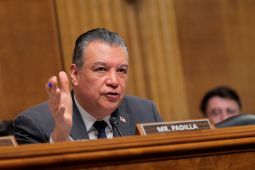
Sen. Alex Padilla, D-Calif., speaks during the Subcommittee on Border Security and Immigration hearing at the U.S. Capitol on Feb. 10, 2026 in Washington, D.C. (Photo by Heather Diehl/Getty Images)
The bipartisan legislation directs agencies to standardize data systems and use cloud-based platforms to digitize federal permitting. A companion bill already passed the House.
President Donald Trump displays a signed executive order during the “Winning the AI Race” summit hosted by All‑In Podcast and Hill & Valley Forum at the Andrew W. Mellon Auditorium on July 23, 2025 in Washington, D.C. Trump signed executive orders related to his Artificial Intelligence Action Plan during the event. (Photo by Chip Somodevilla/Getty Images)
Rep. Dusty Johnson, R-S.D., speaks to a reporter following a House Republican caucus meeting at the U.S. Capitol on Feb. 25, 2025 in Washington, D.C. (Photo by Andrew Harnik/Getty Images)
The bipartisan ePermit Act would create an authorization portal, new data standards, shared software systems and more, with new responsibilities for the CIO Council.
Roughly 65 positions that are part of the new Federal Rotational Cyber Workforce Program are currently open through the Office of Personnel Management.
President Joe Biden walks to sign an executive order after delivering remarks on advancing the safe, secure, and trustworthy development and use of artificial intelligence, in the East Room of the White House in Washington, DC, on October 30, 2023. (Photo by BRENDAN SMIALOWSKI/AFP via Getty Images)
Agency AI use case inventories have so far been “spotty” and “inconsistent” said Lynne Parker, a former Trump and Biden White House official who helped draft the…
Many of the roughly 180 artificial intelligence use cases recently reported by the Department of Energy began development or acquisition between 2017 and 2023.