Warner, Rounds float federal commission to guide AI policymaking
A bipartisan Senate duo is eyeing “practical, bipartisan solutions” to address the economic and workforce effects of artificial intelligence, introducing a bill Wednesday to create a federal commission to deliver recommendations on the issues.
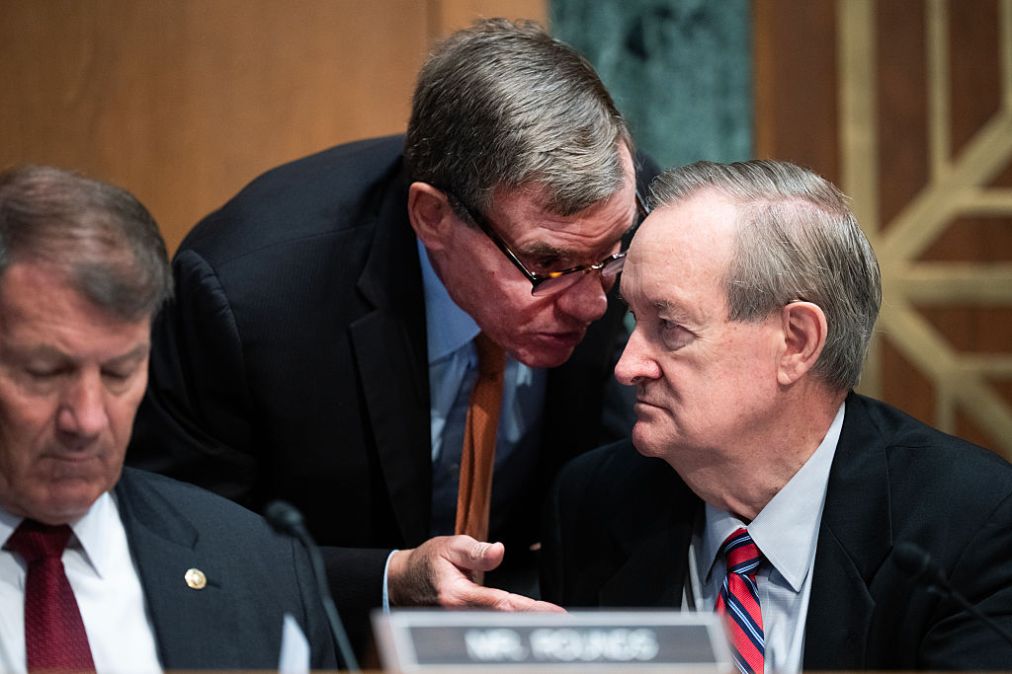
In a press release unveiling the Economy of the Future Commission Act, Sens. Mark Warner, D-Va., and Mike Rounds, R-S.D., said the panel would help U.S. workers “adapt” to the rapid changes brought on by AI through policy.
“The legislation,” the senators continued, “will bring together policymakers and experts from across industries to identify steps Congress can take to strengthen workforce training, support workers as jobs evolve, and ensure the United States remains globally competitive in an AI-driven economy.”
Warner, vice chairman of the Senate Intelligence Committee, said in a statement that there’s no question AI will “transform nearly every sector” of the economy. But whether the country is prepared for those changes remains an open question.
“We need clear-eyed analysis and practical, bipartisan solutions to help workers gain new skills, support people whose jobs are disrupted, and make sure the United States leads the world in the industries of the future,” Warner said. “This legislation is about bringing together the expertise needed to chart that path forward.”
Per the bill text, the commission would comprise 10 members of Congress — three appointed by the Senate majority leader, three by the House speaker, two by the Senate minority leader, and two by the House minority leader.
Those lawmakers would get to appoint other members to the commission, drawn from Senate and House committees, including Homeland Security, Armed Services, Commerce, Finance and others. The commission would also include the deputy Education, deputy Labor, deputy Commerce and deputy Treasury secretaries as nonvoting members.
Members from outside government would be experts in AI technology, education, workforce retraining and taxation. The whole body would be selected within 45 days of the bill’s enactment.
“American dominance in AI is a matter of both economic and national security,” Rounds, co-chair of the Senate AI Caucus, said in a statement. “America’s workforce must be equipped to lead the transformation of the economy happening due to AI. This commission would help keep America ahead of our global competitors and keep America prosperous and innovative.”
The list of “consensus legislative recommendations” the commission aims to target under the bill is lengthy: the development of standards to evaluate AI adoption across the federal government; the merits of open-source vs. open-weight models for industry and government; how best to scale AI manufacturing technologies via public-sector programs; tackling supply chain challenges; spurring collaboration with the private sector on cloud computing-based labs; meeting energy generation, storage and transmission demands due to AI adoption; and many more.
Within seven months of the bill’s enactment, the commission would be expected to publish a report detailing anticipated labor changes from AI, along with resources aimed at educating the public on the technology. Within 13 months, the group would deliver a final report that includes all of its legislative recommendations.
The bill is backed by a host of technology companies (Google, IBM, Workday), trade groups (Information Technology and Innovation Foundation), think tanks (Third Way, Center for Security and Emerging Technology, New America) and academic institutions (Virginia, Virginia Tech, James Madison, George Mason, William & Mary).
“AI is already dramatically reshaping our country’s workforce and economy. Lawmakers have to act before advanced AI puts Americans’ economic security at risk,” Alliance for Secure AI CEO Brendan Steinhauser said in a statement. “The Economy of the Future Commission Act is a smart, bipartisan approach to developing legislative solutions that protect working Americans and their families. This is an important first step to navigating the AI-era economy, and Congress must continue working to guarantee that federal AI policy keeps Americans’ livelihoods at the center.”
The introduction of the bill comes in the wake of the Trump administration’s decision to bar Anthropic from government use following a clash between the AI company and the Pentagon over guardrails preventing the surveillance of Americans and autonomous weapons. That move has spurred legal action and pushback from lawmakers on both sides of the aisle, tech lobbyists and even one of the architects of the White House’s AI Action Plan.
“The question here is pretty simple: should the United States government be able to use policy to destroy a law-abiding American company because it feels like it?” Dean Ball wrote on X on Feb. 28, a day after the president posted about the Anthropic ban. “My answer is no, and yours should be too.”