Labor Department nears launch of AI workforce hub
The Department of Labor aims to unveil its AI workforce hub in “the coming months,” an agency official said Tuesday, providing the public with “empirical evidence” — including never-before-shared private-sector data — on how the emerging technology is affecting the economy.
The concept of a Labor-managed AI workforce hub was first introduced in President Donald Trump’s AI Action Plan last July. The 28-page strategy document called on the DOL to “lead a sustained Federal effort to evaluate the impact of AI on the labor market and the experience of the American worker” via a new online portal.
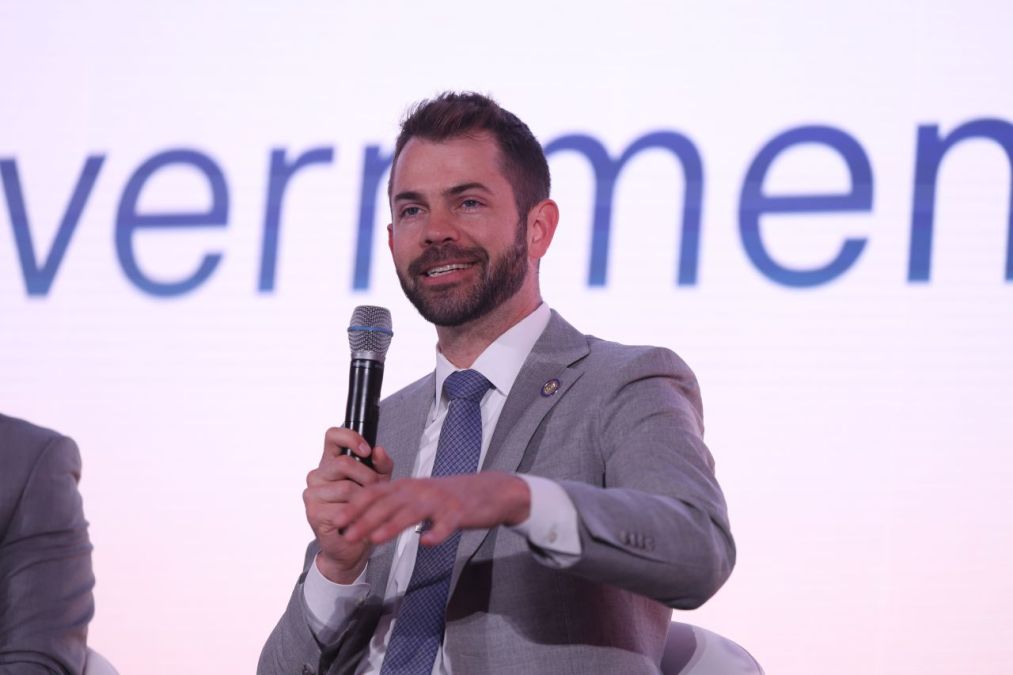
In a sideline conversation at the Scoop News Group-produced Workday Federal Forum in Washington, D.C., DOL Chief Innovation Officer Taylor Stockton told FedScoop that the agency has done a lot of work so far on data collection for the hub.
The AI Action Plan assigns DOL the job of leading a collaborative effort on the hub’s production with the Bureau of Labor Statistics and the Department of Commerce’s Census Bureau and Bureau of Economic Analysis. Recruiting data-rich private-sector partners has also been a top priority, Stockton said.
“There’s incredible data that’s out there in the private sector that really has leading indicators on the changes that are being seen in the economy,” he added. “And I think we’re encouraged, because a lot of these companies have never shared data publicly or at the federal government in this way.”
The AI hub will feature recurring analyses and actionable insights meant to inform workforce and education policy, per the AI Action Plan. It will also conduct scenario planning for “a range of potential AI impact levels,” the document stated.
If all goes as planned with DOL’s one-stop-shop for government and industry data, Stockton believes the end result will be a hub that serves as “the central source of truth for how AI is impacting work.”
“I think part of what we see right now in the societal narrative is there’s a lot of speculation of what AI may do,” he said. “And we think there’s tremendous value in grounding the conversation in the empirical evidence of what we’re actually seeing in the economy when it comes to AI adoption, productivity impacts, increases or decreases in demand for different jobs, [and] different skills.”
Though he couldn’t put a specific date on the hub’s introduction, Stockton said the Labor Department is coordinating “directly” with the White House on the launch and views it as a “super big initiative” for the agency. DOL wants to “make sure that that public launch is as impactful as possible,” he added.
When the workforce hub does make its public debut, it’ll be following a handful of other AI or data-related projects introduced by the Labor Department in recent months. The agency unveiled an open data portal in February that pulls together 42 datasets spanning everything from unemployment insurance claims to county-level childcare prices.
The agency this year has also released an AI literacy framework, teamed with the National Science Foundation on workforce development efforts linked to artificial intelligence, and pledged to integrate AI skills into registered apprenticeships.
“The mandate that we have in DOL,” Stockton said on stage Tuesday, “is to say, ‘how do we make sure that all Americans have the AI literacy skills, the apprenticeships and other job training pathways, the rapid re-skilling programs in place, such that no matter where and how AI transforms all of these different industries and occupations, American workers have the supports and pathways to having more paths to the American dream?’”
Bipartisan groups of lawmakers, meanwhile, have pressed the Trump administration for more information about AI’s impact on the workforce. Others have pushed for federal AI policy to take on a labor-centric approach. Some experts have expressed skepticism that the White House’s AI Action Plan truly follows a worker-first agenda.
Stockton told FedScoop that when it comes to the buildout of the AI workforce hub, labor unions are a “really important stakeholder” that the agency considers in all of its work.
“We believe that all stakeholders need to be at the table, including labor unions,” he said. “We certainly are going to continue to engage them, to make sure that we think about how AI can improve the livelihoods of American workers.”