Senators take another swing at bill to codify federal AI resource
A bipartisan congressional push to codify a National Science Foundation-based artificial intelligence research enabler continued this week with the reintroduction in the Senate of the CREATE AI Act.
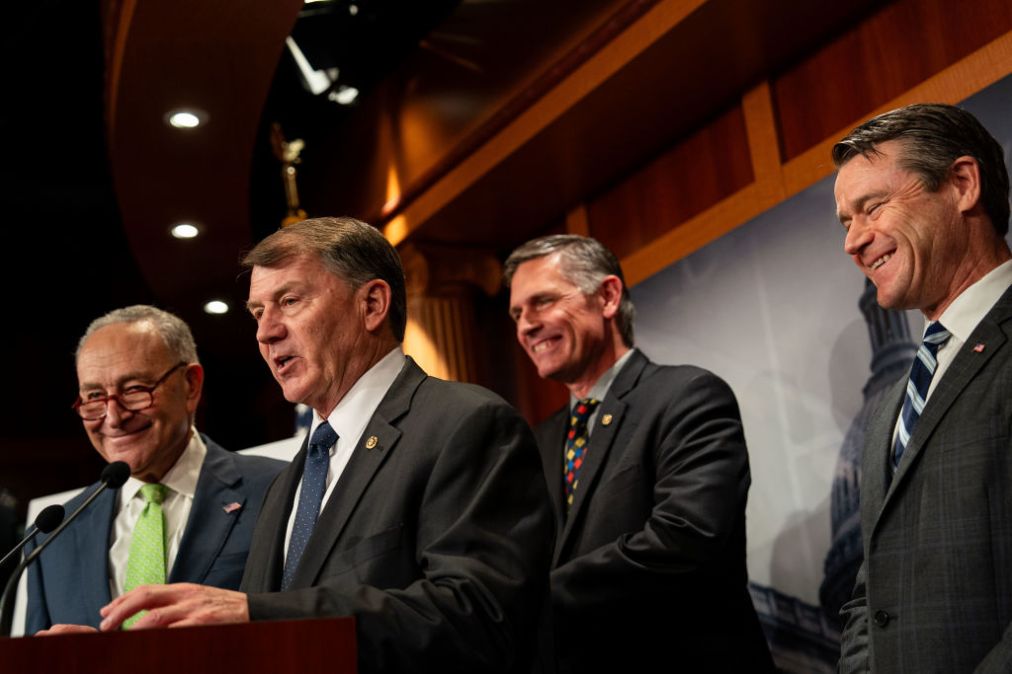
The bill (S.4441) from Sens. Martin Heinrich, D-N.M., Todd Young, R-Ind., Mike Rounds, R-S.D., and Cory Booker, D-N.J., would establish the National Artificial Intelligence Research Resource (NAIRR) that would give AI researchers, educators and students more access to tools, data and other information to help develop new systems.
Heinrich, founder and co-chair of the Senate AI Caucus, said in a press release that the NAIRR would go a long way toward “democratizing access to AI,” ensuring that American workers are prepared for the future and primed to lead “rapid advancements” with the emerging technology that boost the U.S. economy.
“The CREATE AI Act will help us develop and deploy AI responsibly, while also unleashing American innovation by expanding access to the tools needed to conduct cutting-edge research,” Heinrich said.
“But as we push this technology forward,” he added, “we must also take seriously our responsibility to rein in its potential harms — putting the right safeguards in place to ensure AI is used safely, ethically, and in the public interest.”
Young framed the NAIRR in more national security-focused terms, saying in a statement that the resource is essential for keeping the country a global leader in the AI race.
“The United States cannot cede leadership in AI development to China,” Young said. “For both our economic and national security, we must harness AI’s potential and mitigate its risks.
“By establishing the National AI Research Resource in statute, the CREATE AI Act will give incredible access and resources to America’s brightest, allowing for advancements in AI innovation, deployment, and safety for our country and ultimately the world.”
The NAIRR’s origin story dates back to 2023, when a federal task force recommended a pilot version of the resource that was later launched via an executive order from then-President Joe Biden. An NSF spokesman told FedScoop last year that despite President Donald Trump’s move to revoke that EO, the NAIRR pilot was still operational.
A companion bill in the House (H.R.2385) led by Reps. Jay Obernolte, R-Calif., and Don Beyer, D-Va., was introduced nearly a year ago. Heinrich last year led the bill out of the Senate Commerce, Science, and Transportation Committee. The legislation claims a host of influential backers, including the AI Policy Network, the Information Technology Industry Council and the Business Software Alliance.
Despite the concerted push from both sides of the aisle and industry supporters, lawmakers have yet to get the CREATE AI Act across the finish line. If the bill passes and is signed into law, it would establish a NAIRR that offers computational resources including structured access to AI models, curated datasets, an “AI data commons,” education and technical training tools, and AI testbeds paired with a collaborative project with the National Institute of Standards and Technology.
Doing AI research comes with “steep financial costs,” Booker noted in his statement. Passing the CREATE AI Act and codifying the NAIRR would finally give universities, nonprofits and researchers “the tools they need to pursue new breakthroughs.”
The bill also “ensures that the future of AI research isn’t shaped only by a small number of large companies,” the New Jersey Democrat added. “And it helps us build a stronger, more diverse AI research community that’s focused on serving the public good.”