Bipartisan ‘Great American AI Act’ draft proposes new federal AI governance framework
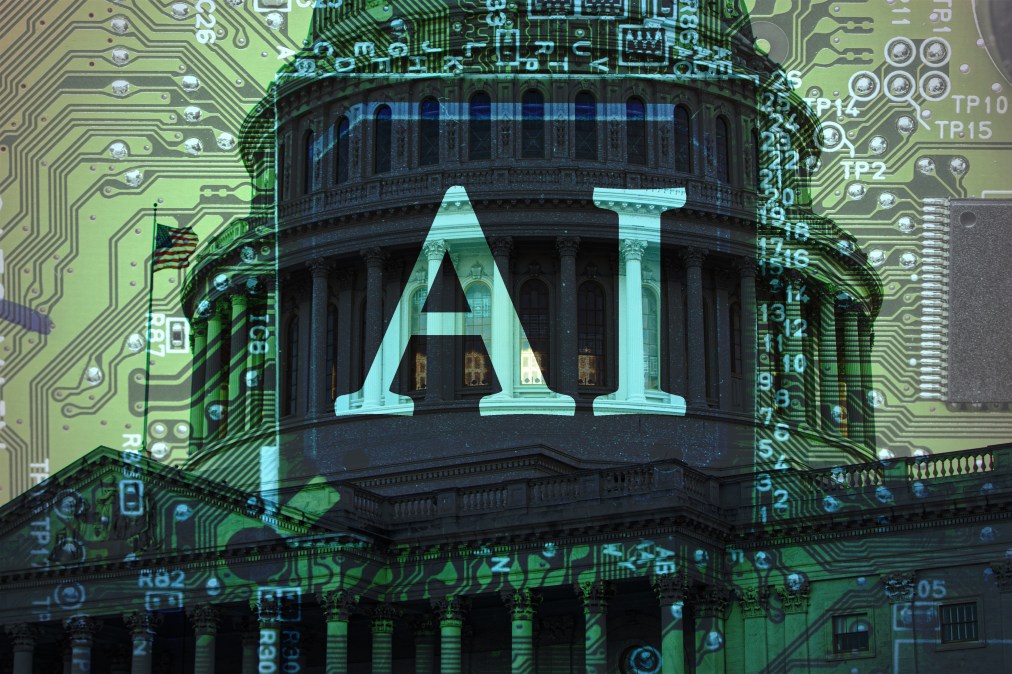
An expansive bipartisan House draft bill issued Thursday would set up a federal framework for artificial intelligence governance, laying groundwork for the codification of a key federal AI standards center and calling for accountability in government AI adoption.
The discussion draft, led by Reps. Lori Trahan, D-Mass., and Jay Obernolte, R-Calif., came two days after the White House issued an artificial intelligence-focused executive order asking for early access to AI models for oversight. The draft is “intended to solicit feedback from stakeholders, experts, and the public before the bill is formally introduced,” the lawmakers said in a release.
“The threats AI poses to our national security, our safety, and our workforce are here and growing by the day,” Trahan said in a statement. “This bipartisan framework is designed to meet the challenges posed by this rapidly advancing technology without smothering American innovation.”
The draft bill would formally codify the Center for AI Standards and Innovation in the Commerce Department, with $100 million per year authorized for fiscal 2027-2029. The center would develop voluntary guidelines, best practices and standards for AI security, as well as evaluate AI systems and monitor AI progress.
Commerce Secretary Howard Lutnick last June rebranded the U.S. AI Safety Institute, launched during the Biden administration, as the Center for AI Standards and Innovation. Despite being established by the executive branch in late 2024, the organization lacks a formal authorization from Congress.
Deemed the “Great American AI Act,” the bill would also require the Government Accountability Office to evaluate federal AI adoption progress, identify federal statutes and regulations that “directly affect AI innovation or unduly burden AI infrastructure (including energy)” and provide legislative and administrative recommendations, according to a bill summary.
“Artificial intelligence is advancing rapidly, which is why Congress must take a thoughtful and bipartisan approach to regulating this critical technology,” Obernolte said.
The bill draft, nearing 270 pages, would also add penalties for using AI to impersonate government officials, require large frontier developers to report critical safety incidents to the government and direct the Census Bureau and Bureau of Labor Statistics to revise federal surveys to incorporate AI use and adoption questions.
A key issue in American AI governance over the last year, the draft also includes provisions that would preempt states from issuing their own laws regulating the development of frontier AI models — though it would allow for states to pass laws of “general applicability” related to AI and regulate models after they’ve been deployed.
The bill would also require the Energy Department, the National Institute of Standards and Technology and the National Science Foundation to establish a testbed program for public and private sector labs and entities to collaborate on evaluating AI systems.
The Energy Department and NIST would additionally jointly lead the nation’s international AI standards development to “form coalitions with like-minded governments to promote private sector-led standards adoption, advocate for U.S.-developed AI standards internationally, counter foreign adversary influence, facilitate cross-border AI R&D collaboration, and share cybersecurity best practices,” a draft summary said, expressly excluding China.
“America should lead the world in artificial intelligence, not regulate ourselves into falling behind China through a patchwork of fifty different state laws,” co-sponsor Rep. Erin Houchin, R-Ind., said in the statement. “That approach would make it harder for American companies to innovate and compete while doing little to improve consumer protections.”
The draft bill would authorize the Cybersecurity and Infrastructure Security Agency to award grants to maintainers of widely used open-source software for security improvements, including those for patching, maintenance and security audits. The GAO would evaluate security protocols protecting AI model weights and the security of the open-source software ecosystem.
NIST and NSF would establish several grants and prizes, including one to broaden participation in AI research, education and workforce development. The National Artificial Intelligence Research Resource, also a product of the Biden administration and housed in NSF, would be formally codified by the legislation to procure and provide data, training and resources for AI development for the public and private sectors.
A discussion draft is a bill that has not yet been formally introduced for congressional action. The sponsors did not indicate when or if the bill would be introduced, but did encourage all to send feedback to GAAIA@mail.house.gov.
“This discussion draft is the product of ongoing bipartisan conversations, which we hope to build upon with input from workers, researchers, stakeholders, and members of the public, all of whom have an interest in getting this right,” Trahan said.