GSA playing catch-up with industry on AI and tech, agency head says
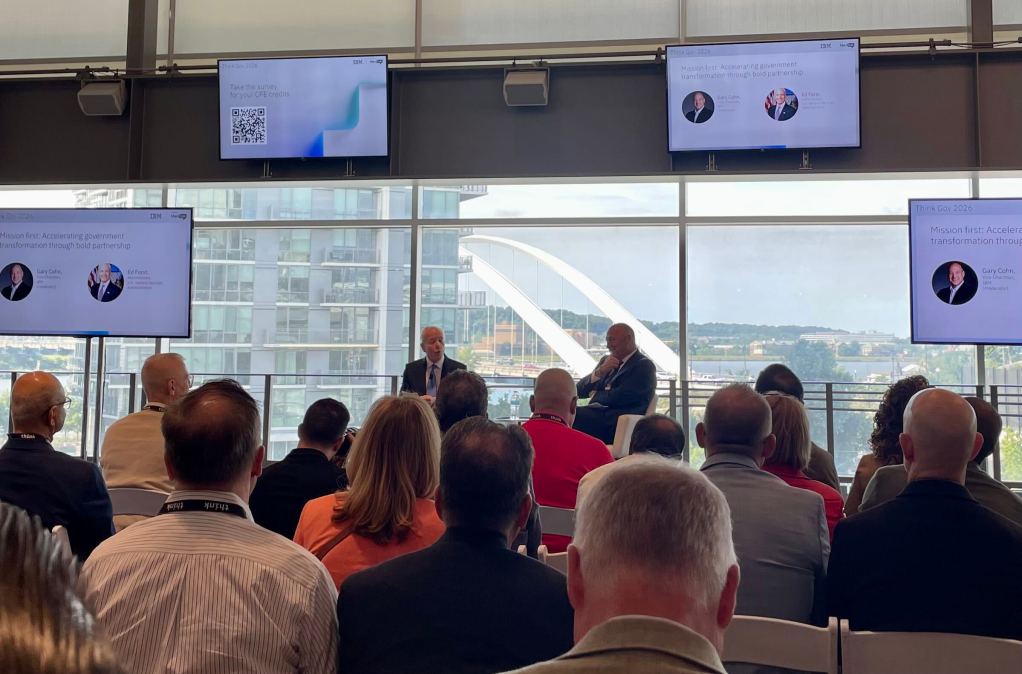
A more centralized government portal and more artificial intelligence deployment are just a couple ways the General Services Administration is slowly but surely trying to bring government services up to industry speed, its top official said Tuesday.
At the IBM Think Gov 2026 conference at Nationals Park in Washington, D.C., GSA Administrator Edward Forst said the name of the government technology modernization game is catch-up, and the play is a bit of “instant gratification” from early wins and measurable goals.
“We have stricken — although not to perfection yet — the word ‘modernization’ from our vocabulary,” he said. “I view it in our context as just catching up to yesterday.”
One goal the agency is working toward is building upon Login.gov to simplify government access, “which is going to be so good for the American citizen to be able to find one way into all the stuff we do,” Forst said.
He said President Donald Trump’s administration is very “outcome-driven” and he needs industry partners to achieve his goals.
“We’re not going to leave our jobs without making a lot more of this happen, where it makes sense,” Forst said of federal procurement. “If we stumble in the early days of doing more of this, it’s going to disable us to get to where they do want us to be.”
Forst said he is “eager for engagement with people to help us do better.”
“I’ve never had more stakeholders in my life since it’s the entire American population, and I’ve never had more bosses than I have right now,” he said. “Every congressman, senator, everybody’s my boss. I have a real boss who sits in the White House, too. You’ve got to engage with them, you’ve got to do a partnership approach, recognizing there’s elements where there are countervailing tendencies, but we’re really trying to measure and get better on that.”
The pressure of getting it right, especially around AI deployment, ricochets down through the agency, said Jennifer Rostami, assistant commissioner of GSA’s Technology Transformation Services.
“As the government, we are responsible to the public to be conservative with what we do; we can’t introduce something that then makes mistakes, and then somebody in the public is suffering because of that,” she said in a session about agentic AI. “That’s not our job.”
Rostami said because of this, government innovation is “inherently a bit slow,” so it has “relied on industry for always injecting innovation” and to “push” them toward AI use.
Despite the slowness, she also said agencies are experimenting with AI. Forst believes GSA is “at the doorstep” with AI.
As an example, Richelle Gibson, deputy director at the Department of Veterans Affairs, said on a panel that the agency is “leaning forward” with AI automation, especially to do repetitive tasks like issuing health benefits faster.
“We make decisions on simple things within hours,” she said. “That’s a massively different experience for veterans.”
But hesitancy in AI adoption among government workers is a barrier, Gibson said, especially with fears around AI replacing workers. Gibson said tuning into the people and understanding their fears builds trust.
“Don’t forget the people,” she said, “even though we’re dealing with technology, because their use of the technology is what determines if it’s successful or not.”
This story was updated June 10, 2026, to correct the misspelling of “modernization.”