National Weather Service taps Accenture, Booz Allen for data system modernization
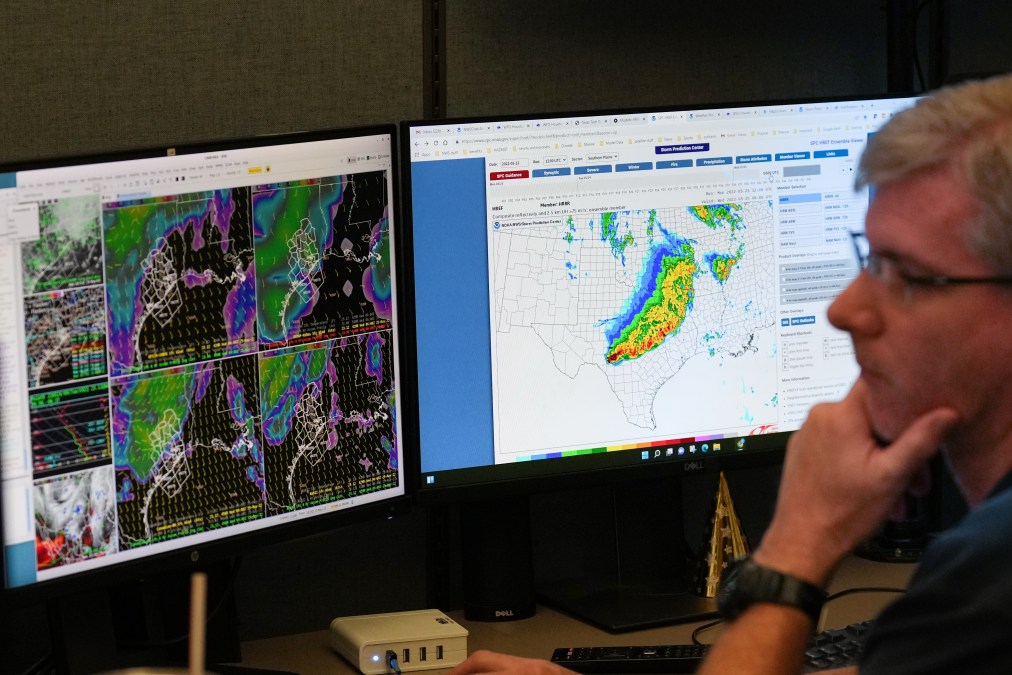
Accenture Federal Services and Booz Allen Hamilton will take the lead on contracts to help the National Weather Service replace a legacy IT system and transition its weather data and resources to cloud-based technology.
The two contracts, announced last week, are aimed at transferring the functions of the Advanced Weather Interactive Processing System (AWIPS) to two new tools in a move the agency says will improve availability of that data to forecasters across the nation.
Among the anticipated benefits: access to the systems away from home offices and ability for forecasters to provide remote backup.
As it stands, the AWIPS is an on-premises system and deployed at roughly 170 sites across the country, per a request for information the agency posted on the modernization effort last year. But that structure has drawbacks, Ken Graham, director of the National Weather Service, told FedScoop via email.
“Our current operational system is physically installed and tied to each NWS office separately, which limits our employees’ ability to easily work alongside decision-makers (e.g., local emergency operational centers),” Graham said.
The two new cloud-based systems will change that, allowing forecasters to conduct their work — including creating and distributing forecasts and warnings — “without being tied to a specific location,” Graham said. Those systems will also “enable forecasters to quickly provide back up and support to other offices across the NWS,” he said.
NWS and the National Oceanic and Atmospheric Administration describe the AWIPS online as the “cornerstone IT system” for ingestion, analysis, and dissemination of weather data as well as warnings that stem from that information.
The tools created under the new contracts will essentially take over those functions.
For one, Accenture Federal Services will create the Hydrometeorological Interactive Virtual Environment (HIVE), which will be the application environment for forecasters to “analyze data, create weather forecasts, and issue warnings.”
Meanwhile, Booz Allen will create a system known as the Central Integrated Real-Time Repository for Unified Services (CIRRUS), which is envisioned as a centralized cloud-based repository for data from NWS and its partners. In its press release, NWS described that system as something that would “allow partners to access more data faster, adding value to a multi-billion dollar private weather enterprise.”
NWS declined to confirm contract details, but based on information posted to SAM.gov, each award appears to be worth roughly $281 million. An award made to Accenture Federal Services covers work related to the AWIPS application environment (Award ID: 1305M226A0004) and a similar award to Booz Allen covers the system’s data environment (Award ID: 1305M226A0005). Both were signed Feb. 13.
The transition to cloud-based tools “is a monumental improvement,” NOAA Administrator Neil Jacobs said in a statement included in NWS’s release.
The new technologies, he said, will improve operations “by eliminating time spent downloading data to desktop workstations, while increasing flexibility through remote laptop accessibility.”
In addition to the improved access and assistance functions, the new systems will also allow forecasters to interface with the system via mobile phone and apply use of AI and machine learning, per the release.
Implementation of the systems will take place in two phases, per the release, with the first finishing in early 2027 and the second in early 2028.
The first phase will create storage and viewing capabilities for weather and water data, and deliver public-facing products. The second will provide the remaining capabilities that will allow AWIPS to be decommissioned.
The two awards come as NWS is attempting to transform its operations.
In its RFI last year, NWS said that over the next zero to five years, it aims to distribute workload across field offices, national centers and teams. That transformation also includes a shift away from a deterministic forecast to one focused on risk-based decisionmaking.
The shift in NWS operations comes as the agency has struggled in recent years with staffing. Last summer, amid the Trump administration’s reduction of the federal workforce and hiring freeze, multiple NWS offices across the country were reportedly experiencing shortages.
Those issues prompted questions from lawmakers on both sides of the aisle, including to Commerce Secretary Howard Lutnick, who oversees NOAA and NWS. In response to questions at a June 2025 hearing about those shortages and whether regional offices would close, Lutnick pointed to plans to modernize technology and allow forecasters to remotely assist other offices.
“The concept is we’ve got to be able to automate ourselves and back each other up,” Lutnick said at the time.