White House sets $75.7B topline IT budget for fiscal 2027

After slashing IT spending across civilian federal agencies last year, the White House’s fiscal 2027 budget calls for a return to pre-Trump levels and then some.
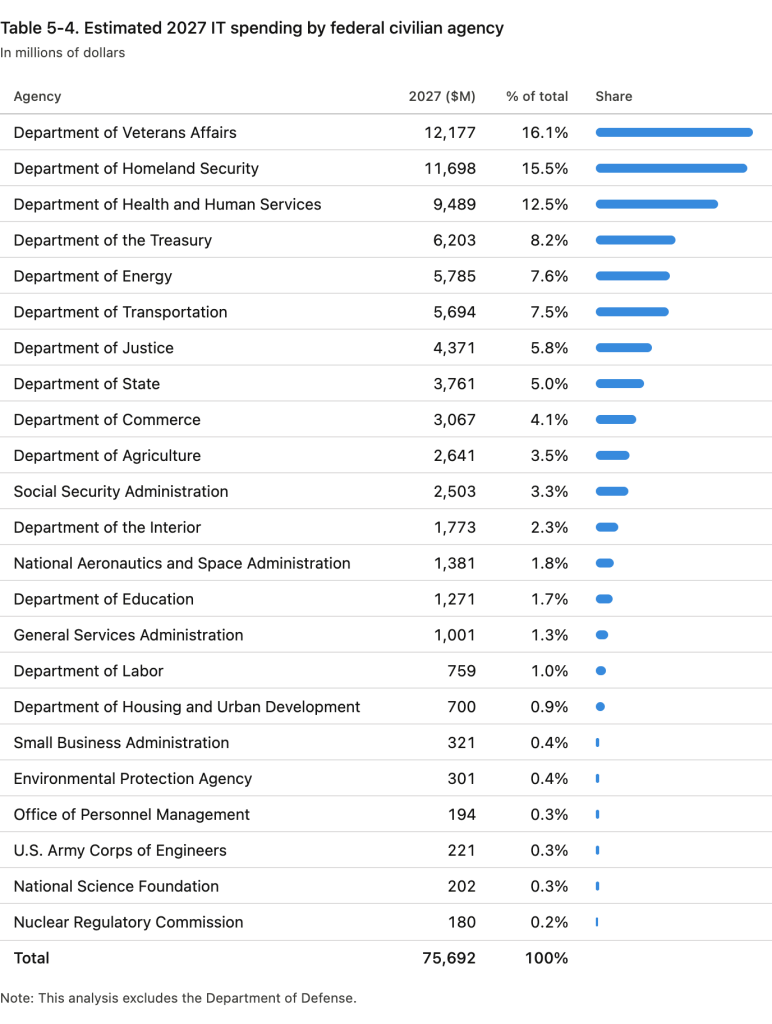
Though the proposal from President Donald Trump is just a starting point for haggling in Congress over what will ultimately be spent, the summary document released Friday projects $75.7 billion in federal civilian IT spending, up from $67.9 billion in fiscal 2026 and $75.1 in fiscal 2025. It doesn’t include the Department of Defense’s IT budget request, which in fiscal 2026 was a whopping $66.1 billion on its own.
Despite the upward trend for overall spending on tech, OMB’s budget request calls for a small decrease in funding for cybersecurity across all civilian agencies — falling from about $12.5 billion this year to $12.2 billion for 2027. This trend tracks with the Trump administration’s decision to cut the Cybersecurity and Infrastructure Security Agency’s budget by $707 million.
The largest IT investments are slated for the Department of Veterans Affairs ($12.2 billion), the Department of Homeland Security ($11.7 billion) and the Department of Health and Human Services ($9.5 billion). Each of those spends represents at least a 12.5% share of that agency’s overall budget.
The VA is the beneficiary of an additional funding infusion for its Electronic Health Record Modernization, to the tune of $4.2 billion — an increase of $800 million year over year. The much–beleaguered EHRM initiative received a big boost in Trump’s fiscal 2026 budget request as well — and the summary document takes a shot at the “stalled” effort under the Biden administration.
“VA’s EHRM modernization program is moving the Department from a decades-old legacy system to a modern system that is interoperable with [the Department of Defense] and other Federal partners, as well as participating community care providers, allowing veterans to receive care at any provider knowing that their clinicians would be able to easily access their full medical history,” the document states. “The EHRM program, when fully implemented, would improve the transition from servicemember to veteran and would enable closer VA-[DOD] collaboration, which is a priority for the Administration.”
DHS’s tech shop is also a major winner in the new budget proposal, including: the procurement of advanced border security technology as part of a $190 billion investment for the agency through the so-called Working Families Tax Cut; $136 million to Customs and Border Protection for its Automated Commercial Environment (ACE) technology plus $322 million for counter-drug tech and operations; and $1.2 billion for protective technology and enhanced protective operations at the U.S. Secret Service.
CISA isn’t the only agency that comes in for substantial funding cuts. The White House’s proposal once again seeks to gut work at the National Institute of Standards and Technology. A $993 million cut targets a host of Trump hobby horses: namely diversity, equity and inclusion initiatives and programs that “advance a radical climate agenda.”
Previous proposed cuts to NIST have been largely ignored by congressional appropriators. In January, Senate and House lawmakers essentially rejected cuts to the standards agency, the National Science Foundation, the National Oceanic and Atmospheric Administration, and NASA in a package of appropriations bills.
The IRS also comes in for more budget reductions while touting the shutdown of Direct File and a 27% reduction in agency staff. The proposal seeks another $1.4 billion in cuts for fiscal 2027, pledging to “streamline IRS operations utilizing technology improvements to help focus the IRS on providing high-quality customer service while ensuring the tax laws are fairly administered.”
Though IRS leaders have repeatedly pointed to artificial intelligence as a means to keep the agency on track amid the evisceration of the workforce, the budget makes no mention of the emerging technology at the Treasury Department component.
AI is mentioned a handful of times throughout the document, with nods to the White House’s AI Action Plan. The Department of Energy, for example, gets a $1.2 billion “commitment” to AI and “the ways it can improve energy systems and outcomes across the DOE enterprise.”
There’s also a mention of AI tools and machine learning to help streamline the Food and Drug Administration’s “regulatory capability” and to “develop alternatives to animal testing.” And the Veterans Benefits Administration would receive $130 million for automation and AI investments to modernize claims processing.
“These tools limit the costly practice of relying on surge staffing and extra labor costs while using taxpayer dollars more efficiently,” the proposal states. “The result—faster decisions for veterans delivered with greater accuracy.”