NRC uses more AI than its inventory suggests
The Nuclear Regulatory Commission is accelerating AI adoption within the agency, but it’s taking “small steps” to get there, according to a senior IT official.
“We felt like if we went too fast on our adoption … it would actually set us back,” Chief Data Officer Basia Sall told FedScoop on the sidelines of an AI symposium held at the agency’s headquarters Thursday.
The agency has taken a “metered” approach to AI, focusing on the data foundation and ensuring use case pursuits align with its mission. But even so, Sall said, the NRC isn’t falling behind its peers.
“We meet with other agencies, and we’re about at the same level of adoption,” Sall said.
The public got a peek behind the curtain on federal agencies’ AI efforts earlier this year as organizations began releasing their 2025 AI inventories. The exact number of use cases varied from agency to agency, but many listed hundreds. The Department of Health and Human Services had nearly 450 AI use cases, Homeland Security recorded more than 200 entrants, and the Justice Department logged 315.
NRC’s AI inventory comprised four line items.
“We have a lot of different use cases, but we rolled them up,” Sall said of NRC’s inventory. “We kept them at a very high level. Most of them are still at a pilot stage.”
The agency is readying teams to move some of those pilots forward. Sall said NRC is looking at a broader rollout of AI capabilities via Microsoft 365. The regulator has also been testing different models from OpenAI and Google to measure performance in a variety of environments.
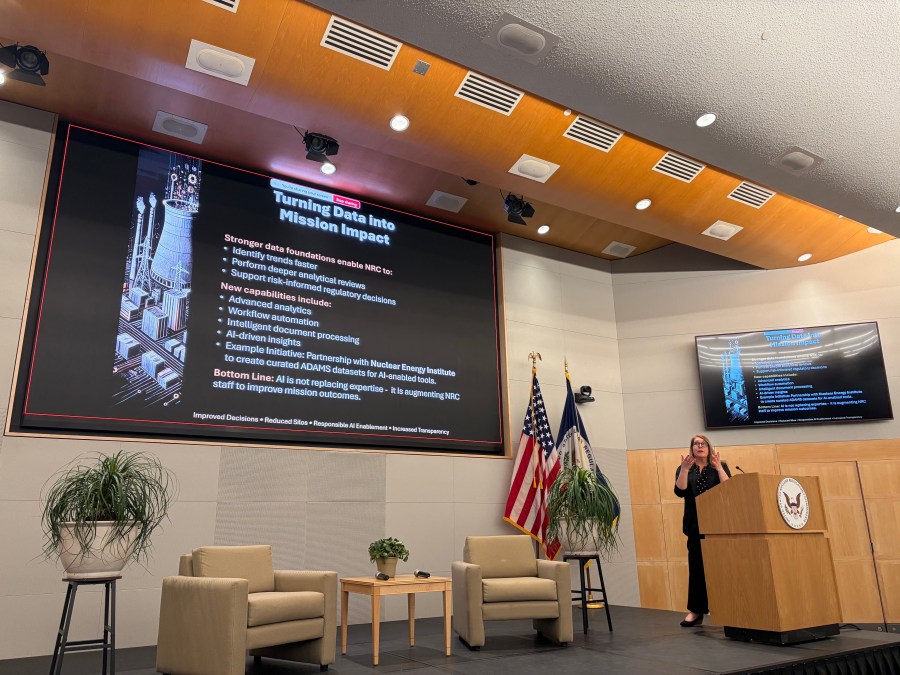
“We’re doing it all with public data,” Sall said of the testing, during a presentation at the event. “We are finding variables that will help inform us as we move forward into a more permanent solution.”
Looking toward the future, Sall hopes AI will reduce the number of dashboards floating around, bringing workers closer to the insights they’re looking for.
The NRC has a monthly meeting to check-in and assess projects and potential use cases. Just like with any experiment, some pilots won’t pan out, according to Sall.
“We’re OK with that,” she said. “We learn from every one.”
The agency’s inaugural generative AI use case — and one of the two AI use cases that are listed as deployed in the inventory — is its internal chatbot, SimplifAI.
For a user, the tool is really simple, according to Nicholas Buggs, chief enterprise architect within the NRC’s Office of the Chief Information Officer. An employee goes to an internal website, enters a query and gets a response, similar to commercial generative AI offerings.
“When you enter a prompt, if you do it effectively, you have to use the tenets of prompt engineering,” Buggs told FedScoop. “What we did was we built that context into the tool itself, so you, as a user in NRC, don’t have to keep doing it.”
The built-in context includes the mission of the NRC, principles of good regulation and other relevant information. Rather than pulling from the web, SimplifAI answers queries using NRC documents. The tool is powered by an OpenAI model and launched in August 2025.
“We’ll continue to iterate on it and we’ve tweaked it” since the launch, Buggs said. “We’re constantly getting feedback from users. As we learn, we get better.”
The tool is meant to be a productivity enhancer, not a replacement for subject matter experts.
Users “are the ones who are really going to create that efficiency,” Buggs said. “They’re going to take their institutional knowledge, and they’re going to embed that in the way that they use SimplifAI.”
“This isn’t something that we are forcing on anyone,” he added.