New AI-powered surveillance towers are coming to the southern border
Customs and Border Protection is moving forward on AI-powered autonomous surveillance towers that are expected to be deployed across the southern border, signing a $71 million task order with GDIT last week.
The award is the latest in a massive indefinite delivery/indefinite quantity contract, worth up to $1.8 billion, that kicked off three years ago and is aimed at modernizing and expanding CBP’s surveillance tower system.
GDIT is a business unit of aerospace and defense company General Dynamics, which generated more than $52 billion in revenue last year. The vendor is a key player in CBP’s modernization plans as the prime contractor on a remote video surveillance program, the developer of a CBP database with quantum sensors and a fundamental part of a number of other projects including the smart border wall.
“We started working on this next-generation autonomous tower about three years ago,” Michael Wagner, VP of biometrics, border and transportation security at GDIT, told FedScoop. “We’ve gone through several iterations of solutioning and testing and validating out in the field.”
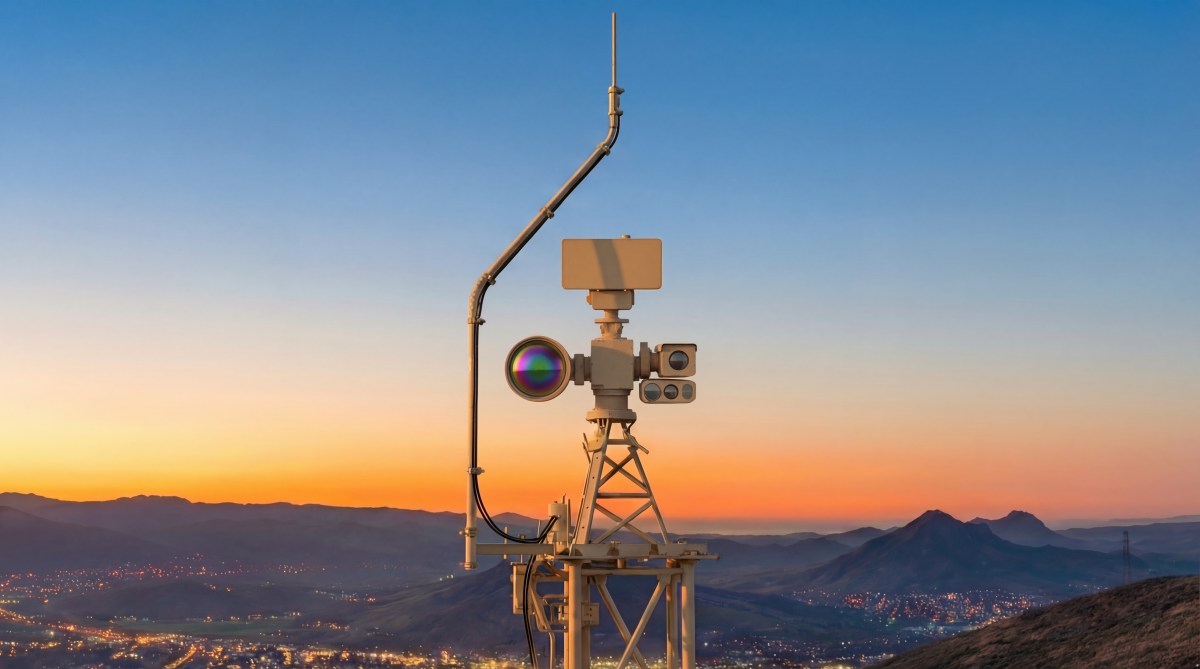
The surveillance towers come in two sizes: 80 feet or 120 feet. In testing scenarios, the towers can detect, track and identify objects up to eight miles away, according to Wagner, though the range varies depending on the deployment site and surrounding terrain.
Built for off-the-grid locations, the towers feature solar panels and batteries, with propane generators as emergency back-up. Edge computing also enables deployment in remote areas without sacrificing speed or function, Wagner said.
GDIT is looking to incorporate counter-UAS capabilities in the future amid the rise of drone threats at the border. But for now, the towers are focused on the ground.
“It’s looking at, is someone coming across the fence, is there something moving out there,” Wagner said. “It’s not pointed up to do counter-UAS but that’s something that we are internally exploring and working towards in our technology roadmap.”
The towers are equipped with several cameras and sensors that can track hundreds of targets simultaneously. Thermal infrared imaging helps the system better determine items of interest in darkness or low visibility, and laser rangefinding improves distance assessment and identification accuracy.
AI powers the classification capabilities, distinguishing between a car, person, animal or other object. Over time and with help from human operators, the goal is for the system to be able to determine whether a person is carrying a weapon or large backpack, according to Wagner.
Another layer of AI connects several towers together into one operating picture for those back in command and control centers.
“There are logistical challenges in getting these items procured and built,” Wagner said. “There’s a lot of chips on these tower solutions.”
In April, CBP Commissioner Rodney Scott told lawmakers during a hearing that the challenge was not signing a contract, but making sure vendors could overcome supply chain constraints.
“The industry has grappled with supply chain issues and logistical challenges in the past three to six months,” Wagner said. “A lot of that [is] driven by the AI boom and the shortage of chips.”
This story was updated June 10, 2026, to correct information provided by GDIT regarding back-up fuel sources for the towers.