ICE plans for robodogs met with concern by privacy experts
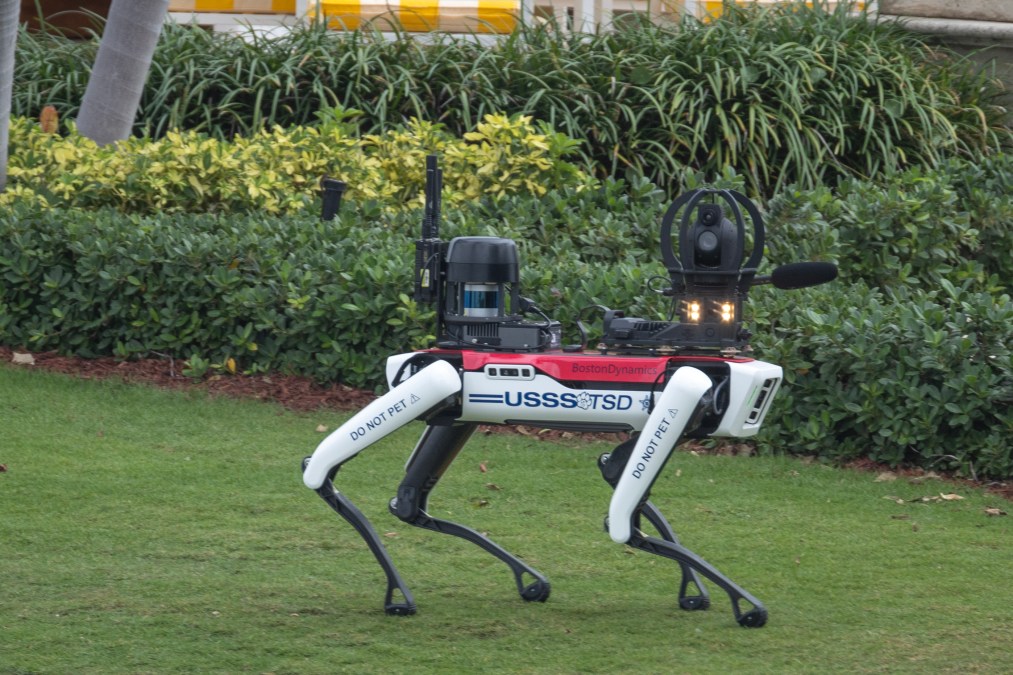
Immigration and Customs Enforcement intends to deploy four-legged robots, but advocacy groups warn of misuse.
“The last thing ICE needs is a camera-equipped canine that can open doors,” Will Owen, communications director at the Surveillance Technology Oversight Project, said in a Friday statement. “The Trump administration has given ICE an unprecedented slush fund for new spyware, terrorizing immigrant communities, protesters, and observers. Congress must step in and put ICE’s spending on a leash.”
When ICE published its acquisition planning document last month, the expected investment dominated headlines. The Department of Homeland Security unit said it intends to spend between $1-$2 million on Boston Dynamics’ Spot robots as a way to boost situational awareness and hazard assessment.
“This capability helps improve officer safety, supports informed operational decision-making, and enhances DHS’s ability to respond to incidents involving dangerous, confined, unstable, or difficult-to-access areas,” DHS said in the document. When reached for comment, an ICE spokesperson reiterated the safety goal, saying that the robots would provide “an additional tool to safely assess potentially dangerous situations before placing personnel or the public at risk.”
In a sources sought notice posted earlier this week, the agency said it was conducting market research about “quadruped unmanned ground vehicle[s].” Details about how exactly ICE plans to use the robotics capabilities are scant, though the ICE spokesperson said the technology would not replace law enforcement officers or their judgement.
“ICE is constantly assessing the needs of our officers in the field to ensure they have the tools and equipment necessary to safely arrest and remove criminal illegal aliens from our country,” the ICE spokesperson said. “Every decision is made with careful consideration and appropriately reviewed to ensure that any technology ICE utilizes is consistent with all applicable law enforcement policies and standard [sic].”
A Boston Dynamics spokesperson said the robots are typically used to “keep people out of harm’s way and aid first responders in assessing dangerous situations.”
“Specific Spot applications typically include things like hazardous gas detection, unexploded ordnance inspection, suspicious package investigation, search and rescue, subterranean or confined space exploration, and structural assessments following fires, disaster events, and other hazards,” the Boston Dynamics spokesperson said in an email. “Additionally we want to point out that any attempted weaponization of Boston Dynamics’ robots is strictly prohibited, as clearly outlined in our Terms and Conditions, our ethical principles, as well as in an open letter against weaponization, which was spearheaded by Boston Dynamics and co-signed by 5 other leading robotics companies.”
Some experts question whether the safeguards to prevent misuse are strong enough.
“In a live scenario — ICE agents using Boston Dynamics robot-dogs to corral or kettle migrants they’re chasing, for example — the practical checks are: whoever is operating the robot (an ICE agent with the controller), the network configuration the government chose, and after-the-fact accountability (litigation, oversight, public pressure) — not a vendor override,” said Patrick Eddington, senior fellow in homeland security and civil liberties at the Cato Institute.
“Which means,” he continued, “the reassurance value of ‘Boston Dynamics prohibits misuse’ collapses almost entirely at the moment of an actual field abuse: the contract is a purchasing-relationship instrument, and the migrants in the hypothetical would be relying on the ICE operator’s restraint and downstream legal accountability, not on anything Boston Dynamics could do in that window.”
Privacy advocates also raised questions about data storage and retention windows, as well as whether facial recognition technology would be used.
“We need some real transparency here,” said Abigail Kunkler, law fellow at the Electronic Privacy Information Center. “ICE needs to explain exactly how these machines will work without violating our rights and liberties.”
The robot dogs have found an emerging role in law enforcement.
Four of the four-legged vehicles were deployed during the World Cup games at the International Broadcast Center in Dallas and the New York-New Jersey stadium for asset protection and identification of physical security threats.
FIFA implemented the technology in partnership with Hyundai Motor. For the World Cup deployment, Boston Dynamics said the robot dogs did not have facial recognition capabilities.
The robots have also been acquired by the Department of Defense, NASA and the National Institute of Standards and Technology, per procurement documents.