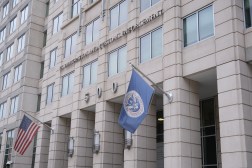
ICE awards contested, controversial surveillance contract to Thomson Reuters

Immigration and Customs Enforcement is just days away from starting work on a $125 million contract with Thomson Reuters Special Services that will enable it to monitor 1 million individuals and identify potentially criminal and fraudulent behavior before it happens.
It’s a goal the Department of Homeland Security has been working toward since at least six years ago, per documents obtained by Democracy Forward as part of a public records request. The contract documents, shared exclusively with FedScoop, outline an agreement between DHS and national security and defense tech company CACI that ran from September 2020 to March 2025.
With around $106 million obligated over the course of the contract, CACI provided ICE and its Homeland Security Investigations team with a “continuous monitoring and alert service” that supplied real-time data from “various” and “available” sources, including the “deep web,” according to the contract. The system was required to be able to keep tabs on 1 million individuals, enabling ICE and HSI to “proactively scrutinize known or suspected crime.”
ICE also wanted the information it gathered to be shareable with partners, including those outside of the U.S., in order to “expand the resource equities within the various law enforcement agencies and intelligence communities.”
While it’s unclear how far back these broad surveillance efforts date, the contract documents offer insight into one of the building blocks of DHS’s current surveillance apparatus.
“The federal government has worked with private technology companies for a long time to build sophisticated surveillance systems,” said Daniel McGrath, special counsel for oversight at Democracy Forward. “The Trump administration is now weaponizing these systems to intimidate immigrants, silence protestors, and interfere in elections.”
The contract
DHS began market research last year to see what private-sector tech firms had to offer as time was running out on its deal with CACI, FedScoop previously reported.
In documents posted at the time, ICE reemphasized its goal to deploy a service that could continuously monitor 1 million people and conduct data analysis for the purpose of “identifying potentially criminal and fraudulent behavior before crime and fraud can materialize.”
While most of the information provided in procurement postings last year mirrored the 2020 CACI contract, there were some differences.
The request for information provided more concrete examples of the data ICE was looking to gather compared to the redacted contract documents obtained via the records request. ICE pointed to the potential contractor’s proprietary data, court records, social media posts, international travel data, geolocation information, property records and supply chain information, among others.
The DHS unit received more than 50 industry responses to its inquiry but subsequent changes were made to the requirements, leaving only Thomson Reuters in the mix, Biometric Update reported. Despite initially announcing a sole-source procurement of Thomson Reuters services in July, ICE reversed its plans in August “in response to industry feedback,” per a Sam.gov posting. The feedback was not made publicly available.
ICE then republished an acquisition planning forecast document for the contract. In the procurement posting last week that identified Thomson Reuters as the awardee, ICE said it received just one offer.
“The economy may not be great in general right now, but surveillance is booming with the Trump administration’s unprecedented spending on spyware since the so-called One Big Beautiful Bill,” said William Owen, communications director at the Surveillance Technology Oversight Project. “This has led to a surge in spyware firms looking to cash in on the erosion of our civil rights and privacy.”
“ICE and the Trump administration are certainly interested in a lot of these new emerging technologies and firms — yet they still will often fall back on some of their long-term, tried and true partners, like Thomson Reuters,” he added.
Out of all its business with the federal government, DHS and ICE are the vendor’s highest-paying customers, spending $71.7 million total and $61.1 million from just the one component, per USASpending records.
When reached for comment on potential transparency, accountability and governance mechanisms used to prevent misuse or abuse, a DHS spokesperson said: “We will not comment on law enforcement sensitive methods.”
Predictive policing and other concerns
Privacy and civil liberties advocates told FedScoop that a system as massive as the one DHS is going to be working on with Thomson Reuters sounds a number of alarm bells.
One concern raised by experts is around the predictive element of DHS’s goals for the system.
“What most of the available research tells us is that you can’t anywhere near consistently predict who is going to turn into a criminal,” said Patrick Eddington, senior fellow in homeland security and civil liberties at the Cato Institute. “And any kind of software or AI that essentially encourages the fictitious belief that you can do that is a prescription for constitutional rights violations at scale — I don’t think there’s any doubt about that.”
Technology systems produce outputs based on biases in their training data that could lead to overpolicing of one group or other negative outcomes.
ICE recently retired a high-impact AI use case that was used to predict whether noncitizens would try to evade detection. The outcome helped to inform whether individuals could remain in their communities while cases are processed instead of being held in an immigration facility. While it’s unclear why ICE scrapped the use case, sources previously told FedScoop the move indicated the tool likely didn’t help in the way they thought it would.
Other instances of AI have shown the technology’s limitations, too.
“AI-driven tools to monitor social media, for example, are highly inaccurate and racially biased in how they flag certain language,” Owen said.
Sources said the sheer quantity of individuals that ICE was looking to track combined with the potential for misuse underlined the need for congressional oversight.
“A lot of stuff can fly below the radar, especially when you’re in an election cycle … but this is the kind of thing that should absolutely be a top three issue,” Eddington said, pointing to potential Fourth Amendment concerns tied to warrantless data purchases.
Jake Laperruque, deputy director of the Center for Democracy and Technology’s Security and Surveillance Project, echoed the need for greater congressional oversight of large-scale data-gathering operations.
“It’s a critically important lesson that genuine safeguards can’t come from just trusting the people currently in charge or internal agency protocols,” Laperruque said. “When it comes to DHS surveillance and enforcement powers, lawmakers have given them a bulldozer and simply trusted it will always be someone safe behind the wheel.”
Some of the concerns Laperruque identified included weaponization of surveillance systems against critics of the administration and more individualized instances of abuse, such as reports surrounding Flock cameras.
The automated license plate readers have been the subject of controversy, as several law enforcement officers have used the technology to spy, stalk or harass current or past romantic interests, StateScoop previously reported.
“We want a system of checks and balances … and that the government has to actually clear some hurdles when it wants to collect and use sensitive information about Americans,” Laperruque said. “There’s a lot of skepticism and concern about how much these oversight entities have been hollowed out and much less able to actually act as a canary in the coal mine.”
DHS, in particular, has shown signs of lagging transparency and accountability measures at a time when spending on surveillance and data analysis tools has only increased.
“This is one part of the surveillance and intelligence wing that ICE is building,” said Cooper Quintin, senior staff technologist at the Electronic Frontier Foundation. “It’s a big part of it, but it’s still just one part. It’s good for us to think about what ICE is building holistically.”
“It’s going to feed in and be indexed alongside all this other surveillance equipment and pipelines,” Quintin said.