Inside the bipartisan backlash to the $27 billion VA-Oracle EHRM contract blindsiding Congress

On its fourth attempt in two decades, with billions of dollars spent and at least 50 congressional meetings held across three administrations, the Department of Veterans Affairs still has not completed the rollout of its electronic health record modernization — and it just added more time and money to the project.
Despite recent victories touted by Secretary Doug Collins and Deputy Secretary Paul Lawrence, nobody outside the VA and its contractor, Oracle Health, can say how the update is truly going. Watchdogs and lawmakers continue to express concern about cost and oversight of the project to bring millions of veterans’ health records into the modern age.
VA first struck a $10 billion contract with digital health developer Cerner in 2018, a company acquired by Oracle in 2022, before pausing all work in 2023 following a rocky rollout to renegotiate the contract. Now, what was once stop-and-go is full speed ahead as the VA works toward fully modernizing the EHR by 2031, with 19 sites completed by the end of this year — and a ballooning new price tag.
(View interactive timeline here.)
Last month, the multi-year contract increased its ceiling to $27 billion without widespread knowledge in Congress — the body that funds the project — and the VA has not provided insight into how negotiations reached this point.
Oracle co-CEO Mike Sicilia told the Senate Veterans’ Affairs Committee in a 2022 statement that the company would absorb any “performance or workflow” issue costs above the original $10 billion ceiling.
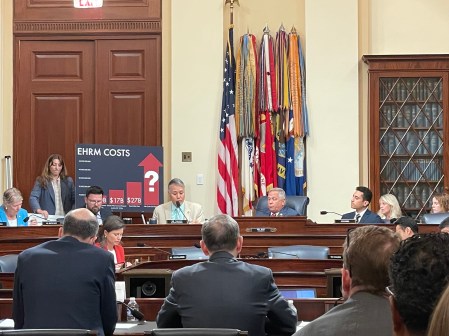
“If I had my druthers, you would sever this contract with Oracle because that person lied to us,” Rep. Derrick Van Orden, R-Wis., told Lawrence at a recent House Veterans’ Affairs Committee hearing, saying the $17 billion increase is “corruption.”
In a rare showing of bipartisanship, members across the aisle responded to the “blank check” for Oracle with frustration and a unanimous subpoena to the company.
“Enough, enough, I’m saying enough,” Rep. Morgan Luttrell, R-Texas, told FedScoop. “We’re not doing this anymore because we have to answer to our veterans, and I’m a veteran.”
While Sicilia and Oracle Executive Chairman Larry Ellison won’t testify until November and December respectively, there is still $3.4 billion in fiscal 2027 funding that hangs in the balance.
The VA presses on with modernization aided by at least another $526.4 million spent on other contractors, with more opportunities seemingly every day. According to Lawrence, the VA’s internal estimate for full deployment through 2031 is about $37 billion, plus about $11 billion for sustainment, or roughly $48 billion total.
(View the interactive spending table here.)
Fiscal 2027 ushers in the $27 billion surprise
This year alone, there have been at least 68 opportunities posted on SAM-dot-gov related to EHRM, about a third of which have already been awarded. Almost all of the opportunities fall under the North American Industry Classification System codes for building construction and electrical wiring.
In July, VA spokesperson Quinn Slaven told FedScoop that the agency anticipates about $400 million in additional EHRM-related construction through fiscal 2026 “and is on track to complete all necessary renovations.”
“Renovation needs related to EHRM vary by facility, but typical construction work includes electrical upgrades, improvements to HVAC, new horizontal data and communications cabling, and physical space for telecommunications and data center hardware,” he said.
At about half a billion dollars, construction costs since 2017 add only a little over 5% to the $10 billion VA-Oracle contract and nearly 2% to the new $27 billion contract ceiling.
(View the interactive solicitations table here.)
“Due to unanticipated complexities in deploying this system, extensive site-specific customizations, as well as the other factors … VA has reached the current contract ceiling sooner than originally planned,” contracting documents said. “VA anticipates using the remaining ceiling by the first quarter of fiscal year 2027 and thus requires an increase.”
While the new ceiling is, according to the documents, “based on historical work executed to date, the standard deployment model, and all other requirements necessary to deploy and sustain the EHR under the approved accelerated deployment schedule, which is required to meet VA requirements and Veteran’s needs,” lawmakers are stunned at the number.
“This has been the biggest boondoggle I’ve ever seen,” said House Veterans’ Affairs Committee Chairman Rep. Mike Bost, R-Ill.
A spokesperson for the committee told FedScoop that they have not yet received all the information on the contract extension, saying cost and financial transparency “remain the Committee’s biggest concerns,” as “Congress needs confidence that the current plan is realistic and adequately funded.”
“If the deployment schedule or other assumptions change, VA should explain the cost implications early and transparently rather than coming back to Congress after the fact with a bigger price tag,” they said.
Despite the surprise 170% contract ceiling increase — or perhaps because of it — Republicans still stand in support of the $3.4 billion set for EHRM in the House-passed fiscal 2027 Military Construction and Veterans Affairs Appropriations bill.
“The Chairman’s focus is making sure VA can demonstrate that the program is adequately funded to complete deployment through 2031 and that Congress is not repeatedly asked to increase the price tag as the program moves forward,” the committee spokesperson said.
Collins told the Senate Veterans’ Affairs Committee in May that the agency needs EHRM “fully funded going forward.”
“There’s no going back on the EHRM,” he said. “We’re beyond that point, so it’s got to be done.”
Democrats like Rep. Nikki Budzinski, D-Ill., aren’t as sure.
“We do need to reconsider what the funding priorities are,” she said. “We need to evaluate whether Oracle is the best vendor to move this project forward. If not, we need to start dialing back spending on that contract and start evaluating other options.”
The VA did consider other vendors in July, it said in contracting documents, including Epic, Veradigm, Athenahealth and Meditech. But the agency concluded that “no other source than Oracle can meet all of VA’s requirements for an EHR system and associated support.”
The committee spokesperson said the VA is in a binding contract with Oracle, and other committee members said they weren’t keen on finding a new contractor this far into the project; they just want the job to get done right. But, Luttrell wonders if when the contract is up, Oracle won’t come back and say, “Thanks for the $27 billion, we couldn’t get it done, see you later.”
“Now to talk about somebody else coming in doing this, the price tag goes up about $50 billion because you have to undo everything that’s been done and then figure out how to get the system to work,” he said. “So we’re in this kind of odd nexus.”
Budzinski warned that Oracle “seems to be attempting to lock VA into only using their products.”
“VA should be using the best-in-class software for each of its needs, not relying on whatever Oracle has created simply because it is the easiest path to implement said software,” she said.
While Oracle did not attend the hearing, Seema Verma, Oracle Health and Life Sciences’ executive vice president and general manager and a top public health official during the first Trump administration, sent a statement for the record, detailing recent rollout successes in Michigan, Ohio and Indiana.
“Oracle remains committed to working closely with VA to deliver a modern and reliable Federal EHR that supports veterans and the teams who care for them,” Verma said.
The company has been a matter of “deep concern” for other members outside of the committee, like Rep. Michael Baumgartner, R-Wash., who has corresponded in a series of letters obtained by FedScoop with Collins regarding EHRM.
“Any material change in ownership, financial posture, or strategic direction affecting Oracle Health could have significant implications for program continuity, system performance, cybersecurity, workforce stability, and vendor accountability,” he wrote in March, citing reports that Oracle was poised to sell or divest its healthcare component.
Baumgartner’s district includes VA hospitals used for the troubled early EHRM rollout in 2022. “Veterans and clinicians in Walla Walla have already suffered the consequences of a difficult rollout,” he wrote.
“As this thing has gone on, I cannot begin to fathom why this is so complicated and why it’s having this degree of problems,” he told FedScoop. “Of all the things that [the Department of Government Efficiency] did or didn’t do, why didn’t they do this thing?”
In response to Baumgartner’s inquiry, Collins wrote in a letter that the reported changes to Oracle Health “have had no impact on VA’s rollout of the Federal EHR system” and listed EHRM successes under the Trump administration.
Oracle and the VA did not respond to a request for comment by the time of publication.
(Watch the video explainer here.)
‘Telling Congress everything is fine while the GAO says otherwise’
In a letter dated last month, Baumgartner also asked Collins for the agency’s timeline to address oversight recommendations related to EHRM that have remained open since as far back as 2022.
“As the VA continues to accelerate deployments to additional medical centers, it is important that these longstanding oversight concerns are addressed to ensure the success, transparency, and accountability of the modernization effort,” Baumgartner wrote.
The Government Accountability Office recently reported and testified that of the 18 recommendations the office has issued to VA for EHRM, 14 remain open.
“Until VA fully implements the recommendations, future deployments risk prolonging management challenges like those experienced in the initial deployments and users will likely not be positioned to achieve optimal usage of the new electronic health record (EHR) system,” the report said.
To it all, Rep. Nancy Mace, R-S.C., said the VA “cannot keep telling Congress everything is fine while the GAO says otherwise,” and these recommendations must be addressed before more sites go live.
Rep. Maxine Dexter, D-Ore., expressed frustration with “the fact that neither Oracle nor the VA has provided a complete and comprehensive cost estimate for this contract, while simultaneously accelerating the rollout across VAs.” She also called the possible “conflicts of interest” between the company and the Trump administration “particularly concerning.”
Beyond the GAO and inspectors general, lawmakers have attempted to conduct their own oversight, as is their constitutional responsibility over all federal funding.
Members have tried to oversee the project with bills to establish an independent advisory committee, slow deployments down until Oracle’s EHR meets certain standards and terminate the company’s contracts for EHRM training and change management nine months after enactment. Another bill sought to terminate the EHRM program altogether. All have failed.
Lawmakers have also tried the committee route, with at least 50 meetings about EHRM since discussions began in 2017. These included oversight, budget and legislative hearings as well as markups, but only a handful were Senate meetings. When asked if the president should be involved in the project, House members said it is Congress’ responsibility to oversee federal funding.
‘Unsustainable’ and unchecked speed?
The VA modernization efforts do not exist within a bubble, as Federal EHRM touches the Defense Department, the Coast Guard, the National Oceanic and Atmospheric Administration and other federal agencies.
The Federal EHRM Office says there are currently more than 223,000 users of a system with over 8.8 million unique patients across agencies.
President Donald Trump issued an executive order last week directing the VA and DOD to review “any existing contracts for information technology systems and software” to guarantee interoperability for service members’ records, affecting the EHRM and the VA-Oracle contract.
With much to do, members aren’t convinced that stopping, or even slowing down EHRM, is the best way to approach their concerns. Luttrell said slowing down would “exacerbate the current problem, and I don’t want to do that.”
The only news about how EHRM is going comes from the VA itself, with near-daily updates by Lawrence on LinkedIn featuring his tour around the country of facilities as they go live.
“I’ve seen mascots, themed events, and posters that turn a hallway into a countdown to go-live,” a recent post said. EHRM users “acknowledged some anxiety around staffing, training, and information overload, but expressed gratitude for the structured process and support,” another said. Lawmakers in a recent hearing shared concerns that training isn’t up to par.
Previously, a March 2025 GAO report found that 58 of 71 EHR users surveyed said the new system increased patient safety risks, or about 80%.
Tech modernization is already happening quickly, and with added pressure from the Trump administration to push even harder, Democrats are concerned that the pace to fully update all sites by 2031 is “unsustainable.”
“It’s going to burn out the workforce needed to support the go-lives, which will only create more risk,” Budzinski said.
Overall, members are concerned that after all of this, the VA will return in a few years, saying they need more money and more time.
“The answer is no, we’re not going to come back and ask for more money,” Lawrence said in the hearing. “I’m very confident that is the money we need.”