Federal IT leaders to agencies: collaborate, use AI to rethink workflows
Artificial intelligence must be integrated into reengineered processes for federal employees, tech leaders from across the government and industry said at the Federal Emerging Technology Showcase on Thursday.
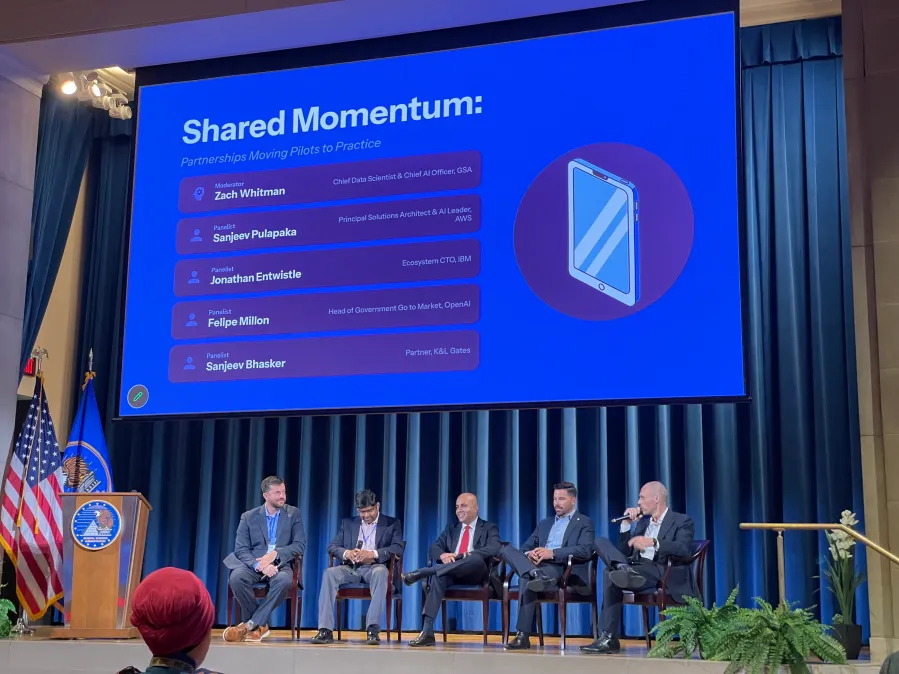
Hosted by the General Services Administration at the Interior Department, over 1,400 online and a few dozen in-person attendees heard how different agencies are encouraging AI adoption and what tech leaders want to see in the future.
“Our goal is not just to automate for the sake of automation, but rather to really question longstanding ways of doing things and really challenge ourselves with whether or not that should be eliminated or, at a minimum, streamlined and optimized,” said Chris Grigsby, acting director of GSA’s Office of Digital Finance.
Speakers ranging from the outgoing federal Chief Information Officer Greg Barbaccia, acting Technology Modernization Fund Director Jessie Posilkin and Felipe Millon, OpenAI’s head of government go to market, spoke on cross-governmental collaboration, access to the right tools and how to practice using AI to rethink how employees work.
“We must move together as one federal enterprise,” Barbaccia said. “We can’t be using different models and different harnesses and different orchestrations to solve the same problems that are fungible across all the agencies.”
But some of the AI barriers are not just between agencies, but within them.
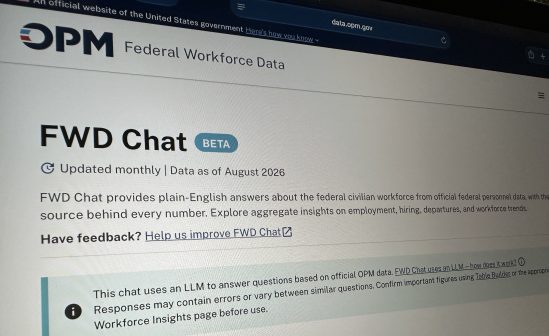
Adam Starr, the Office of Personnel Management’s CIO, said the government’s human capital agency asks employees what their barriers to AI adoption are, and gives bonuses to workers who innovate with AI.
Starr said OPM also started an “AI Catalyst Program, where I’ve repurposed some of my top engineers to go sit with different businesses on rethinking their work around technology, and maybe it’s a connection to a new data source, but trying to drive down those barriers to tech adoption.”
“How do we enable the people on our teams, the really smart federal employees, to rethink their work?” he said. “And it has to be a combination of top down and bottom up. … It requires investment in rethinking that.”
Posilkin said it’s not just about whether the tools exist, but if government employees have access to them. Barbaccia said FedRAMP is no longer a point-in-time certification; it is ongoing.
OpenAI’s Million gave the GSA a “ton of credit” for the FedRAMP 20x program, which the agency utilized to allow “new technology to come in faster.”
Other agencies are also considering how to quicken the pace of tech adoption. The Department of Veterans Affairs on Wednesday issued a memo, obtained by FedScoop, that said existing FedRAMP certification is not required for contractors to win bids. FedRAMP Director Pete Waterman said in a LinkedIn post Thursday that he “loved” the memo and will “bring a version of it to the FedRAMP Board and recommend we share it with other agencies.”
No matter how AI gets authorized for use, the bottom line, Million said, is that federal employees must use AI to understand it. OpenAI’s $1 OneGov deal, as well as Google’s $0.47 deal, expire in the coming months.
TMF, meanwhile, stands ready to help agencies as they use AI to speed up processes, Posilkin said. Posilkin has put out a call for proposals for more AI projects as TMF’s funding runs out, awaiting congressional reauthorization.
“It’s not about novel technology; it is about going back to the humans,” Posilkin said. “I think often user-centered design gets talked about as this sort of nice-to-have, woo-woo thing in the corner, instead of actually it can drastically change what your architecture needs are and what your infrastructure costs are.”
Jonathan Entwistle, ecosystem chief technology officer for IBM, predicted that the next few years will bring in a new phase of AI and quantum computing.
“If 2024 was all about models and ‘25 was kind of, ‘let’s go build agents,’ I think what we’re going to start to see at the end of ‘26 into ‘27 is software and engines that create more context,” he said.