DOT pushes back on drone industry calls for speedy rules

As the Department of Transportation prepares to roll out its standards for Beyond Visual Line of Sight drone operations, the agency isn’t rushing the release for industry’s sake, per a top agency official.
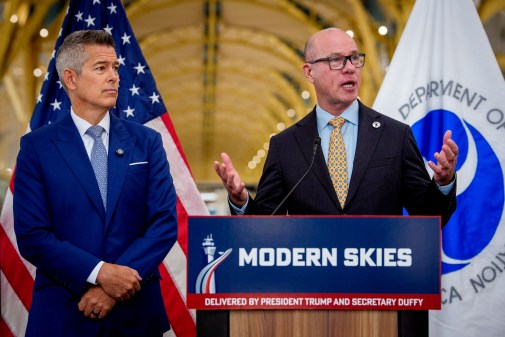
“You see all of our rules come out so quickly, but BVLOS, we took a little bit of time with,” Pete Meachum, chief of staff at DOT, said during a Commercial Drone Alliance event in Washington, D.C., on Friday. “There was pressure to get the rule out.”
The BVLOS rule will detail requirements for operations, aircraft manufacturing, safe separation distances, operational authorizations, security, information-sharing and record-keeping.
During agency meetings with industry, Meachum said there were calls for a speedier rulemaking process. A similar message came from a panel of drone industry CEOs held just before the official took the stage.
“Convincing investors relies on certainty of regulatory approach and framework,” said Keller Cliffton, CEO at drone delivery company Zipline. “If you wanted to ice all private investment in this very important area of technology, the fastest way to do it would be to make it impossible for investors to know what the regulatory environment is going to be like.”
The final rule has been delayed, building anticipation for its release. The Trump administration set the process in motion in June 2025 as part of the drone dominance executive order. The president tasked the Federal Aviation Administration with publishing a final rule within 240 days, which would have been Feb. 1.
The federal government’s longest shutdown in history last year set the date back, as did DOT’s reopening of a related request for information in January. The agency said it wanted to ensure that it fully understood comments regarding location-tracking, data-sharing and detection technologies.
“Of all the rules, we’ve either met or been faster on the deadlines,” Meachum said. “BVLOS was held up again because the secretary really wanted to have a full conversation about locking ourselves into technology.”
The agency wanted to make sure it wasn’t too prescriptive with its rules to avoid being “tied in knots” in a few years “because new technologies come along and you can’t use it,” Meachum said.
Future-proofing rules is a difficult task for quick-moving industries. The agency has also been cognizant of the downsides of writing a rule that would favor industry incumbents.
“The secretary certainly doesn’t want lock-in protection for incumbents,” Meachum said. “He wants a diverse space.”
Industry shouldn’t have to wait too much longer before the rules arrive.
“What’s been out in the public is very much what’s coming, what’s going to be published and we’re pretty excited about that,” Meachum said.