- Sponsored
- Insights
Why unified data services are key to helping agencies escape AI ‘pilot purgatory’

Federal agencies are racing to harness the transformative capabilities of artificial intelligence. Yet, they face a sobering reality that is undermining the government’s technological ambitions. Despite a 70% year-over-year increase in federal AI use cases, agencies are hitting an operational brick wall.
That’s leaving federal agencies stuck in what some experts call “pilot purgatory” or “AI 1.0” — an era defined by well-intentioned experimentation yet plagued by misguided operational alignment and an inability to scale.
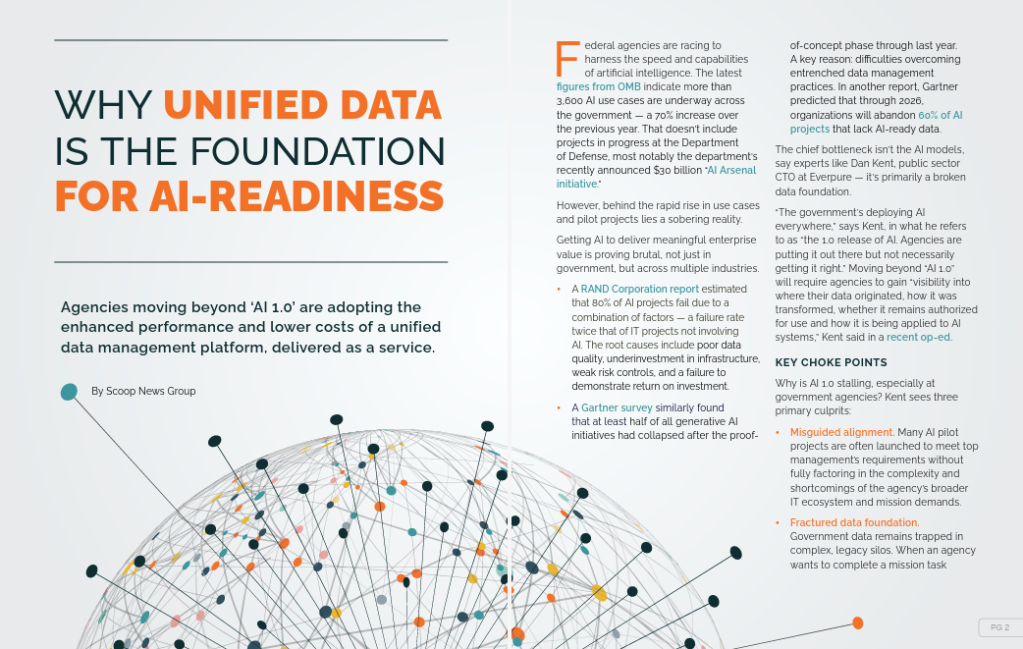
The core stumbling block, according to a new report, is not a lack of sophisticated algorithms or compute power but a fundamentally fractured data foundation.
To move beyond “AI 1.0,” the report suggests that federal chief information officers and program managers must rethink their data and storage management practices and shift to a centrally managed, software-defined, unified data environment.
“By using a unified data plane with a software-defined operating environment, agencies can prepare data for AI directly at the source, without adding more fragmented infrastructure or management silos,” explains Dan Kent, public sector chief technology officer at Everpure, in a new Scoop News Group report underwritten by Everpure.
Kent points to three distinct structural and programmatic advantages of shifting to a software-defined, unified data layer:
Enhanced security and data integrity. A unified data plane standardizes complex environments by automating continuous optimization in the background, delivering a cloud-like experience, and deploying complex security workflows. It also enables agencies to avoid copying data to intermediate clouds for AI inference, where data can become instantly out of sync, leading to self-inflicted errors and AI hallucinations. Advanced tools now provide deep discovery directly at the source. Everpure’s acquisition of 1touch technology, for instance, enables agencies to scrub data and identify personally identifiable information before it reaches a large language model.
Dramatic storage and power improvements. AI workloads are consuming facility storage and power resources at an unsustainable rate. Transitioning to a unified, flash-based architecture fundamentally rewrites the real estate equation. Consolidating unstructured and structured data into a single platform allows agencies to host capabilities within a single server rack that would traditionally require up to two dozen racks, drastically reducing both physical footprint and power consumption.
Improved scalability and budget control. The transition to consumption-based storage-as-a-service ends the crippling cycle of rigid capital expenditures and “forklift upgrades.” Moving from conceptual AI pilots to daily operational applications often triggers sticker shock due to new hardware requirements and token allowances. A consumption-versus-capital-expense model allows agencies to scale incrementally, improving budget predictability and tying technology spending directly to actual data consumption. It also helps address the chronic IT skills shortages agencies face.
Fixing the data foundation
Early adopters in the commercial and federal sectors are already demonstrating the viability of this architectural overhaul. Both NASA and the Department of Defense are actively moving toward this unified data model, recognizing the operational necessity of centrally managed enterprise data platforms for expansive missions.
These new demands are also reflected in the way vendors such as Everpure are evolving, according to the report. Everpure recently integrated its data streaming software with the Nvidia Blackwell GPU architecture, enabling agencies to build on-premises “AI Factories” that securely scale inference across the enterprise.
That will become increasingly important as autonomous AI agents create their own databases at an exponential rate.
“Legacy databases are becoming a smaller fish in a bigger AI pond,” observes John Foley, a database analyst cited in the report. “Data sovereignty and resiliency requirements are forcing new thinking around how and where data gets stored.”
To that end, the report offers a five-point plan for building an infrastructure and data foundation capable of scaling AI beyond experimental pilots.
For defense and civilian agencies alike, leadership must prioritize foundational data readiness over rapid AI model deployment, the report concludes. By fixing the underlying infrastructure first, government IT leaders can ensure that the autonomous systems guiding tomorrow’s critical missions are drawing from a secure, unified, and unassailable source of truth.
This article was produced by Scoop News Group for FedScoop and sponsored by Everpure.