Workday Government has Trump’s HR overhaul in mind with coming agentic AI tool
Workday’s public-sector arm is set to launch its latest federal government offering next year in the form of an artificial intelligence agent aimed at automating the process that underpins personnel actions.
The tool, dubbed the Personnel Action Request (PAR) Agent, will be included in Workday Government’s existing platform and is marketed as a time- and cost-saving feature that will supplant largely manual processes.
It’s also something the company is aligning with the Trump administration’s so-called “HR 2.0” efforts to consolidate disparate and aging human capital systems across the government.
In an interview with FedScoop, Lynn Martin, the general manager for Workday Government, said the tool will eventually be embedded in the company’s human capital management (HCM) system “to support HR 2.0 initiative across the government from Workday.”
When asked whether the focus on HR 2.0 meant Workday had won an anticipated contract to support the administration’s consolidated HR system push, Martin said no, but pointed to changes in standards across the government as a result of the effort.
She added later: “HR 2.0 is really to perform the basic HR functions in a consistent manner with reliable data. Across the government today, there’s different systems across every agency. Some agencies have far more than one.”
That’s where Workday sees the PAR Agent coming in. According to the company, the feature will use data on the Workday platform to automate processes for personnel actions such as hiring, promotion, transfer, and separation that are often done manually and with those other outdated systems. It’s something agencies will be able to turn on or off if they choose.
By Martin’s estimation, each step of the current process today is 44 days and the new AI agent can cut that down to almost a third of the time. The tool is expected to be available in March 2027.
The HR services company announced the tool this week ahead of its Workday Federal Forum in Washington, D.C., which featured speakers such as federal CIO Greg Barbaccia and acting federal CISO Mike Duffy. It comes as Workday has been expanding its public-sector presence.
Workday entered the federal market with its cloud-based finance, payroll, and other human capital services in 2021, and launched its government subsidiary in July 2025. Just this fall, it added the Department of Energy as a customer — the first cabinet-level agency to deploy its services. It’s also working with agencies such as the Defense Information Systems Agency (DISA) and the U.S. Space Force.
Rob Enslin, president and chief commercial officer for Workday, told FedScoop the two biggest growth areas for the company are international and federal.
“I would say that probably the investment in Workday Gov is the largest investment Workday has had from an engineering point of view,” Enslin said. “So it’s key for us, actually globally, on government.”
Roughly a year ago, the Office of Personnel Management awarded and abruptly canceled a sole-source contract to Workday to facilitate the Trump administration’s HR modernization efforts. OPM later launched open competition for such a contract, but has yet to announce an awardee.
Notably, a host of PAR processing tasks were among items in the agency’s wish list for an eventual vendor.
While the AI agent would be the first that Workday has brought to government, agentic uses are part of its broader strategy on the technology. AI agents are tools that carry out specific programmed tasks autonomously rather than merely the response generation typically seen in chatbots. They’ve been particularly buzzy in the private sector in recent months.
Enslin said Workday’s approach to the technology includes ensuring the company can connect agent-to-agent to work with others in the market, making acquisitions of agentic tools, and creating their own agentic offerings.
When it comes to bringing its tools to the federal market, Martin said the company is partnering with government to identify the best use cases. That includes aligning them with applicable government policies, such as the Trump White House’s AI framework.
“Things like that framework are all in the concept of our PARs agent to comply with how the government’s thinking about rolling out responsible AI,” Martin said.
It’s learning from its existing federal customers, too. The company’s work at DOE served as the basis for its estimates about the PAR agent’s potential time savings, per a release about the forthcoming product.
When it comes to turning on new tools for government customers, Martin said the company is taking an approach that aims to address the parity between the latest commercial services and what federal agencies can actually get their hands on.
“Anything we’ve built for federal are now in the code that all customers get,” Martin said. And because all customers run on that code, they’re “getting upgrades regularly and moving with the latest innovation,” she said.
As a result of everyone running on the same code, the platform is also designed to be “built for configuration management, not customization,” Martin said.
“You’re not customizing that base code,” she said. “You can configure it, you can use connectors, you can do all kinds of things with it, but your long [operations and maintenance] tail that exists today in all the legacy environments are minimal.”
Ultimately, Workday’s approach appears to fit neatly into what at least one Trump administration leader said they want from industry.
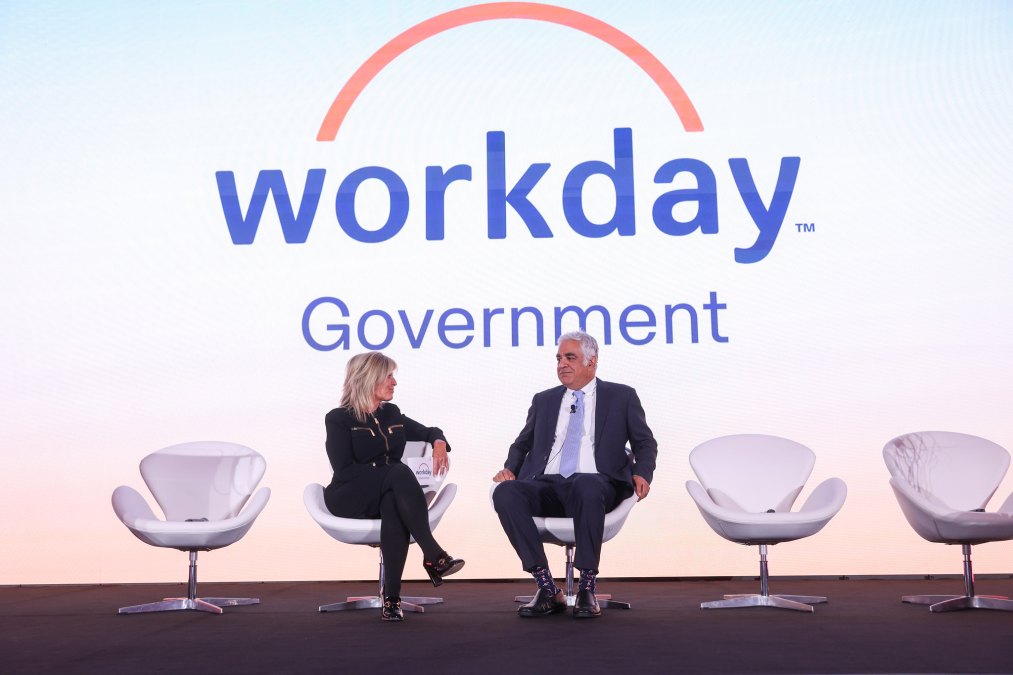
During a panel discussion with Enslin, Barbaccia described the administration’s approach to technology as looking for services that are fungible across the federal government — such as AI, cyber, and workforce management — and envisioning solutions that can be applied widely.
In terms of what the government wants from the private sector, Barbaccia said the government needs “partners who understand the mission.”
That means partners who understand the outcomes the government is trying to achieve as well as the landscape for repairs and compliance, he said, and not vendors “selling a statistical basis software to fit a very narrow scope of problems that one agency may or may not have.”