GSA official on OneGov AI deals: Some extensions, some new offers coming
Some OneGov artificial intelligence deals will be extended and some companies will be offering new deals for others, a General Services Administration official said Thursday.
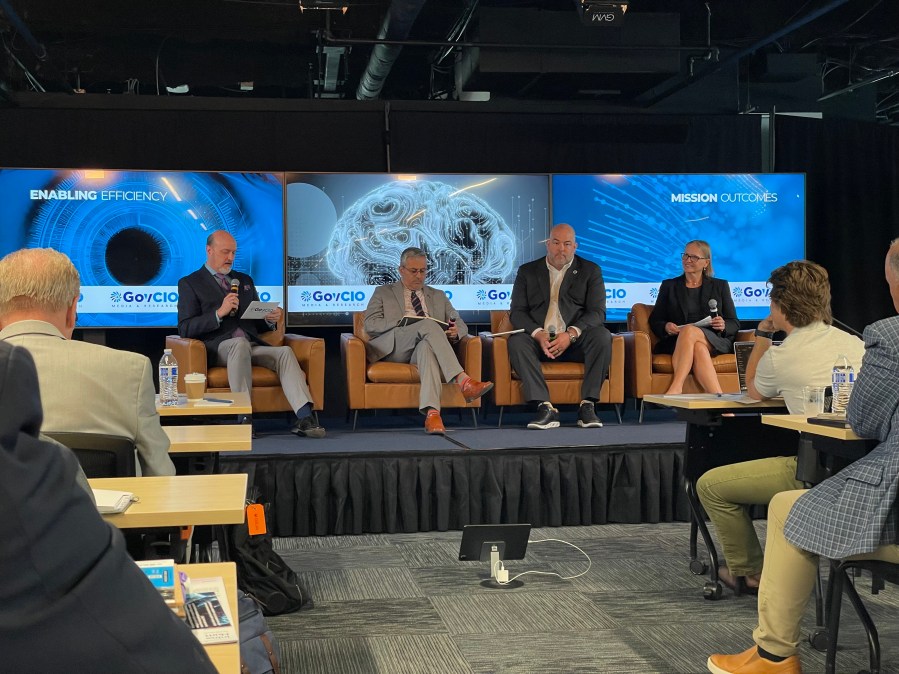
At the GovCIO Media & Research Federal AI Forum in Reston, Va., Birgit Smeltzer, director of the agency’s Office of IT Products, asked for people to “keep working with us” as GSA negotiates bargains.
“Some of the [original equipment manufacturers] have already agreed to extend some of the limited-time offers, and some are looking at producing new offers for us,” she said. “We continue to work very closely with the OEMs to get extension of those offers, or maybe get new offers in place. We look very much at what makes sense for the government and what may not have taken flight so much, and put some offers out there that work for our agencies.”
Smeltzer told FedScoop that some of the OEMs include the AI offerings, as well as other deals, but did not say when the new deals will be announced.
Three popular deals — for OpenAI’s ChatGPT, Google’s Gemini and Anthropic’s Claude — are expiring next month. Touting prices as little as $0.47 to $1 per agency, the barrier to entry to state-of-the-art technology has all but vanished — by design. Founded in response to President Donald Trump’s executive order for more “cost-effective” solutions in federal contracts, the GSA has said OneGov deals accelerate AI adoption across agencies.
Smeltzer also said the AI limited-time offers alone have saved the government $1.4 billion, and some agencies have used the deals to negotiate their own contracts outside of GSA. She did say the prices will “eventually increase.”
In May, Smeltzer said “more than 120 orders have been placed against OneGov’s AI offerings, and that has provided this new technology, or availability, to about 3.4 million across government.” An OpenAI spokesperson said the company has over 1 million users across federal, state and local governments.
Geoffrey Sage, director of the enterprise service and analysis division in NASA’s Office of Procurement, said AI is a “necessity.”
“Leveraging the OneGov has been tremendous in order to really prove value,” Sage said, explaining that the deals have helped NASA balance speed and cost. “I can then focus on putting a man on the moon.”
NASA has also been using AI to decrease the number of contract writing systems they have, Sage said, adding that he anticipates getting it down from three to one next year.
Anil Chaudhry, the Transportation Department’s senior AI advisor, said government employees need to experiment with AI and collaborate with industry.
“Everybody is in this forward-looking mindset that for a career employee, it’s OK to take a little educated risk in this world where we don’t have all the answers,” he said. “You won’t get in trouble for doing the right thing, taking an educated risk that we can walk back, right? But the worst thing you can do is not be innovative, stick with the same old, same old, and try to force fit that five-year methodology that no longer works.”
Chaudhry also said government employees “can no longer have a mindset that you’re competing with industry.”
“You have to have that mindset that you’re collaborating with industry, that industry is your partner, that your success is contingent on your industry partner and the fact that you are being honest with your industry partner on what your actual problems are and what your requirements are and pulling them in a lot earlier in the process to sort of ideate solutions,” he said.