Meet the physicists making NIST the epicenter of quantum advancement
One physicist’s quantum material discoveries have opened the door to groundbreaking global research. Another has led the way on major advancements in error-corrected quantum computing. And yet another is the brains behind a measurement standard paving the way for innovation in quantum computing applications.
For decades, technological innovation in the United States has been synonymous with Silicon Valley. But when it comes to quantum, the federal government is setting the pace.
The National Institute of Standards and Technology has emerged as ground zero for some of the most advanced developments in quantum and is home to those aforementioned physicists, who spurned the possibility of private-sector riches to work with the country’s brightest minds in the field.
Drs. Nicholas Butch, Michael Gullans and Stephen Eckel will be honored Sunday for their government service at the 77th annual Arthur S. Flemming Awards, which celebrate the contributions of early-career federal employees in applied science, engineering, basic science, legal achievements, and leadership and management.
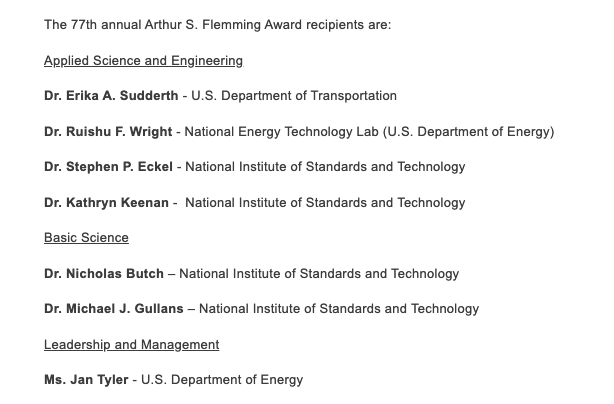
This year’s Flemming Awards hold particularly special meaning for the three NIST physicists since one of their own, Bill Phillips, will receive a lifetime achievement award for outstanding federal service. A 1997 Nobel Prize winner in physics, Phillips is best known for his trailblazing work on laser cooling and trapping techniques that now uphold today’s quantum technologies.
Eckel was drawn to NIST in part because of Phillips. When he was finishing up his PhD in physics at Yale in 2012, Eckel decided “on a whim” to send Phillips an email asking if any postdoctoral researcher openings were available in his group at NIST.
There were, and so began Eckel’s career in the federal government.
“I came down thinking that I would just spend a couple years here doing a postdoc, doing really exciting research, and then moving on to the next step in my career,” he said. “And it wasn’t until I got here that I really became inspired by federal service.”
Eckel was thrown into “cutting-edge research” with Phillips’ group, working with brilliant scientists and getting a front-row seat into how NIST plays “a vital role” in ensuring that the country has “the measurement infrastructure it needs to support commerce and industry,” he said.
Near the end of this postdoc, Eckel was approached by some researchers about a new project to advance measurement capabilities for vacuum pressures. He “jumped at the idea,” became a permanent NIST staff member, and began a journey that has led to him becoming one of the world’s preeminent experts in cold-atom sensing and precision measurement.
Eckel’s advancements in quantum-enabled measurement science include the development of the world’s first deployable cold atom vacuum standard, a project that began around 2016 and ended in 2023 with the validation of the technique. Essentially, the standard enables ionization gauges in vacuums to be replaced and be accurate to 2%, without calibration.
“The upfront expense of the gauge isn’t the limiting cost; it’s the constant need to calibrate and recalibrate,” he said. “And with this type of a measurement technique, that’s no longer required.”
Accuracy has also been the focus of Gullans’ work at NIST, where he first landed in 2014 as a National Research Council postdoctoral fellow after earning his PhD in quantum optics and condensed matter theory from Harvard.
Gullans left the government in 2017 to earn a postdoc at Princeton, but returned to NIST in 2020. He currently splits his time between the agency and the University of Maryland as an adjunct assistant professor of physics and computer science, in addition to another gig with the Boston-based startup QuEra Computing.
Essentially the entire focus of Gullans’ group at NIST since his return to the agency has been quantum error correction — a discipline that’s much more “crucial” for the precision required in quantum computing compared to classical computing.
He’s also focused on trying to understand how noise affects quantum systems — a pursuit that dovetails neatly with his error-correction work.
“Error correction is one strategy for dealing with noise, but it’s also helpful to just understand more broadly what effect noise has and how you can either mitigate it or how it changes the computational power of quantum systems, because that informs how much error correction we need,” Gullans said.
Gullans’ expertise in quantum information science and the performance and fault tolerance of noisy intermediate‑scale quantum processors essentially boils down to “improving the technology around computing and what’s possible,” he said.
Butch’s discoveries in the quantum material UTe₂ have less to do with computing specifically, but his work similarly shapes the future of quantum and aims to provide better components for the technologies.
Armed with a PhD in physics from UC San Diego, postdocs at the University of Maryland and a stint at the Lawrence Livermore National Laboratory, Butch arrived at NIST in 2013 without ever really giving the private sector “serious consideration.”
He was drawn by the opportunity to work for NIST’s Center for Neutron Research, where the group he leads operates three neutron spectrometers that are used to study the properties of materials, among other functions.
The ability to do “a lot of exploratory basic research” with “no obvious financial benefit” has created the right conditions for Butch — also an adjunct professor at Maryland — to make his quantum material discoveries.
One particular breakthrough came “accidentally,” he said, with his team in the laboratory “trying to make something else” but ultimately demonstrating a rare superconductivity behavior that “gave birth to essentially a subfield of physics.”
That scientific triumph and others involving surprising responses to extreme magnetic fields were made possible by the opportunities afforded to Butch by NIST, Maryland and his fellow researchers.
“It is extremely beneficial to society, and … yes, it absolutely required financial support from the government to do this kind of work,” Butch said. “It also benefited dramatically from collaborations between government entities, universities, and [other] different groups have been playing important roles. It is a story of collaboration, a little bit of competition.”
For all three NIST Flemming honorees, it’s also a story of chasing quantum innovation with government backing — and without deadline-oriented industry pressure.
The way Eckel, Gullans and Butch see it, their groundbreaking, federally supported work is critical for the country and hugely beneficial for the private sector, which can think about commercialization once government scientists are ready to pass the baton.
Under an administration that has attempted — but largely failed — to make severe cuts to the agency, the physicists are especially grateful to be where they are and doing what they love.
“I think it is extremely important to keep doing what we’re doing,” Butch said. “And I hope that we can.”