DHS plans ‘large investments’ in biosurveillance as it ramps up capabilities
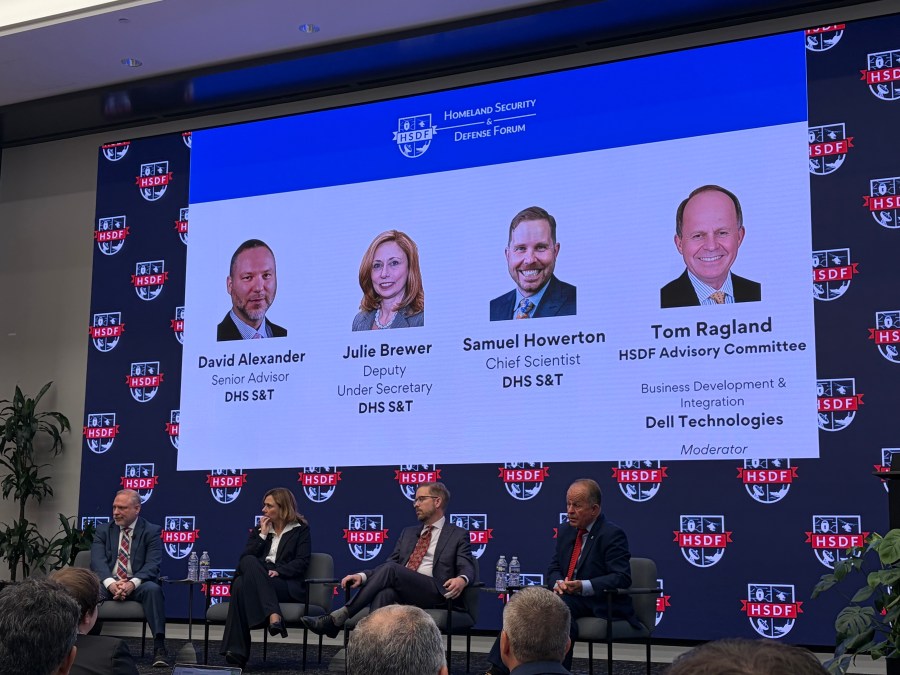
The Department of Homeland Security’s Science and Technology Directorate is looking to improve the agency’s biosurveillance toolbelt, according to three leaders who spoke during a fireside chat hosted by the Homeland Security & Defense Forum on Tuesday.
Within DHS, biosurveillance includes capabilities for detecting and countering biological, chemical or agricultural threats. It’s now one of the top three major focuses of the DHS unit, with pressure mounting to ramp up related efforts and investment.
While the law enforcement agency has focused on the tools since the early days of its creation, threats are evolving due to AI and other emerging tech.
Samuel Howerton, chief scientist at DHS S&T, said he’s regularly thinking about “the escape of biological agents by people who either have nefarious intent or, to be honest with you, are just kind of stupid as scientists can be sometimes.” What DHS S&T can do to prepare for that moment is a major consideration, he said.
The “biosurveillance of tomorrow,” as characterized by Julie Brewer, deputy under secretary for DHS S&T, is top of mind across the department and extends to other parts of the federal government.
“We’ve been working with the Hill, we’ve been working with the interagency and the White House on really developing a vision for biosurveillance of tomorrow,” Brewer said. “It’s a major investment that the government does need to make to really advance the integration of data we have, as well as the ability for environment biodetection in high threat spaces.”
“We’re going to be making large investments in this space,” she added.
As the agency considers where to broaden the efforts, it’s looking at adding testing and evaluation sites, forging new partnerships with industry and increasing staff levels to drive the work.
“We will be hiring new positions within our [Homeland Security Advanced Research Project Agency] to stand up this strategic initiative,” Brewer said. “And then we’ll have R&D roadmaps aligned to advancing that portfolio.”
DHS’s research and development unit has historically tested emerging biosurveillance solutions in New York City, per Brewer. DHS’s National Urban Security Technology Laboratory is headquartered in Manhattan, serving as a central resource for the effort.
“You go into any New York subway system, you’ll see boxes everywhere,” Brewer, who has held her position since 2023, said during the event. “There’s usually about 16 different detection technologies under there with all different keys, all under testing and evaluation, all working with the state and local teams.”
The potential list of locations targeted in the expansion include Austin, Miami and Seattle. Brewer said the efforts would build on the agency’s existing partnership with the Department of Energy’s Pacific Northwest National Laboratory.
For its industry partners, DHS S&T leaders emphasized the need to go beyond incremental improvements.
“We need people thinking differently,” Brewer said, adding a call-to-action for industry to innovate.
The agency has already signalled its intention to industry throughout the year. In May, DHS posted a request for information about AI’s potential to improve biosurveillance and anomaly detection. Earlier this month, the agency also launched what it’s calling an AI-Assisted Algorithmic Biodetection Prize Challenge, inviting researchers to compete and share innovative AI approaches to help identify biological threats.
Despite the increased effort and sharpened focus, challenges still lie ahead.
“The biosurveillance problem isn’t going to be solved by one technology,” said David Alexander, senior science advisor at DHS S&T. “It’s going to be a convergence and blend of technologies, from the sensor and all the integration and data analysis layers and architecture.”
“There are hard problems that we need the technology sector to help us solve,” he added.