Nearly 8,000 federal positions lose workforce protections under Trump order
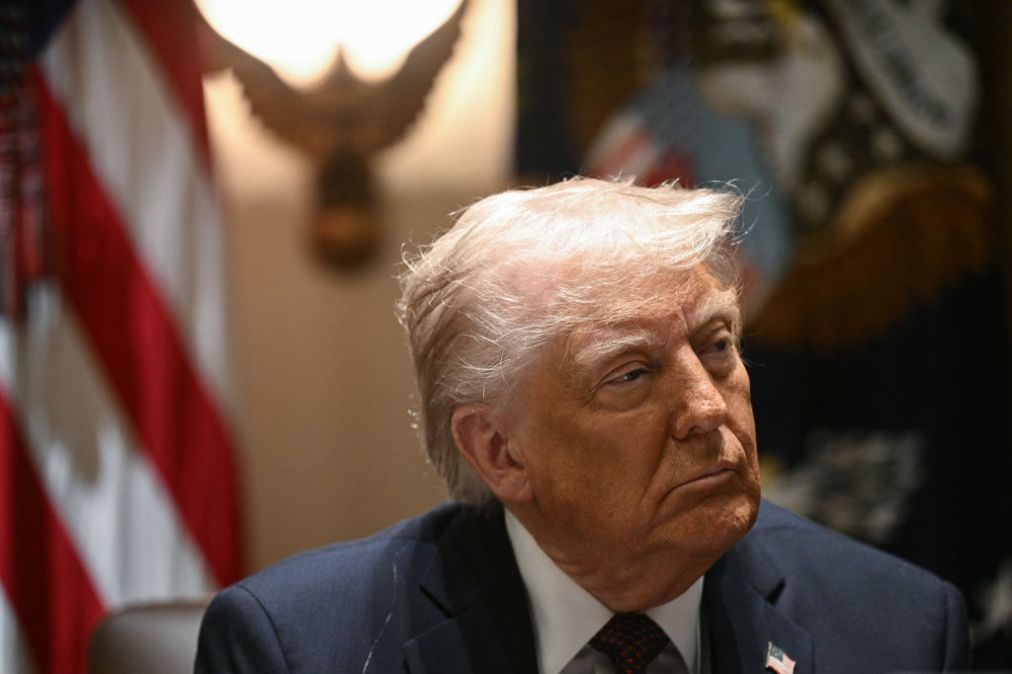
President Donald Trump is rolling back federal workforce protections for nearly 8,000 federal roles under a new executive order signed Wednesday, with IT chiefs and their deputies among those impacted.
The executive order finalizes the administration’s process of determining which specific government jobs fall under a controversial new administrative classification for federal roles called “Schedule Policy/Career.”
That category was formally established by the Office of Personnel Management earlier this year and is designed to transform nonpolitical — yet still policy-influencing positions — into “at will” roles, taking away their ability to challenge adverse employment actions and appeal terminations. It’s a successor of a previous policy introduced during the last Trump administration known as Schedule F.
While the Trump administration argues that the classification is for accountability and workers would not be judged on their political beliefs, federal worker advocates have long asserted that the policy would allow the administration to replace thousands with workers who align with the president.
The Wednesday order amends federal civil service statute and includes an appendix with the positions being transferred. According to an administration official on a call ahead of the executive order signing, there are nearly 8,000 career federal roles being transferred.
An appendix attached to that order lists those position titles by agency. The list includes several chief information officers and their deputies, a chief information security officer, a chief technology officer, and multiple other roles that touch IT, data, cybersecurity and artificial intelligence.
OPM Director Scott Kupor defended the administration’s position during the call with reporters.
“The principle is very fundamental, which is: In order to effect the policy priorities of the administration, we need to have people who are in these senior policy-making decisions willing to and capable of obviously carrying out those directives,” Kupor said.
Per Kupor, the politics of those workers in Schedule P/C roles does not matter, there won’t be loyalty tests and it doesn’t interfere with whistleblower protections. He also said the Presidential Personnel Office, which handles political appointments, is not involved in removal or hiring decisions.
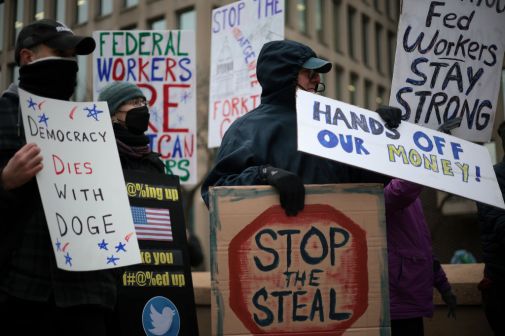
But worker advocates said the threat of job loss will likely have a chilling effect on workers.
“The practical implications of this action are clear. Workers who once felt comfortable reporting waste, fraud, abuse, and mismanagement at their place of employment because they were protected from retaliation will now be afraid for their jobs if they speak out,” Everett Kelley, national president of the American Federation of Government Employees (AFGE), said in a written comment.
The result, they argued, is harm to the work Americans rely on.
“When government experts can be fired without cause, it’s not just federal workers who are harmed — it’s the people across the country who rely on these essential services every day,” Skye Perryman, president and CEO of Democracy Forward, said in an emailed statement.
Democracy Forward, which has been behind many legal challenges against the Trump administration, sued the Trump administration over the creation of Schedule P/C in federal court last year, which is still an active case. There, the organization argues that the policy would undo merit-based civil service established by Congress and return to a spoils system.
Meanwhile, another organization with an existing challenge against that policy in a different federal court said it plans to submit an amended complaint as a result of the order. That group is Protect Democracy — which describes itself as a nonpartisan, anti-authoritarianism organization.
“Schedule Policy/Career would take us back to a system where the government was run by political loyalists, not neutral professionals,” Ori Lev, special counsel at Protect Democracy, said in an emailed statement. “We will continue our work to protect civil servants who are meant to be free to do their jobs without fear of retaliation for their politics, work assignments, or whistleblowing.”