‘Unlocking’ the Evidence Act: Ex-feds’ AI tool aims to bring policy docs to life

Let’s say you’re a researcher interested in the federal government’s data on educational outcomes for at-risk youth. You may start your search at the Department of Education’s website before realizing that the Department of Labor and the Social Security Administration and lord knows how many other agencies have also weighed in on the matter.
All of a sudden, you’ve got dozens of browser tabs open and are wearing the paint off your CTRL-F keys as you ploddingly drown in PDFs.
The Foundations for Evidence-Based Policymaking Act of 2018 made this scenario possible by requiring agencies to provide statistical evidence to support their policies — and make all of that data accessible to the public.
The legislation, which also required each agency to have a chief data officer and created the federal CDO Council, was a massive victory for government transparency advocates.
It was also a logistical nightmare for anyone interested in pulling together reams of disparate, unstructured Evidence Act data. Until now.
A new tool from the nonprofit, nonpartisan Data Foundation uses artificial intelligence to scan more than 200 Evidence Act documents across the 24 CFO Act agencies, providing users with a simple way to get comprehensive answers — with citations — to policy-specific questions.
The tool, called Evi, is “really about unlocking that immense value that’s buried” in documents and websites, said Ted Kaouk, a senior fellow at the Data Foundation who co-led the small team that built the product. “And making it easier for people to access and find that information.”
Kaouk, a former CDO at the U.S. Department of Agriculture, the Office of Personnel Management and the Commodity Futures Trading Commission, came at the project through the lens of a recovering federal data leader. So too did Sara Stefanik, the Data Foundation’s director of evidence capacity and a veteran of data and statistician roles with the Department of Education and the U.S. Census Bureau.
Having that federal background meant knowing that “there’s so much data that everybody wants and needs,” Stefanik said. “But the really important part are these documents.”
Origin stories

Creating a platform to identify and bring those documents to the fore — particularly at a time when the internet is increasingly overrun with AI slop and bots crowding out legitimate information — felt like an imperative “mission” for the Data Foundation duo.
For Kaouk, seeds of that mission were planted during his run as the first chair of the CDO Council, where he set the data agenda for more than 80 agencies from June 2020 to January 2024.
Kaouk spent much of his tenure figuring out how to make data more accessible both inside agencies and to the public. Roughly 80% of his time back then was focused on structured data — meaning data housed in spreadsheets, databases and other formatted containers.
Now, that number has essentially flipped; Kaouk advises organizations that 80% of their time should be spent digging into the “tremendous insights” lurking in unstructured data — PDFs, emails, texts, images, audio, video and other undefined formats.
As the founder of the AI consulting firm Generative Work Labs, Kaouk has made it his business to help clients “extract value” from that data via his company’s Structured Notes app. The tool “essentially builds a private knowledge graph” that visualizes “decades and decades of documents,” he said, producing “AI-ready” data that now serves as the backbone of Evi.
“Some of the opportunity has shifted pretty dramatically with generative and agentic AI,” said Kaouk, whose fellowship with the Data Foundation began in September 2025. “So that opportunity is really what we’ve been pursuing.”
Stefanik, meanwhile, was on the ground floor of the work dating back to her time as a junior staff member with the Commission on Evidence Based Policymaking, the precursor to the Evidence Act itself. She parlayed that work into positions with Census and Education before completing a two-year stint as Pittsburgh Public Schools’ director of research and evaluation.
Since joining the Data Foundation in April 2024, Stefanik had been eyeing a website that brought together Evidence Act documents — but knew it would be a significant undertaking.
“We know that they existed, they were there, and people were using them,” she said. “But they were so hard to find and discover.”
Step one was building the Data Foundation’s Evidence Act Hub, which collects strategic plans, reports, laws and policies connected to federal data activities required under the law. The nonprofit views the “living archive” as a “central venue for the evidence community to access critical resources that support federal transparency and capacity-building.”
Stefanik said creating that “one-stop shop” was a big move, but it also sparked more questions from users: What’s in agencies’ open data plans? What are the differences between new evidence and evaluation plans and existing learning agendas? Are all agencies approaching these changes in the same way?
The hub needed an AI assistant to take the Data Foundation’s work to the next level, and attempt to address those and other Evidence Act questions. That’s where Kaouk came into play.
Building Evi

At a Data Foundation event last September on the rooftop of the LINE Hotel in Northwest D.C., Kaouk was officially welcomed into the think tank’s fold and gave attendees a peek into his prolific AI-focused mind.
The presentation was an opportunity for Kaouk to flex his AI-creation muscles and share a broader philosophy he aimed to bring to the Data Foundation: help people “build thoughtfully with AI, so that they can produce novel outcomes while still nurturing their own development.”
That early-autumn evening set the tone for the sprint toward Evi. Kaouk and Stefanik were joined by other federal alumni on the team charged with creating the AI assistant, most of whom had direct experience with designing, implementing or complying with the Evidence Act.
The Data Foundation also solicited feedback from former CDOs and evaluation officers across multiple agencies, including OPM and the Department of Health and Human Services.
With that level of expertise, the pace was exceptionally quick. Stefanik said it would have taken her Data Foundation team “months and months of digging” through documents to get some semblance of what it hoped to achieve with Evi. But with Kaouk — who downplayed any serious technical challenges standing in their way — the product was launched in about three months.
The testing journey included experimentation with multiple large language models, which Kaouk noted are “not always particularly good at providing very good quantitative responses.” So the team “had to develop other mechanisms for tabulating responses … to ensure that you get both qualitative and quantitative responses to be accurate.”
The group found the right fits and then leveraged the Structured Notes platform to create an agentic AI tool that could access material from across a “pre-built knowledge graph,” he said. That means Evi wasn’t just pulling material from the document where that search term appears, but drawing connections about people, relationships and concepts, and building richer narratives around them.
Everyone can relate to hunting through documents and using search engines but still “never really [getting] the results you want,” Stefanik said. “This makes it more narrow, more specific.”
And it might just be scratching the surface.
What’s next
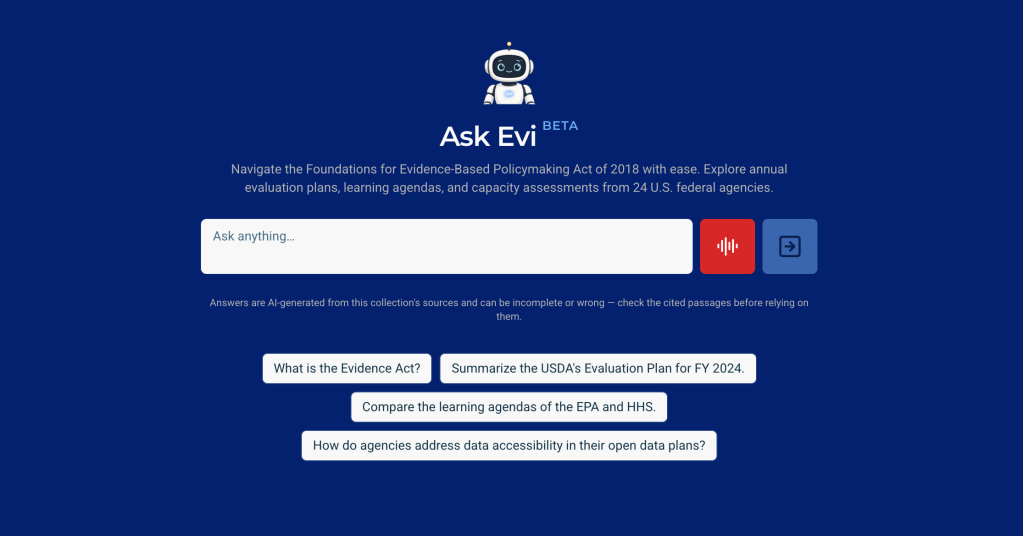
Since Evi launched a little more than a month ago, the public has had a taste of its AI capabilities but not the full, agentic meal. Kaouk said the tool can take source material and transform it into a finished document or a slideshow presentation, complete with outlines, drafted content, citations and images.
Those authoring features are available in Structured Notes, and the team is considering opening it up to outside users in the future, Kaouk said. Until then, Evi exists as a chatbot to navigate the Evidence Act in a way keyword searches and other AI tools couldn’t dream of.
“It is going to surface hidden connections across those documents that no human could find individually, or would have been very time-consuming to find,” he said.
“I think that it’s really a step change in the ability for us to make this kind of information more accessible,” Kaouk added. “And doing it in the evidence space seemed like a good place to start.”
With its Evidence Act focus, Data Foundation staffers believe Evi will be especially useful to agency workers and state and local policymakers, as well as congressional staffers looking to get up to speed on regulatory issues and even journalists covering the federal government.
Stefanik said she’s especially excited about the tool’s ability to break public data out of silos, making it more accessible to current and former feds like her that are interested in getting a clearer picture of policy work throughout government.
“We know things don’t happen in a vacuum,” she said. “I think this gives everyone a really great insight into how you can be working with others and building that research community across agencies.”