Disclosed government AI use increased by 70% in 2025, per OMB

The Office of Management and Budget’s public tally of governmentwide AI use again grew in 2025 — this time amid the Trump administration’s push to use the technology in the name of efficiency.
Per OMB’s recent publication on GitHub, the U.S. government reported about 3,600 AI use cases across agencies, a nearly 70% increase in disclosed applications of the technology from the previous reporting year.
As with previous disclosures, the accounting captures pre-deployment uses, pilot projects, those in active operation, and retired deployments. The figure does not include uses in the Department of Defense or elements of the intelligence community. Per the 2025 inventory, roughly 9% of the reported uses had been retired.
Although agencies have been individually publishing their annual disclosures since January, the consolidated version of the inventories is the first comprehensive look at AI use across the government under President Donald Trump. The second Trump administration has generally pushed for increased deployment of the technology with fewer guardrails.
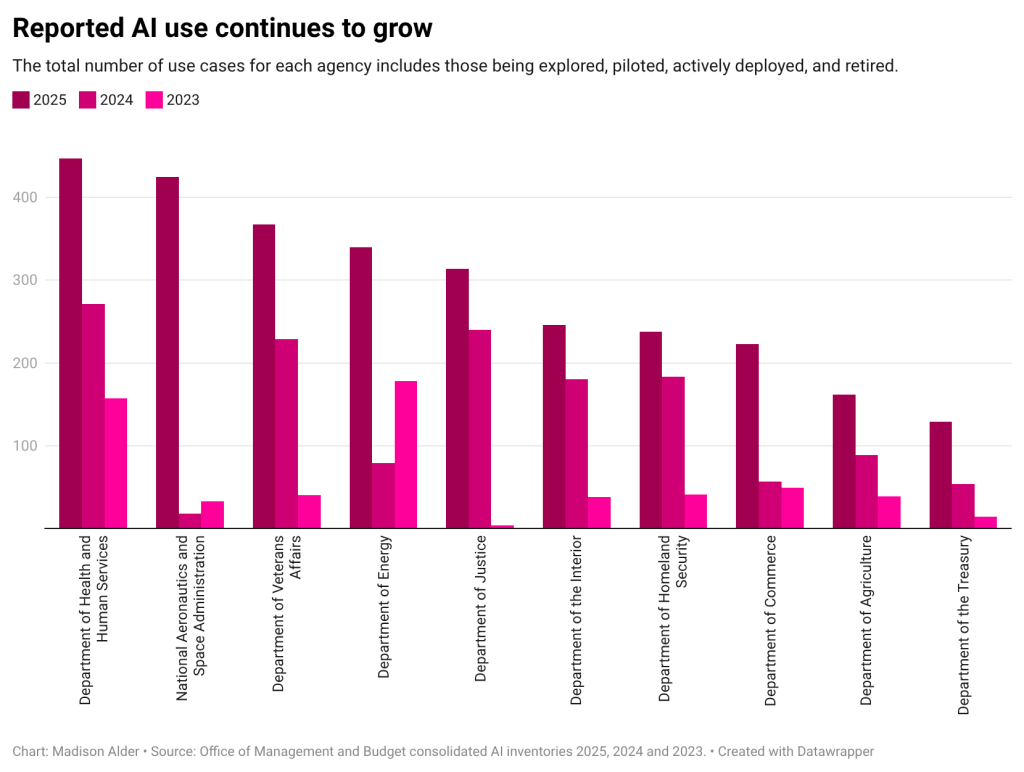
Among the takeaways: The majority of the roughly 40 agencies in the publication reported more uses than the previous year, from small upticks to major expansions. Though the bulk of uses are still in pre-deployment and pilot phases, agencies have increased use cases that are actively being used in their operations.
There’s also substantial variation between agencies in disclosure of “high-impact” uses or those that need to adhere to minimum risk management practices to operate. And one agency’s increase in inventory size certainly stood out.
NASA’s leap
When asked whether the increase across the government appears to be due to improved reporting or actual new uses, Valerie Wirtschafter, a Brookings Institution fellow who analyzed OMB’s 2025 publication in a recent report, told FedScoop: “It’s probably both and also NASA.”
While many of the same agencies again topped the list of highest number of uses, a couple of new additions rose to the top: Chief among them was NASA.
The space exploration agency reported 425 use cases — a roughly 2,260% change from the 18 it disclosed in 2024. The agency’s reported volume was second only to the Department of Health and Human Services, which maintained its position as the agency with the most applications of the technology for another year.
But in an emailed response to questions from FedScoop, NASA spokeswoman Jennifer Dooren said there weren’t major changes in the agency’s strategy or actual use that led to the uptick. Rather, she attributed it to a change in reporting.
Dooren said the inventory reflects a “more comprehensive reporting based on changes in reporting requirements and feedback from the 2024 submissions.” Specifically, she said, the 2025 publication includes research and development (R&D) use cases that hadn’t previously been reported.
Research-and-development use cases have long been a murky area for inclusion in inventories. For example, the Department of Energy similarly increased the size of its inventory in 2023, at the time attributing that change to clarification on what constituted R&D, though its total uses again dipped the following year before its major spike this year.
As it stands, R&D use cases that are for basic or applied research are generally exempted from the inventory unless the aim of the research is to create an application for the agency’s use.
HHS and NASA were followed by the departments of Veterans Affairs, Energy, and Justice, which all reported more than 300 uses. Though not as large as NASA’s, DOE also reported a major increase in AI uses in 2025. Its 340 use cases are a 330% increase from the previous year.
While the government would have still added about 1,000 uses without NASA, the agency’s increase still obscures some of the categories.
For example, NASA’s surge was so large that its entries made science-related use cases the most common reported by agencies in 2025. Science was followed by administrative functions, IT, law enforcement, and health and medical. It’s important to note, however, that agencies didn’t fill out the category for a significant portion of uses.
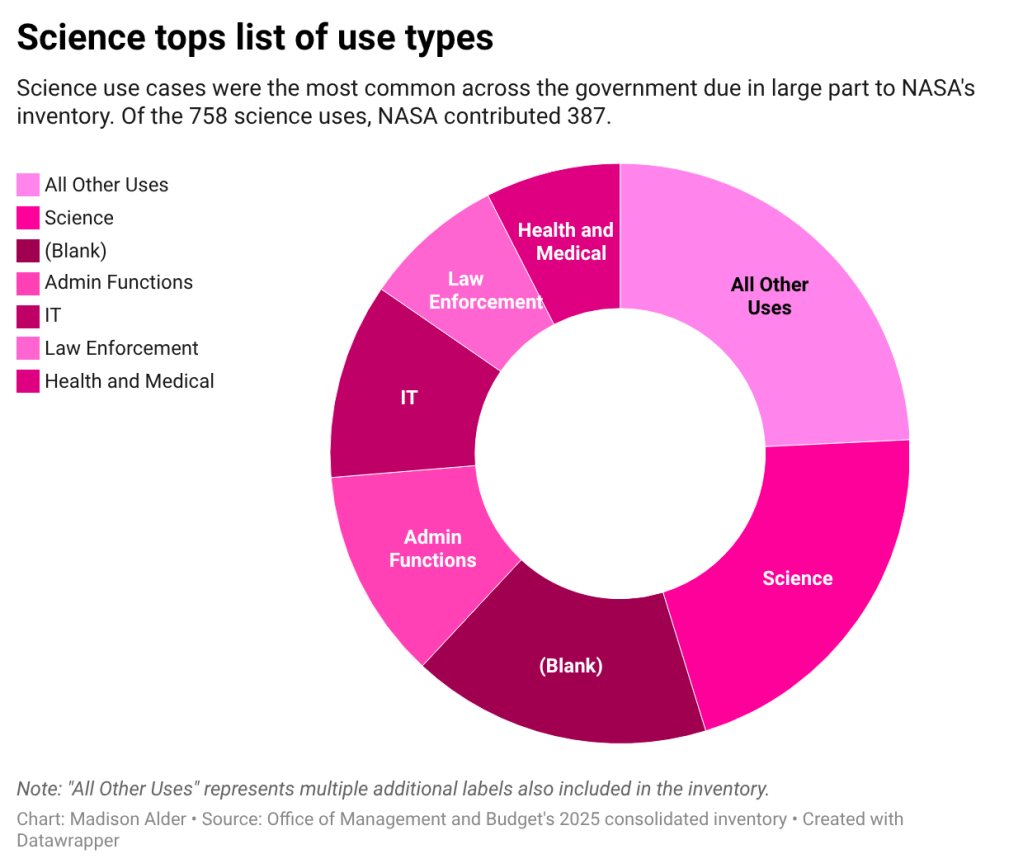
This category is difficult to truly compare year over year, as the categories were slightly different. For example, the No. 1 use case type by far last year was “mission enabling.” That said, law and justice as well as health and medical uses were also high on the 2024 tally.
Inventory history
The process of inventorying and publicly disclosing uses of AI initially came about as the result of an executive order in the final days of the first Trump administration.
Congress later enshrined the requirement into federal statute, and the Biden administration built out the disclosure process after a rocky first couple of reporting years. The second Trump administration has made changes to that process but generally maintained the major aspects.
The reporting schedule for 2025 was delayed as a result of the federal lapse in appropriations last year. The original deadline for agencies to publish their inventories was Dec. 2, 2025, per an internal document shared with FedScoop last year. But the administration cited the 43-day government shutdown as the reason it pushed that deadline back to Jan. 28.
OMB’s publication on GitHub follows the Biden administration’s move last year to publish the 2024 data on the code-sharing website for the first time. That step made progress in normalizing the often disparate publications from the agencies and made it easier for the public to compare all of the information in one place.
The 2025 consolidated inventory also comes after a recent compliance deadline for agencies that prompted some to alter their own disclosures.
Earlier this month, agencies were required to bring certain “high-impact” uses into compliance with minimum risk management practices or stop using them. Several agencies altered their inventories around that time, adding more detail and, in some cases, removing the high-impact label.
High-impact fuzziness
Establishing the high-impact category is arguably the most substantial change the Trump administration made to the inventory process.
Under former President Joe Biden, riskier uses that needed to meet the minimum risk-management practices were labeled “rights-impacting” and “safety-impacting.” The high-impact category combined those into one and changed the criteria.
Overall, high-impact uses made up 12% of the inventory in 2025. That compares to roughly 16% for rights- or safety-impacting uses in 2024. The majority of those uses are at the VA, followed by the DOJ, the Department of Homeland Security and DOE. The proportion of high-impact uses varies widely by agency.
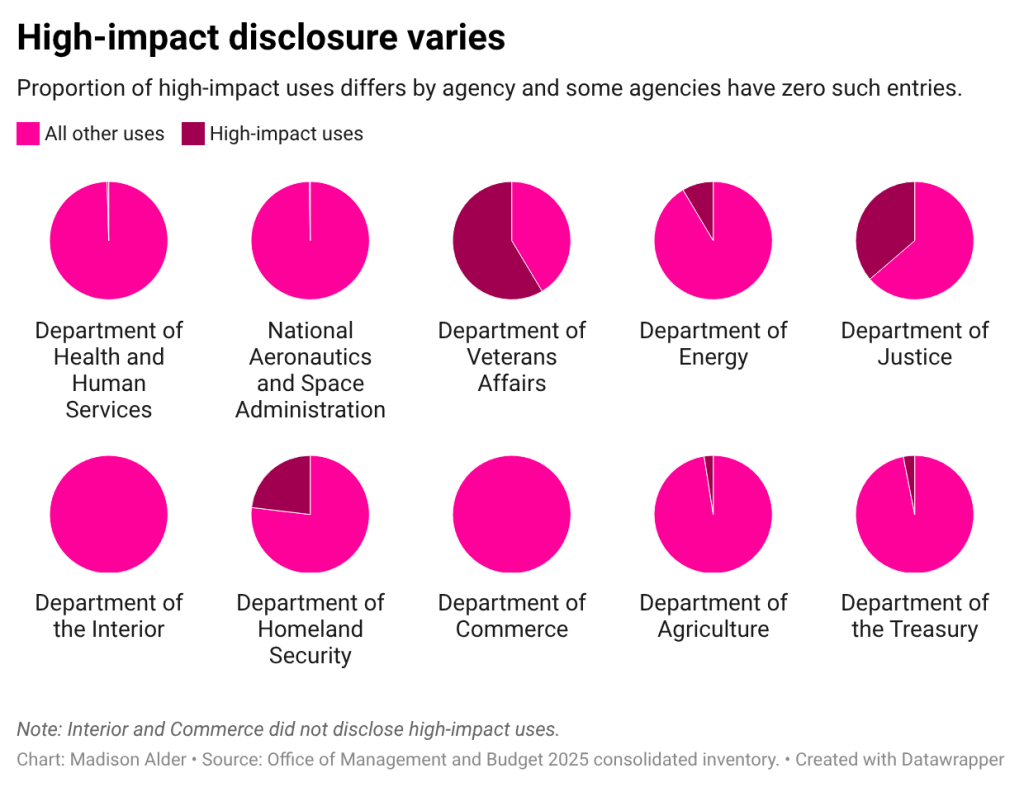
With agencies like HHS and NASA reporting very small portions of high-impact entries, despite having some of the largest disclosures. FedScoop previously reported on the eyebrow-raising nature of HHS’s low number of high-impact uses given the agency’s public health mission. When asked about its small showing, NASA pointed to the fact that most of its uses are in research and development.
“Due to the extremely strict safety standards for any system used in human spaceflight and potential significant safety risks, most of NASA’s AI systems remain in the research or discovery phases rather than being deployed operationally,” Dooren said.
She said that all of the agency’s use cases completed an impact assessment to ensure appropriate risk management. The agency initially identified three use cases as potentially high impact, “but after thorough assessment they did not meet the criteria,” Dooren said. The agency currently has one such use case.
In addition to the high-impact category, a new classification for use cases that are presumed high impact but determined not to be has caused some head scratching among analysts. Per the consolidated inventory, 110 fall into that new category, raising questions about how agencies came to those determinations.
Wirtschafter told FedScoop many agencies pointed to a use not being the “principal basis” for a decision when classifying something as high impact but determined not to be. Whether AI serves as a principal basis for an agency decision or action is the bar for whether a use case meets the bar for high impact.
“To me, that’s extremely narrow as a definition,” she said.
Sorelle Friedler, a computer science professor at Haverford College who contributed to the Biden administration’s its policies governing the use of AI while working in the Biden White House, similarly told FedScoop that language could be confusing some agency officials and serving as a loophole for others that might not want their system covered.
“From a sort of technical perspective, I don’t really think that language makes a lot of sense,” Friedler said. AI systems, particularly those that are high impact, are often part of a larger system that combines the technology with a human process — in other words, using the AI to inform a human.
Whether it’s a principle basis “can be really hard to tell,” she said. “‘Is it part of the decision-making process?’ That’s a much easier line to determine.”
Commercial uses
The administration has highlighted the government’s commercial uses of the technology.
Speaking at the FedScoop-produced Box Federal Summit last week, Eric Ueland, OMB’s deputy director for management, addressed the increase in reported use cases and highlighted the widespread use of major AI chatbots.
Ueland said he was relieved to see how the government could “take advantage of cutting-edge technology as it’s rolled out into the marketplace.” Often, he said the story is that acquisition and security processes take too long and agencies can only get access to outdated technology.
“In 2025 more than three quarters of CFO act agencies reported deploying at least one major AI chatbot, like ChatGPT, CoPilot, or Gemini, to at least 10,000 employees,” Ueland said.
This year was the first time that some agencies also shared a separate inventory of the commercial AI products they were using, often showing uses such as generative AI chatbots or the services built into programs like Adobe or devices like iPhones. Ueland’s comments came after the recent release of an OMB memo aimed at increasing agency acquisition of commercial products and services.
Ueland said administration leaders see the application of AI as something that can free government employees to focus on questions that need humans. He said the administration will “sharpen that focus in the months and years to come,” and the technology “will also provide a significant supplement to our ability to govern.”
He suggested AI could be used to look at executive orders, OMB memos, and other policy documents to “ensure that we are driving the federal agenda on management, resources [and] execution consistent with presidential direction and presidential intent.”
Already, there are examples of that kind of use.
At HHS, agencies including the Administration for Children and Families, the Centers for Medicare and Medicaid Services, and the Health Resources and Services Administration all reported uses for compliance with executive orders or other administration policies.
Two of those tools at ACF, for example, are being used to identify position description and grants that run afoul of the president’s executive orders aimed at erasing diversity, equity, and inclusion from the federal government.
Uneven adoption
While the inventory shows increasing utilization across the government, Wirtschafter believes adoption of the technology is uneven and gaps still persist with respect to transparency.
Among the findings in her report: That large agencies are scaling their AI adoption faster than small and midsized agencies. Wirtschafter said that could be caused by different missions, but also a different level of resources to put toward AI use and experimentation.
Despite some strides in reporting, there is also still room for improvement. Not every agency, for example, maintains the required IDs for their use cases, which ensures that an entry can be tracked year over year regardless of changes to the name or description.
Friedler said she was “a little disappointed” in the 2025 publication.
Some agencies, she said, had more information in the 2024 publication that is now gone. The VA, in particular, outlined risk management and what it was doing to protect veterans from inappropriate use cases, but the 2025 release doesn’t have the same level of detail, she said.
Friedler said it’s possible the agency is still applying the same case and chose not to release the same level of detail, but the lack of information gave her “a lot less confidence that the folks implementing these systems were taking that kind of care, because they didn’t make it transparent.”