FAA brings on AI, software partner for ATC modernization as industry champions tech upgrades
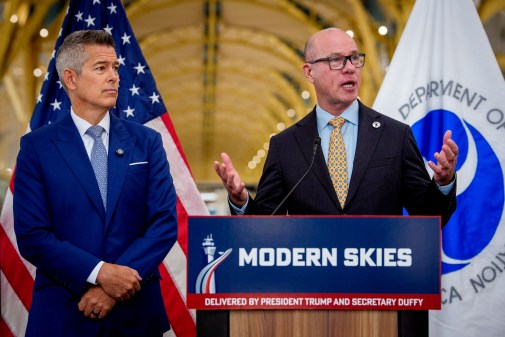
The Department of Transportation’s Federal Aviation Administration is welcoming a new partner to its air traffic control modernization project amid renewed calls for technology upgrades by airport and industry stakeholders.
The FAA picked Air Space Intelligence to create a central data platform, called the Flow Management Data Services, to proactively identify delays. FMDS will serve as the “new technological backbone” of the FAA’s Air Traffic Control System Command Center, the DOT unit said Monday in a press release announcing the 12-year, nearly $876 million contract.
“We’re already making remarkable progress on upgrading the radars, radios, and telecom wires,” Transportation Secretary Sean Duffy said in a statement. “But to really improve the flying experience for the traveling public, we must change how flights are managed.”
Within FMDS, the vendor will also create an AI tool that allows controllers to overlay weather patterns into one visualization, called Strategic Management of Airspace, Routes, and Trajectories. SMART is expected to begin “initial operations” by the fall, per the FAA. ASI said both technologies will be fully deployed in the next 24 months.
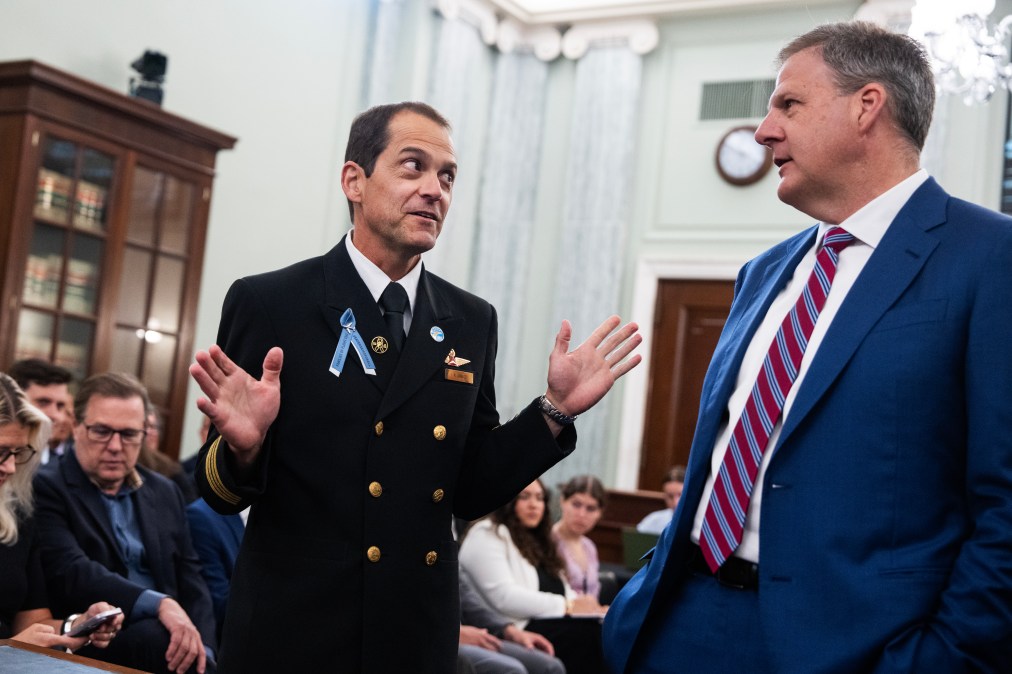
Airport and industry stakeholders are ready for the technology upgrades. During a Commerce Subcommittee on Aviation, Space and Innovation hearing Tuesday, witnesses emphasized the need for tools that would bring improved safety.
“It is absolutely essential that we have the tools we need to do our job the safest, and weather is certainly an example of that,” Captain Jason Ambrosi, president of the Air Line Pilots Association International, the largest pilot union and largest non-governmental aviation safety organization, said of the importance of accurate weather data and predictions.
Automatic Dependent Surveillance-Broadcast In, which allows aircraft to receive data from other aircraft and improves collision avoidance and situational awareness, was top of mind, too.
“Everybody here agrees that ADSB-In could have avoided the accident here in D.C. for sure,” said James Viola, president and CEO of the General Aviation Manufacturers Association, an international trade association representing 130-plus companies across the aviation sector.
The National Transportation Safety Board said as much in February following its final report on the midair collision near Ronald Reagan Washington National Airport last year. Lawmakers have pushed back on grumblings about the price tag of the safety-enhancing technology, which costs about $50,000 per plane to retrofit. During the hearing, witnesses echoed the sentiment.
“I don’t know why anybody would be opposed to this,” Ambrosi said. “It’s a readily available technology.”
Drone-influx
The need for enhanced situational awareness was underscored by concerns of increasingly congested airspaces due to unmanned aircraft systems.
“Whether it’s a commercial airline, a private jet or UAS, they all present a risk,” said Chris Sununu, president and CEO of Airlines for America, a trade association comprising American Airlines, Delta Airlines, FedEx, UPS and others. “Integrating UAS safety regulation into all aspects, whether it’s through the FAA or other modes and regulatory frameworks, that manage the national airspace is absolutely integral.”
“There can’t be any loopholes,” he added.
Federal agencies have had a sharpened focus on the technology due to President Donald Trump’s “drone dominance” executive order that was signed last June.
The FAA set up a new office to oversee its integration of drones and other advanced aviation technologies as part of a broader reorganization, which kicked off in January. The DOT unit has also worked to finalize drone-related rules, from policies on aircraft location-tracking and detection technologies to droneport operational evaluations. Though, these have yet to be finalized.
“From the pilot perspective, we welcome this new technology and all these new entrants, but we have to proceed with caution,” Ambrosi said. “We have a responsibility as an industry to make sure that they’re integrated safely.”
Governance and oversight are still a work in progress with unanswered questions aplenty.
“Some airports would be interested in having that command and control authority,” said Todd Hauptli, president and CEO of the American Association of Airport Executives, the largest professional organization with 12,000-plus members representing airports and companies supporting the airport industry. “Other airports believe that that is a federal responsibility — that’s an issue that still needs to be resolved.”