The revolving door for tech officials at Trump’s DHS

The Department of Homeland Security was looking to bring on a vendor to provide desktop support services for its Office of the Chief Information Officer last year. With 30 competitors throwing their hats in the ring, the sought-after contract ended up going to a subsidiary of CACI International in September.
Less than two months after the massive five-year, $983 million contract was awarded, Chris Granger, DHS’s deputy CIO, left government and joined the vendor.
The revolving door between the federal government and private sector is a path well-traveled, with workers regularly moving from one to the other. But there are rules governing that movement, especially when it comes to sizable contracts. After all, these large sums of money come from taxpayers’ pocketbooks — and without proper stewardship, the public ends up paying for what could be a subpar option, influenced by the connections of those responsible for finding the best possible provider.
When reached for comment, CACI told FedScoop that any connection between the contract award and Granger’s previous DHS employment “is non-existent,” and that his position at the vendor “was, and remains, a function of where in this enterprise Mr. Granger can add maximum value consistent with his post-Government restrictions.”
Granger’s situation is not unique, and, in fact, is just one of a series of ethically questionable, potential conflicts of interest that have occurred at DHS since 2025. While the ethics experts and attorneys FedScoop spoke to did not say these moves were illegal — and the organizations and individuals involved deny any wrongdoing — sources said they raised eyebrows nonetheless.
A true conflict of interest depends on the position of the government employee during procurement and their actions shortly thereafter, or before the contract is awarded. Top technology leaders within an agency are typically part of the process.
“If [the contract] is for the entire office of the CIO, then it’s likely that the CIO and deputy CIO would be part of the decision-making,” said Jerry McGinn, director of the Center for Strategic and International Studies’ Center for the Industrial Base and a senior fellow with the think tank’s Defense and Security Department.
McGinn has experience with the revolving door, having spent some time at the Department of Defense prior to joining the private sector.
“Before I left government, they gave me a whole set of things: here’s what you can do, can’t do, how long your restrictions are,” McGinn said. “They’re pretty darn strong rules.”
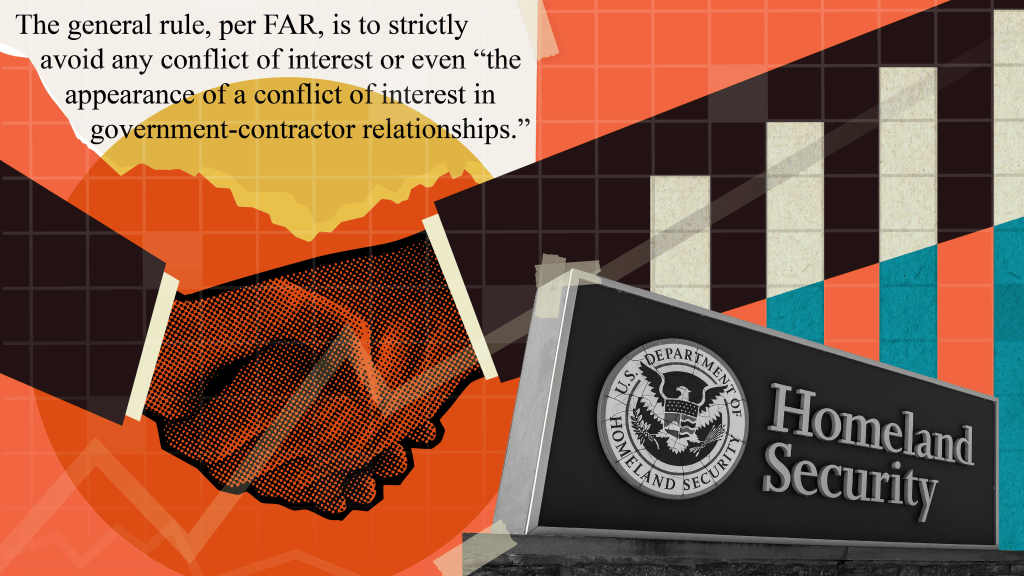
The General Services Administration’s Federal Acquisition Regulation serves as the primary rulebook for governing agencies and their procurement. The general rule, per FAR, is to strictly avoid any conflict of interest or even “the appearance of a conflict of interest in government-contractor relationships.”
Government workers are not barred from accepting employment with any particular private employer, but there are a host of restrictions on what government employees can do after departing.
“There are very specific rules and laws on government ethics,” McGinn said. “If they’re performed well, then the government is protected, industry is protected and individuals are protected. It’s when you go outside of those lines that trouble happens.”
In addition to the FAR, federal laws as laid out in the United States Code outline restrictions for former government employees. The Procurement Integrity Act sets guardrails as well, preventing former government employees involved in procurement decisions for contracts over $10 million from accepting any type of compensation — including via employment-related salaries — from the contractor for one year post-award. It’s a threshold easily surpassed by CACI’s nearly billion-dollar contract.
CACI said it screened Granger for conflicts before extending an offer of employment. The process included a review of the DHS ethics memorandum regarding post-government employment restrictions, and confirmation that Granger had no role in the DSS 3.0 BPA — despite being second-in-command at the office that awarded the contract. DHS did not respond to requests for comment about Granger’s time at the agency. Granger also did not respond to FedScoop’s inquiries.
“Our review indicated, and continues to reflect, that Mr. Granger had no connection to the decision-making process for the DSS 3.0 BPA procurement,” CACI said in an email. “Moreover, his responsibilities and position at CACI have no connection to the DSS 3.0 BPA, which reside in another line of business at CACI altogether.”
A familiar pattern
A few months before Granger left DHS last year, another agency IT leader made a similar move.
For nearly four years, Dave Larrimore held various high-level tech roles at DHS, including stints as chief AI and chief technology officer.
During that time, technology services provider Amivero saw substantial growth in its government contracts from the agency. Amivero provided a number of services for DHS components, from vetting and screening support for immigration enforcement to data entry and quality assurance.
As part of his work at DHS, Larrimore said he led negotiations and awarded an Enterprise User Agreement with Login.gov, according to a resume posted on his personal website. Login.gov is a General Services Administration-managed system that enables single sign-on functionality across participating government websites. DHS spends more on Amivero’s services than any agency other than GSA, with most of its contracts centering on Login.gov-related work, illustrating another tie between the former government employee and the vendor.
Larrimore joined Amivero in April 2025, the same month he departed DHS. Several months later, the law enforcement agency awarded more money than it ever had to Amivero.
While the situation and timing could be considered problematic, it’s unclear whether Larrimore had a direct relationship with Amivero during the procurement process. Larrimore and Amivero did not respond to multiple requests for comment about his time at DHS or current position at Amivero. DHS also did not respond to requests for comment about Larrimore.
Once he landed at Amivero, Larrimore would have needed to steer clear of anything that would’ve put him in front of DHS or working on an Amivero product related to a project he’d been part of at his former agency.
“He’s obviously not going to be lobbying or going back to the government for that company, because that’s illegal,” McGinn said. “The person could not provide advice on something that they were involved in with the government, especially if they were involved with the solicitation that led to that big contract.”
There are instances in which a former government employee can join a vendor and avoid conflicts of interest, though circumventing the firewalls isn’t unheard of.
“I’ve had colleagues who’ve gone to contractors and they have been parked in a division of the company way away from the contracting office for a particular project,” said Dan Meyer, partner at law firm Tully Rinckey PLLC. “I’m always suspicious that when an issue comes up on that contract, somebody’s wandering down the hall … to get their expertise.”
The financial portfolio of DHS’s recently departed top IT leader has garnered criticism regarding potential conflicts of interest, too.
Antoine McCord, who left the agency at the end of August, wore a number of hats at DHS during his year-and-a-half stint. He was the CIO and led the Office of Biometric Identity Management. Following leadership departures earlier this year, he was acting as DHS’s chief information security officer as well.
He was holding the reins of technology contracts across the agency. Required by statute, IT contracts must go through the CIO, a rule the Trump administration called out in a March memo regarding transparency and accountability of federal technology.
The executive kept a low public profile, with no apparent LinkedIn presence and few details provided by his official bio page on the DHS website. It wasn’t until financial disclosures filed by McCord were published by ProPublica earlier this year that it became known where he was employed previously: Anduril, a defense-focused technology company.
While McCord forfeited unvested options and unvested restricted stock units, he retained stock in the company, according to his disclosure. Six months after McCord departed Anduril, DHS awarded the vendor $363 million for its border surveillance towers and sensors. In addition to the towers, Anduril is developing AI and biometric tools that fell under McCord’s purview.
DHS spending on the vendor has surpassed $431 million in fiscal 2026, nearly triple the amount spent in fiscal 2025. McCord returned to Anduril after he departed DHS. He did not respond to FedScoop’s request for comment.
A DHS spokesperson said McCord was not a warranted contracting officer and “therefore has no authority to sign DHS contracts.”
The DHS spokesperson said McCord properly disclosed his financial interests upon assuming the CIO role in March 2025 and “obtained appropriate ethics guidance.” Anduril did not respond to multiple requests for comment.
Financial ties to vendors can appear suspicious during the procurement process.
The FAR points to prior or future employment and financial interests, like stock investments, as sources of personal conflicts of interest that could “impair the employee’s ability to act impartially and in the best interest of the Government when performing under the contract.”
“In general, if you join government, you have to get rid of stocks that are relevant … and then you’re also restricted from engaging with those companies,” McGinn said. “There can be exceptions to that.”
Employees and their spouses who have less than $15,000 in stocks in a certain entity are not required to recuse themselves from the procurement process, per the de minimis exception. Employees with sums exceeding $15,000 could seek an individual waiver and participate in the process if granted. There are also exemptions for diversified mutual funds and other types of mutual funds, among others.
McCord’s stock market value, as stated in his disclosure, exceeds the set limit but is under a double- or single-trigger clause, meaning that an event would need to happen for him to be able to sell them.
Trigger clauses are not “uncommon in the tech and biotech industries,” Meyer said. “But they are a problem for federal appointees in that the triggering events for their sale could be triggered by some federal action.”
A DHS spokesperson said McCord followed the rules when dealing with contracts.
“The financial conflict of interest rule prohibits federal employees from participating ‘personally and substantially’ in any ‘particular matter’ that would directly and predictably affect their financial interests,” the spokesperson said via email. “Mr. McCord has complied with this requirement by recusing himself from DHS matters affecting Anduril’s financial interests, when appropriate.”
The growing prevalence
While conflicts of interest in federal contracting exist across the federal government, there are circumstances that facilitate more questionable moves than others.
One enabler is an influx of investment, according to Dylan Hedtler-Gaudette, interim VP of policy and government affairs at the Project on Government Oversight.
“Anytime you see a lot of cash flowing into an agency, all of a sudden you want to be on the lookout because there’s a lot of money sloshing around, there’s a lot of gray area and a lot of shadows to hide things in,” Hedtler-Gaudette said.
The Trump administration’s One Big Beautiful Bill granted DHS more than $191 billion, amounting to a funding package nearly double the size provided to the agency in fiscal 2024. DHS still had a lot of money to go around for certain technology projects and other endeavors, even as it struggled to pay Transportation Security Administration workers and release Federal Emergency Management Agency funds amid the agency’s historically long appropriations lapse earlier this year and its shutdown in 2025.
Another factor muddying the waters is looser restrictions.
“The revolving door has always been there, but it seems to only get worse over time,” Hedtler-Gaudette said. “Under this administration, that doesn’t seem to prioritize things like ethics and conflicts of interest; it’s even worse than it has been previously.”
As part of his administration’s initial rescissions of Biden-era presidential directives, President Donald Trump struck down an order that set ethical limits on appointees as a way to avoid “the appearance” of government service for private gain.
“The president usually comes in and removes EOs from the previous president, but usually they also replace it with their own EO,” Hedtler-Gaudette said. “The president chose not to issue his own executive order, so that kind of speaks to where we are now under this administration.”
Workforce changes in watchdog offices have also not helped matters, sources said.
In conjunction with the Procurement Integrity Act, FAR and other codified rules, the Office of Government Ethics, which was created by the Ethics in Government Act of 1978, provides guidance to federal agencies to prevent conflicts of interest. OGE, however, has seen a rate of turnover at its helm unlike any administration before, per analysis by the Citizens for Responsibility and Ethics in Washington.
“Directors who served under multiple presidencies — Republican and Democratic — helped maintain a consistent approach to ethics compliance regardless of the shift in politics,” the CREW said in a report published in December 2025. “Until Trump, there have been no other known instances of a president attempting to remove a sitting OGE director mid-term.”
A former federal ethics official said the workforce within an agency has to buy into a culture of compliance with ethical guidelines for it to actually work.
“There are not enough ethics officials in each department to be constantly reviewing whatever activity is happening,” the former official said. “Whether you have that buy-in depends on the individual and their commitment to it and also a heavy influence is how seriously the leader of the agency or the department takes the ethics rules.”
Whether top officials treat ethics rules as valuable and worthy of attention or view them as a headache and hurdle, that message filters down to the workforce, according to the official.
And there are consequences tied to the latter.
“The legitimacy with which the public views the department and its activities is really dependent on whether the department is actually complying with the laws that Congress has passed and the other rules that are out there,” the former official said.
What’s at stake
While rules are on the books, it’s up to enforcers to follow through — and now more than ever, on government workers to do their due diligence.
“You can have the best rules and restrictions on paper, but if no one’s there to enforce them then it doesn’t really matter,” Hedtler-Gaudette said.
Employees are in a precarious situation. In past administrations, for example, it was not unheard of for government workers to ask their agency’s inspector general to waive ethics obligations. But in an era of loose enforcement, Meyer said someone could direct a government worker to not ask for a waiver at all. None of the former DHS leaders FedScoop reached out to answered questions about whether they sought out a waiver.
Deviating from existing laws, no matter the level of enforcement today, brings its own risks, according to Meyer.
“The president can put out the word that he’s not going to enforce and then people proceed on their own peril, but presumably if you’re doing what the White House wants you to do, they’re not going to start enforcing,” Meyer said. “It becomes a way of controlling people, because if the laws are still on the books and you’re just not enforcing, if they don’t do what you want, you can then go and enforce, and they’re already in violation.”
There could also be a flip in November that puts Democrats in charge of Congress, or in the White House in 2028. A changing of the guard could put a target on the backs of government workers operating under loose enforcement. After all, the statute of limitations is typically five-to-seven years, according to Meyer.
Adopting sloppy ethics practices could prove dangerous for private-sector companies, too.
“This is not an area for cowboys,” Meyer said. “It’s not an area to be doing contracts willy-nilly without watching your ethics obligation because what happens is, once the contract is cut, somebody will challenge it.”
Even if challenges aren’t upheld, company executives could find themselves in a whirlwind of litigation and congressional inquiries.
After reports surfaced in March of alleged pay-to-play conduct by then-DHS special government employee Corey Lewandowski, Senate Homeland Security and Governmental Affairs Committee Democrats requested that the private-prison operator GEO Group and logistics and defense contracting firm Salus Worldwide Solutions preserve all records related to contracting practices and interactions with the adviser, who was appointed by former DHS Secretary Kristi Noem. Lewandowski denies any wrongdoing, and investigations are ongoing.
“It is essential that the public maintains full confidence in the integrity of federal spending, ensuring that all contracts are awarded through a competitive, merit-based process that upholds the highest ethical standards, rather than personal influence,” the lawmakers said in their March letter to GEO Group Chairman and CEO George Zoley and Salus Worldwide Solutions CEO William Walters.
In June, Democratic Sen. Maggie Hassan of New Hampshire opened an investigation into the allegations. She set a Sept. 1 deadline for the chief management officer and senior acquisition official at DHS to provide documentation and information related to the procurement concerns. It’s unclear if that deadline was met.
“The allegations against Mr. Lewandowski, if true, indicate significant corruption, abuse of taxpayer funds, and flagrant conflicts of interest that require Congressional investigation based on a comprehensive record of his tenure at DHS,” Hassan said in her letter to Brian Cavanaugh, DHS’s undersecretary for management.
Cronyism has a downstream impact on government agencies and on the public, ethics experts said. Hedtler-Gaudette warned that if procurement is happening without legitimate competition and merit isn’t actually taken into account, then “it’s highly unlikely you’re actually going to have the best product at the end of the day.”
The top Democrat on the Senate Homeland Security and Governmental Affairs Committee echoed the sentiment.
“Government contracts should be awarded through a fair and merit-based process that delivers the best results for taxpayers and the American people,” Sen. Gary Peters of Michigan told FedScoop.
Peters has advocated for legislation that expands protections for employees who disclose waste, fraud, and abuse and closes loopholes enabling conflicts of interest in federal contracting.
“The Administration must follow the law,” Peters said. “And DHS must ensure that every taxpayer dollar is spent effectively, free from undue influence, and in the best interest of the American people.”