- Sponsored
- Modernization
Federal business system modernization: New clues regarding readiness, reality and the road ahead

Federal government officials are being told to move full speed ahead toward an AI-driven future. However, according to a new study, agency leaders report that their engine rooms remain strained by a combination of legacy systems, funding limitations, regulatory constraints and workforce challenges, all of which are impeding their progress.
The study, conducted by Scoop News Group (SNG) and underwritten by SAP, reveals a stark reality: Despite high-level commitment to modernizing their financial, HR and business systems, U.S. government agencies are struggling to keep pace with their commercial peers.
The report, Federal Business Systems Modernization: Readiness, Reality, and the Road Ahead, surveyed 278 executives across the public and private sectors in December 2025. The findings suggest that while the technology exists to transform government operations for the AI age, human factors and structural impediments are prolonging the transition from costly, customized systems to more agile, standardized platforms.
Multiple hurdles
The report paints a picture of federal agencies committed to embracing AI capabilities much like commercial organizations, but facing higher and more protracted hurdles than those faced by business leaders at commercial organizations.
Executives from business, finance, IT, HR, and procurement departments at both government agencies and commercial firms with $1 billion or more in revenue reported several common challenges in modernizing their business systems. Most notably, these include the difficulty of integrating fragmented data and the continued reliance on legacy technology. However, federal executives reported a higher incidence of additional factors that impede their transition to modern platforms.
More than half (53%) of federal executives said inconsistent funding and government budget constraints continue to complicate their modernization plans, compared to 33% of commercial executives. Four in 10 federal executives, meanwhile, also cite policy and regulatory restrictions and workforce-readiness challenges as barriers to progress compared with fewer than 3 in 10 of commercial executives.
“Commitment isn’t the problem; execution is,” said Wyatt Kash, SNG senior vice president and author of the study. “Many federal executives believe in the value of modernizing their business systems. But modernization efforts tend to stall when funding is short-term, uncertain or deprioritized relative to mission systems.”
As a result, federal agencies continue to lag behind large commercial organizations in adopting the advanced capabilities that technology experts insist are necessary to fully leverage AI.
Government’s trailing position
That lag is evident in a snapshot of where federal and commercial organizations stand in their adoption of advanced business systems. According to the study, 43% of commercial executives described their current business systems as “advanced” or “fully modern,” compared with just 23% of federal executives. Such systems are predominantly cloud-based with real-time data sharing and analytics.
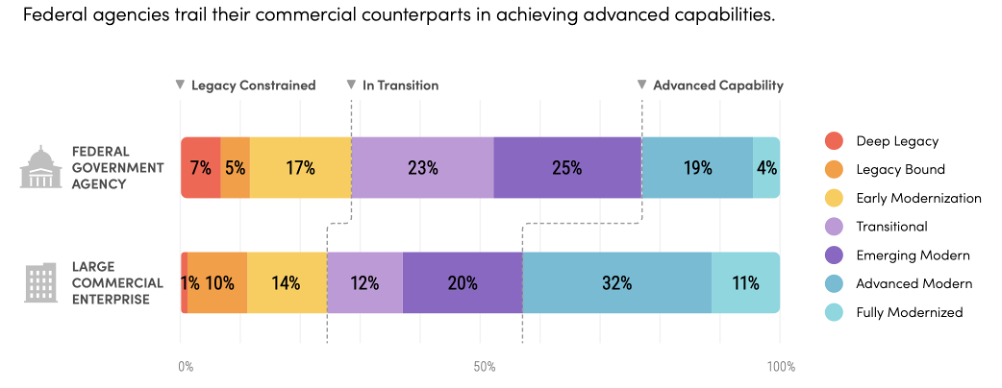
On the other hand, nearly half of federal executives reported their business systems are concentrated in a “transition zone” — a costly middle ground that locks agencies into hybrid complexity, dual maintenance costs, and only partial readiness for AI-enabled analytics, according to the report.
Nearly 1 in 3 federal leaders said their agencies are still using legacy-constrained systems that are typically heavily customized, with minimal data integration and automation.
Revealing gaps
The report highlights other important “gaps” in the findings between federal and commercial respondents, revealing underlying factors that slow federal agencies’ adoption of modern business systems. At the same time, some of those gaps point to opportunities that, if addressed, could help agencies accelerate adoption of modern platforms without necessarily requiring huge investments.
- Data confidence: Data readiness and confidence remain the largest strategic risk in achieving the benefits of modernization. Nearly 6 in 10 commercial leaders are confident their data is AI-ready, compared with 3 in 10 federal leaders. The findings suggest that AI ambition in government is outpacing the operational reality of data trustworthiness, which slows adoption, but remains critical to AI’s success.
- Cultural acceptance: Commercial cultures are nearly twice as likely as federal cultures to embrace “fit-to-standard” (best-practice) platforms. A high proportion of federal workers remain neutral about or resistant to such platforms, in part due to past modernization missteps or a preference for the familiarity of existing systems. Without stronger leadership, training and education, that cultural inertia will continue to be a structural drag on the government’s progress.
- Leadership credibility: While 81% of commercial respondents see strong leadership commitment to system modernization, only 55% of federal respondents believe that’s true in their organizations. That 26-point gap suggests federal leaders are struggling to execute credibly or to communicate effectively, despite their intent. By proactively focusing on delivering — and communicating — consistent system improvements, leaders can boost workforce buy-in and accelerate modernization, the study suggests.
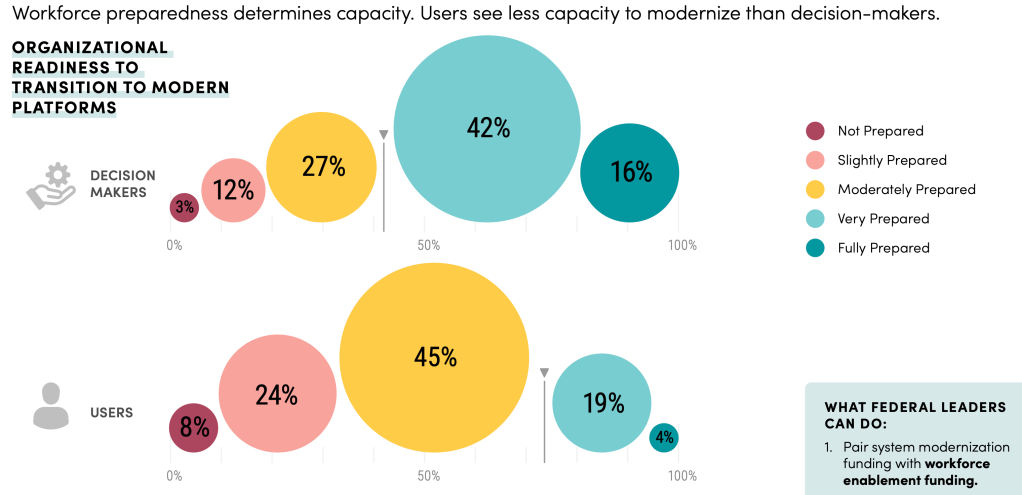
- Workforce enablement: The pace of business-system transformation is constrained more by human capacity than by software. The study found that commercial firms are far more proactive in training and change management than federal agencies — and nearly twice as likely as federal workforces to be “very or fully prepared” to modernize.
- The reconciliation tax: Time spent manually reconciling data across legacy business systems represents a hidden tax on operations. That tax weighs more heavily on federal agencies. More than 4 in 10 federal respondents say that 16% or more of their agency’s monthly workload goes toward manually reconciling data from across different systems. Moreover, 15% of federal respondents say it consumes “more than 25%” of their agency’s time, compared to 7% among commercial respondents.
- Timeline certainty: Commercial firms are modernizing faster: 53% expect full modernization within 3 years, while only 33% of federal leaders expect to reach that mark.
“Commercial organizations have already lived through the hardest part of this journey — and the lesson is clear: Modernization doesn’t fail because of technology; it stalls when organizations hesitate to standardize, invest in their people, and commit to execution,” commented Jamison Braun, senior vice president and managing director, U.S. Public Services at SAP America, in response to the findings.
“The agencies making the fastest progress,” he added, “are the ones treating transformation as a mission — aligning leadership, simplifying their landscape, and moving with urgency. The path forward isn’t theoretical. It’s proven.”
Internal perception gaps
The study also identified differences in perceptions between business system decision-makers and rank-and-file users of those systems, revealing less obvious but potentially more protracted gaps slowing agency modernization efforts. Those views contrast most around:
- Data confidence and AI readiness — Only 3 in 10 (29%) of system users believe their organization’s business data is clean, consistent and ready to support AI, compared to half (51%) of system decision makers. The gap suggests that AI ambitions by system owners are at risk of running ahead of data reality. Lower levels of data trust also slow the adoption of more advanced systems.
- Organizational capacity — Nearly 6 in 10 (58%) of system decision-makers believe their agencies are “very or fully prepared” for modern, cloud-enabled platforms in terms of skills and workforce readiness. That stands in stark contrast to just 23% of actual users who believe that. Workforce readiness determines capacity. This 35-point gap suggests that leadership may be vastly underestimating their organization’s readiness to capitalize on today’s higher-performing platforms and, in turn, how quickly their agencies can benefit.
- Support for modern platforms — Fully two-thirds (66%) of business system users remain resistant to or indifferent about transitioning to modern “fit-to-standard” (best-practice) platforms. This contrasts with 57% of system decision makers who embrace such systems. If not clearly understood or addressed, cultural misalignment can be a structural drag on modernization and delay the realization of AI benefits.
Recommendations for the road ahead
The road to a modern federal enterprise is never-ending. Still, the report identifies several high-priority recommendations for federal leaders to promote quicker adoption of modern business management systems, starting with recommendations for:
Senior agency leaders:
- Attack manual work first: Identify and eliminate administrative burdens to show immediate ROI and reduce burnout.
- Align AI ambition with reality: Prioritize data cleanup and governance before trying to scale AI pilots. Data quality isn’t just a goal of modernization; it’s the engine for AI and modernization.
- Standardize or fail: Make the adoption of “fit-to-standard” platforms non-negotiable and wean the workforce off expensive, slow-moving customized systems.
CFOs and HR leaders:
- Predictable funding: Enable multi-year, dedicated funding streams rather than short-term, uncertain budget cycles.
- Workforce readiness: Treat system transformation as an organizational change program, not just an IT upgrade. Fund training as aggressively as the platforms themselves.
CIOs and industry partners:
- Lead integration: Focus on enterprise-wide standards and shared platforms to reduce fragmentation across the government.
- Outcomes over features: Vendors must demonstrate how their solutions save time, reduce errors, and streamline workflows, rather than emphasizing features and capabilities.
“The challenge for federal leaders now is not whether to modernize or how ready they are,” the report concludes, “but how decisively they are willing to act.” Meaningful transformation will require moving past “modernization theater” and engaging agency stakeholders to see the value of embracing fit-to-standard platforms that support real-time data analysis.
Download the full report.
This article and the research study were produced by Scoop News Group for FedScoop and sponsored by SAP.