‘I’m not here to declare victory’: Oracle and VA face Senate panel on rising EHRM costs
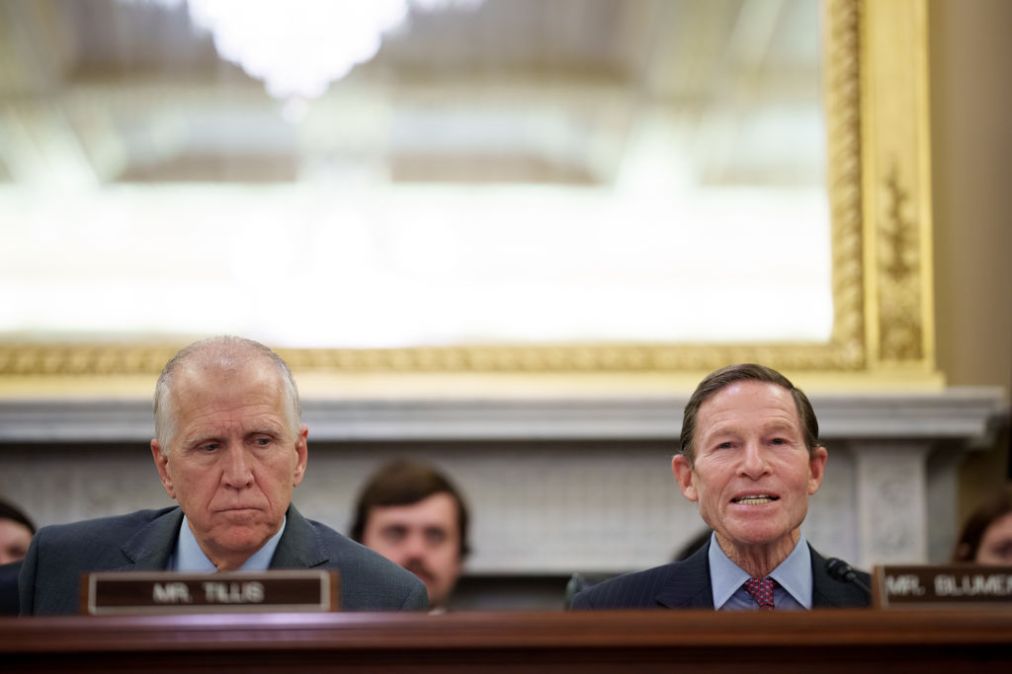
The Senate Veterans’ Affairs Committee demanded answers Wednesday on exactly how and why the Department of Veterans Affairs’ electronic health record modernization program contract ceiling with Oracle Health has risen from $10 billion to $27 billion — largely without Congress knowing, they said.
Oracle Co-CEO Mike Sicilia and VA’s EHRM Integration Office Program Executive Director Neil Evans said the size, scope, timeline and the product have changed, so the price must, too.
“I’m not here to declare victory,” Sicilia said. “I’m also not here to say that everything is perfect with the system, but the scope of the system, the scale of the system has changed dramatically.”
Sen. Thom Tillis, R-N.C., said this project has “all the hallmarks of a failed execution,” not a platform issue.
“But guys, nobody can rationalize a fourfold increase in the cost of a project without somebody’s head rolling,” he said. “I could fully bet, I could create a Kalshi bet that you’ll be back for more money beyond the $37 billion,” referring to the full lifecycle cost, “and I’d put a lot of money on it because all I’ve heard are the same words applied to a new set of numbers and a different set of calendar constraints.”
Where did the $17 billion come from?
The committee’s lawmakers asked different versions of the same question: How exactly did the VA and Oracle arrive at a $17 billion increase?
Sicilia’s prepared remarks for Thursday’s House Veterans’ Affairs Committee hearing said that over two months this summer, Oracle proposed an $18.5 billion increase that was then cut to just under $17 billion, which was made official in August.
From a change in the timeline, to adding work that Evans said the VA originally planned to take over but “has since realized that it is better for Oracle to continue managing,” and putting in new requirements as a result of lessons learned, the scope and size of the project changed, the witnesses said.
“VA is committed to continued tight management of the costs of this program and welcomes this committee’s ongoing oversight,” Evans said.
Sicilia said early changes from COVID-19 pandemic-related delays, customizations and “inadequate infrastructure from Cerner that impacted system stability” also contributed to the rising costs.
As for Sicilia’s 2022 promise that Oracle would absorb any “performance or workflow” issue costs above the original $10 billion ceiling, he said his “desire was to be the best partner that we could be,” and it was a “sincere commitment” that remains today. He said Oracle has absorbed “many” items, such as “stabilizing the system, moving it to our cloud, improving system performance and workflows.”
Also, the original system was for 85,000 concurrent users but has risen to 195,000, and about 60 interfaces needed jumped to about 190, he said. While the pricing remains the same, labor costs have gone up a few percent, and it includes free access to clinical artificial intelligence, he said.
“The sheer amount of scope increases and the two-year pause could not have been anticipated at that time,” Sicilia said. “I want to assure you that we are here to be a partner. … We understand Congress has to decide the value and whether to continue investing taxpayer dollars.”
Evans said he was first aware of the magnitude of the EHRM cost rise in September 2025, when the full lifecycle costs were shared with the committee. He also said acquisition professionals negotiated the price, using the “normal means negotiations occur.”
Carol Harris, the Government Accountability Office’s director of IT and cybersecurity, said $37.2 billion is the full lifecycle cost estimate to go live at all 170 sites by 2031, with another $19.3 billion to operate and sustain the system for another decade, for a total of $56.5 billion. At the Sept. 2 House hearing, VA Deputy Secretary Paul Lawrence estimated about $11 billion for sustainment, for roughly $48 billion total.
Harris said the GAO has been waiting for over a year to receive the underlying analysis for the VA’s full cost estimate. When Evans said there was an agreement to provide the documentation, committee Chairman Jerry Moran, R-Kan., said, “Why do you need an agreement? Just do it.”
That full estimate was “informed by predictable and now validated real-world costs, and VA has high confidence it can complete the deployments within the $37.2 billion estimate,” Evans said, adding that it has also been compared to an independent lifecycle cost estimate that was completed in 2022.
“It becomes much easier to project what the long-term costs are when you have a clear, stable product that has been built and that you’re now rolling it out directly,” he said.
Despite that, ranking member Sen. Richard Blumenthal, D-Conn., said he was “troubled” that Congress learned of the contract ceiling hike through news reports and not the VA or Oracle, to which Evans said, “there was not an intentional decision to not notify Congress.”
Evans said the system is stable “from a technical standpoint,” as the VA has gone a year without a complete outage and has made over 13,000 improvements based on user feedback.
However, while the VA pushes for 26 more site deployments next year, Blumenthal said future deployments should not be made to stick with an “arbitrary schedule” from political leadership or Oracle pressure. It “must be contingent on VA demonstrating the program’s readiness and VA medical professionals having the tools and support they need to deliver quality healthcare,” he said, though “VA has reportedly [received] generally positive feedback from clinicians about the latest deployments.”
Regardless, Moran thanked the witnesses for the “progress” that has been made in “modernizing and improving the VA’s electronic health record system,” even though “concerns remain.”